
ROI Case File No.464 'The Questions Nobody Could Ask, The Memory Nobody Could Answer'
The Questions Nobody Could Ask, The Memory Nobody Could Answer
Chapter 1: Before Someone Retires
"When I think about what happens when a veteran retires, I sometimes wake up in the middle of the night."
Keiichi Hayakawa, Production Management Director at TechNova, said this while gazing out the window at the factory buildings. Three structures stood in a row. In the oldest one, three employees had worked for over twenty years. The most senior was sixty-one. From 2028 onward, their retirements were expected to come one after another.
"What frightens you?" I asked.
"Memory," Hayakawa answered immediately. "The rules for drawing specifications, the criteria for making change decisions, the sequence of steps when a customer complaint comes in—all of it lives in those three people's heads. None of it is in any manual. It isn't written down because it's too obvious. Years of experience have turned it into instinct. Is anyone inheriting it? No. They aren't."
"When junior staff have a question right now, what do they do?" Claude confirmed.
"They go and ask," Hayakawa answered. "Drawing questions, past complaint cases, material selection criteria—around twenty inquiries per week are converging on those three veterans. Each one takes about 30 minutes to handle. Junior staff can't proceed until they get an answer. Including their time to research and wait, each inquiry costs over 45 minutes."
"How long has this been going on?" Gemini asked quietly.
Hayakawa thought for a moment. "At least five years."
"Then let's look at five years' worth of costs," I said.
Chapter 2: The Three Buckets KPT Demands
"This case calls for KPT."
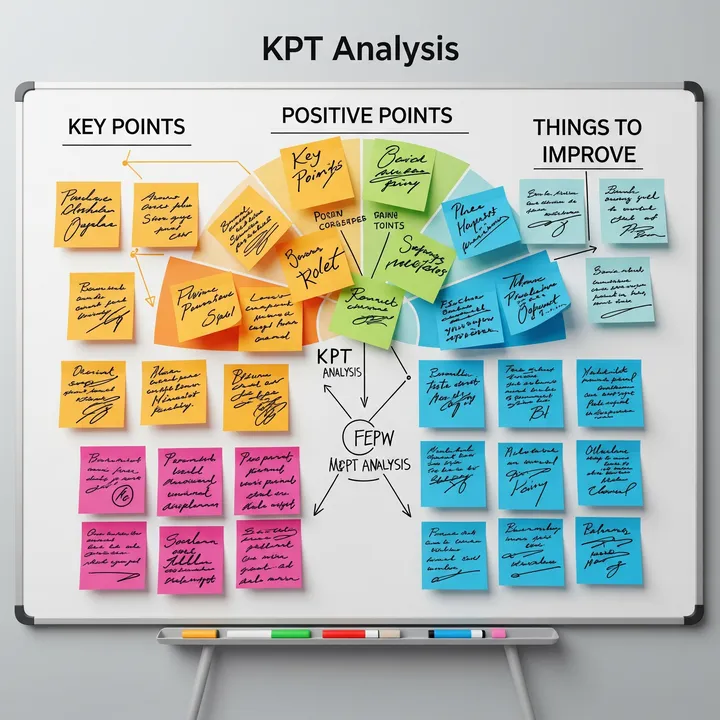
Claude drew three boxes on the whiteboard: Keep, Problem, Try.
"KPT is a framework that sorts the current state into three categories: Keep—what should continue, Problem—what is problematic, and Try—what to attempt next," I explained. "Before deploying an AI chatbot, we need to clarify what to preserve, what to change, and what to introduce fresh. Get the order wrong and the chatbot sits unused."
"Let's measure the current cost first," Gemini said, opening ROI Polygraph and entering the operational logs and interview results Hayakawa had provided.
The numbers returned.
"Veteran staff inquiry-handling labor: monthly average 40 hours," Gemini read. "At ¥4,000/hour, that's ¥160,000/month. Junior staff research and wait time: 45 hours/month at ¥2,500/hour, ¥112,500/month. Total: ¥272,500/month consumed by this inquiry structure alone. Annualized: ¥3,270,000."
Hayakawa frowned. "I'd never looked at inquiry costs as a number."
"Inquiries look like part of the job," I said. "But when they happen every day, they become an invisible cost. If this has been going on for five years, the simple math puts the total at over ¥16 million spent on this structure."
"Then let's begin the KPT sort," Claude continued.
[K — Keep: What Should Continue]
"First, identify what's worth preserving in the current setup," Claude said. "Are there benefits to veterans answering junior staff directly?"
Hayakawa thought for a moment. "Yes. When a case requires complex judgment, nuance comes through in conversation. When explaining why a drawing was changed a certain way, the background—the why—can only really be conveyed in a person-to-person exchange."
"That is a Keep," Claude said. "High-complexity inquiries continue to be handled by veterans. The chatbot is designed as a supplement, not a replacement. Defining Keep first naturally limits the scope the chatbot needs to cover."
"Veteran expertise itself is also a Keep," Gemini added. "The knowledge to train into the chatbot will be drawn from veteran memory. This project isn't about negating that memory—it's about converting tacit knowledge into explicit form. That conversion is the core of what we're building."
[P — Problem: What Needs to Change]
"Next, state the problems clearly," I continued. "List them, Hayakawa-san."
Hayakawa referred to his notes. "Three things. First: past complaint cases exist only in individual memory. Second: drawing change rules are documented nowhere. Third: junior staff wait for veterans to become free before they can ask their question."
"All three Problems share a common structure," Claude organized. "Knowledge is bound to people. If people aren't available, knowledge isn't available. To change this, knowledge needs to be detached from individuals and anchored to a location. That location is a knowledge base."
"With a knowledge base," Gemini continued, "junior staff can search without waiting for a veteran. Veterans can see what they've answered accumulate—and after they retire, the answer remains. The chatbot is simply the search interface that sits on top of that knowledge base."
"The order matters," I emphasized. "The chatbot does not come first. The knowledge base comes first. Build the container for knowledge, then attach the window for querying it."
[T — Try: What to Attempt Next]
"Try is the prescription for each Problem," Claude said. "Three Problems, three Tries."
"Try ①: Digitize complaint cases," Gemini continued. "Start by surfacing the last five years of complaint records through interviews with veterans. Two interviews per month, one hour each, for three months yields over 30 cases. Junior staff conduct the interviews. The act of asking is itself a form of knowledge transfer."
"Try ②: Document drawing change rules," I continued. "Establish a weekly routine where veterans spend 15 minutes writing down 'common judgment calls.' It doesn't need to be polished. Just record the question that came in from a junior staff member and the answer given. That becomes the seed of an FAQ."
"Try ③: Staged AI chatbot deployment," Claude concluded. "Begin pilot operation of the chatbot once the knowledge base has accumulated 50 or more cases. Start with only drawing-change-rule inquiries. One type to begin with; expand scope once precision is confirmed."
Chapter 3: The System for Accumulating Questions
"Let's project the investment plan through ROI Proposal Generator," I proposed.
Knowledge base construction cost, chatbot deployment cost, and savings were laid out side by side.
- Initial investment: Knowledge base construction ¥300K + chatbot deployment ¥500K = ¥800K
- Monthly savings: Veteran inquiry handling 70% reduction = ¥112,000; junior staff research time 60% reduction = ¥67,500; total monthly savings ¥179,500
- Payback period: ¥800K ÷ ¥179,500 = approx. 4.5 months
- Including 3-month knowledge base build: effective payback 7.5 months
"Cases with payback under eight months are easy to present to management," Gemini added. "Beyond that, if you factor in the loss from not having this system when veterans retire—handover costs, quality degradation risk, junior staff attrition risk—the ROI grows even larger."
Hayakawa looked at the numbers and said, "When I think about costs, I only saw the system deployment cost. But the cost of not deploying was higher."
"That's why KPT works best when paired with ROI analysis," I replied. "When you articulate the Problem, the cost of the problem becomes visible. When the cost becomes visible, the investment in the solution becomes rational."
"One thing I want to confirm," Hayakawa said. "When veterans' knowledge is trained into the chatbot, it becomes the company's. How will the veterans feel about that?"
Claude paused briefly. "Tell them: even after you retire, your answers will keep helping the people who come after you. Not that their knowledge is being taken—but that it will remain. Use the word 'remains,' not 'extracted.'"
Hayakawa nodded quietly.
Chapter 4: The Day Memory Found a Home
Six months later, a report arrived from Hayakawa.
The veteran interviews across three months accumulated 37 complaint cases. Weekly documentation of drawing change rules initially met resistance from one veteran—but he eventually continued voluntarily, saying "writing it down helps me organize my own thinking too." In three months, 62 FAQ entries had accumulated.
Chatbot pilot operation began in month four. In the first month, 14 of 20 junior staff inquiries were resolved by the chatbot. Direct veteran inquiries dropped from 20 per week to 6. Handling labor compressed from 40 monthly hours to 11.
A survey of the five junior staff found three saying "searching now gives me an answer," and the other two saying "I still go directly for complex cases, but basic questions I can resolve myself."
The final line of Hayakawa's report read: "One of the veterans saw his own answer appear in the chatbot and said, 'So it doesn't disappear when I leave.' That one sentence captured everything this project was for."
Questions that couldn't be asked became searchable. Memory that couldn't be answered found a home.
"Knowledge is power while it lives in a person. But knowledge that lives only in a person disappears when that person leaves. The three buckets KPT demands—what to keep, what to change, what to try—are the blueprint for detaching knowledge from people and anchoring it to a place. The chatbot is only a window. What gives it value is that someone's answer remains on the other side. The moment memory is accumulated, it becomes a legacy."
Related Files
Tools Used
- ROI Polygraph — Inquiry handling and research labor cost visualization
- ROI Proposal Generator — Knowledge base + chatbot deployment payback simulation


