
ROI Case File No.465 'The Weight of Paper Across Thirty Facilities'

The Weight of Paper Across Thirty Facilities
Chapter 1: The Day the Spreadsheet Reached Its Limit
"Last month, there was an error in payroll. Seventeen employees were affected."
Seiichi Kawaguchi, CEO of MedTech Solutions, placed a single sheet of A4 paper on the table as he spoke. It was an incident report. The cause field read: "Data was overwritten when multiple staff members edited the Excel file simultaneously."
"How many employees is the group managing in total?" I asked.
"The direct scope is 630," Kawaguchi answered. "We operate a group of medical corporations including an NPO, covering 30 facilities. But if you include affiliates, the number could reach 1,630. Even at 630, five HR staff members are already at capacity."
"What does 'at capacity' look like?" Claude confirmed.
"Month-end is particularly brutal," Kawaguchi chose his words carefully. "Attendance consolidation, payroll calculation, document creation and mailing—everything converges at month-end. The five HR staff members work overtime continuously for the last two weeks of every month. Last month's error happened in the middle of that exhaustion. There are thirty Excel files—one per facility—and someone has to open them one by one to verify. When staff changes, they sometimes can't tell which file belongs to which facility."
"You mentioned mailing documents," I confirmed.
"Employment contracts and pay stubs are sent by paper mail to each facility. Thirty facilities, so thirty sets of envelopes every month. Staff tell me it takes a full day just for that."
"How long has this been going on?" Gemini asked quietly.
Kawaguchi thought for a moment. "Since we reached our current facility count—four years."
"Then let's put four years' worth of weight into numbers," I said.
Chapter 2: The Four Realities SWOT Demands
"This case calls for SWOT."
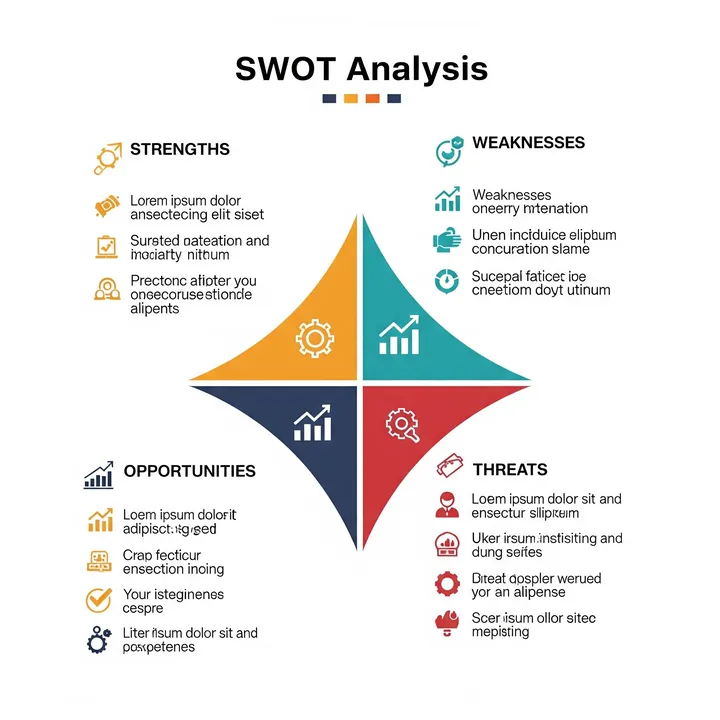
Claude drew four boxes on the whiteboard: Strengths, Weaknesses, Opportunities, Threats.
"SWOT is a framework that organizes an organization's current position across four axes: strengths, weaknesses, opportunities, and threats," I explained. "When considering a system deployment, jumping straight to product comparisons is premature. First, know precisely where you are. SWOT draws that map."
"Let's measure the current cost," Gemini said, opening ROI Polygraph and entering the operational logs and staff interviews Kawaguchi had provided.
The numbers returned.
"Here's the breakdown of the five HR staff members' monthly hours," Gemini read. "Attendance consolidation: 40 hours/month. Payroll calculation and verification: 30 hours/month. Document creation and mailing: 35 hours/month. Data transcription and aggregation: 25 hours/month. Total: 130 hours/month. At ¥3,000/hour, that's ¥390,000/month, ¥4,680,000/year—consumed by HR administration alone."
Kawaguchi's expression changed. "Adding overtime costs would push it even higher."
"Estimating 20 hours of overtime per month," Gemini continued, "adds another ¥1,440,000 annually. Total annual operating cost of current HR management: ¥6,120,000."
"Then let's begin the SWOT analysis," I said.
[S — Strengths: MedTech Solutions' Assets]
"First, the strengths," Claude said. "What is MedTech Solutions genuinely proud of?"
Kawaguchi paused. "Operating 30 facilities for four years without a major incident. The trust between facilities is deep. Coordination between facility managers and the HR team is close."
"That is the core of S," Claude continued. "A network of 30 facilities and trusted relationships on the ground. These strengths persist after system deployment. What sustains adoption of a new system is not technology—it's the relationship with the field. These strengths become most important in the operational phase after launch."
"Brand credibility is also a strength," Gemini added. "An established track record in the local healthcare community becomes negotiating leverage with system vendors."
[W — Weaknesses: What Needs to Change]
"Now, face the weaknesses directly," I continued. "What is the root cause of last month's error?"
Kawaguchi answered. "Data isn't in one place. Thirty facility Excel files are saved across individual staff members' PCs. Who has which file, and which version is current—none of that is shared."
"The weakness exists at three levels," Claude organized. "First: data dispersion. Second: process personalization. Third: lack of scalability. The current structure cannot handle 1,630 people on the same terms as 630. Leaving the weakness unaddressed means the problem accelerates as scale grows."
"The paper-based document process is also a weakness," Gemini continued. "The envelope work that takes a full day every month becomes under an hour with digitization. But it requires first ensuring that facility staff can receive documents digitally—that's the prerequisite."
[O — Opportunities: What to Capture]
"On the opportunity side," Claude said, "cloud-based HR management systems tailored to the healthcare industry have been expanding. Multiple vendors have strong track records at the 600-person scale. IT adoption subsidies may also apply. If a portion of deployment costs is covered by subsidy, the payback period shortens significantly."
"Improved data management through digitization is also an opportunity," Gemini added. "Turnover rate patterns, overtime distribution, cross-facility staffing optimization—data that is invisible right now. Once data is unified, questions arise that could never be asked before."
[T — Threats: What to Prepare For]
"Three threats to account for," I continued.
"First: deployment cost burden," Claude said. "Medical corporations operate on limited margins. Initial and monthly costs must fall within a realistic range—that is the threshold for the deployment decision."
"Second: frontline staff learning curve," Gemini continued. "Getting all staff across 30 facilities proficient in a new system takes time and support. Post-deployment field disruption is the primary risk."
"Third: security," I concluded. "Systems handling medical and personal information face strict security requirements. Confirm vendor security certifications during the selection process."
Chapter 3: From Four Realities to One Answer
"Let's translate the SWOT picture into projections using ROI Proposal Generator," I said, stepping to the whiteboard.
Deployment costs and savings were placed side by side.
- Initial cost: System deployment and configuration ¥1.5M + IT subsidy up to 50% = effective burden ¥750K
- Monthly cost: Cloud license ¥150K/month (630-person scale)
- Monthly savings: 65% labor reduction = ¥253,500 + overtime reduction ¥70,000 = ¥323,500 total reduction
- Net monthly improvement: ¥323,500 − ¥150,000 = ¥173,500
- Payback period: ¥750K ÷ ¥173,500 = approx. 4.3 months
"With the subsidy, payback in the four-month range is achievable," Gemini summarized. "Adding the qualitative risk avoidance from eliminating payroll errors like last month's—reprocessing labor, staff trust damage, potential legal exposure—further strengthens the case for deployment."
Kawaguchi nodded deeply. "Looking at numbers, not deploying is more expensive."
"That is the final question SWOT asks," I replied. "Leverage strengths, address weaknesses, capture opportunities, prepare for threats—lay out the four realities and the next step reveals itself naturally. This time, the answer is system deployment. But how it's deployed determines whether it succeeds."
"Walk me through the deployment sequence," Kawaguchi said.
"Phase 1 (2 months): The five central HR staff achieve proficiency with the system. The core must be solid before rolling out to 30 facilities. Phase 2 (3 months): Facilities roll out in groups of five, six groups total, staged. Rolling out to all 30 at once would concentrate support requests and create confusion. Phase 3 (post-launch): Once data is unified, begin facility-by-facility analysis of turnover rates and overtime hours. Only when the numbers are in place can management-level questions be asked."
Chapter 4: The Day the Paper's Weight Was Gone
Kawaguchi stood and picked up the incident report.
"This error gave me the push I needed. I wish I'd moved sooner—but what happened, happened. If we move now, next month-end will look different."
"The essence of SWOT," I replied, "is not a framework for judging the present. It's for seeing the present clearly so the next step isn't wrong. Weaknesses can be changed. Opportunities can be captured. Strengths can be leveraged. Threats can be prepared for. Only when all four are in view does judgment stand on solid ground."
Outside the window, the evening sky spread wide. Somewhere, an envelope from one of the facilities was probably arriving today.
Six months later, a report arrived from Kawaguchi.
The IT adoption subsidy application was approved, covering half the initial cost. The staged facility rollout proceeded on schedule, and all 30 facilities completed migration by month five. Payroll errors: zero. Month-end overtime across the five HR staff fell 61% compared to before migration.
Document mailing switched to electronic delivery. The full day of monthly envelope work dropped to under two hours. Once data was unified, per-facility overtime analysis revealed two facilities with disproportionate workload concentration—staffing rebalancing began.
The final line of Kawaguchi's report read: "Before implementing the system, I couldn't see the full shape of the problem. Mapping the current state with SWOT clarified what to solve first. What I learned after deployment was this: when data comes together, questions appear that you never thought to ask."
The day the weight of paper across thirty facilities disappeared, new questions were born.
"The moment a weakness is recognized as a weakness, it becomes the entrance to a solution. The four realities SWOT demands—strengths, weaknesses, opportunities, threats—are not measures of superiority or inferiority. They are a map for knowing precisely where you are right now. The four years of spreadsheets and paper were not wasted. Those four years taught us what the next system needed to be. Seeing the present clearly is the first step toward change."
Related Files
Tools Used
- ROI Polygraph — HR management labor, cost visualization, and savings projection
- ROI Proposal Generator — System deployment payback simulation and subsidy impact calculation


