
ROI【🔏CLASSIFIED CASE FILE】 No. X015 | What is VRIO Analysis
- What is VRIO Analysis - Case Overview
- Basic Structure of VRIO Analysis - Evidence Analysis
- VRIO Analysis Implementation Process - Investigation Methods
- The Power of VRIO Analysis - Hidden Truths
- Limitations and Cautions of VRIO Analysis - Potential Dangers
- Evolution of VRIO Analysis and Related Methods - Related Case Files
- Conclusion - Investigation Summary
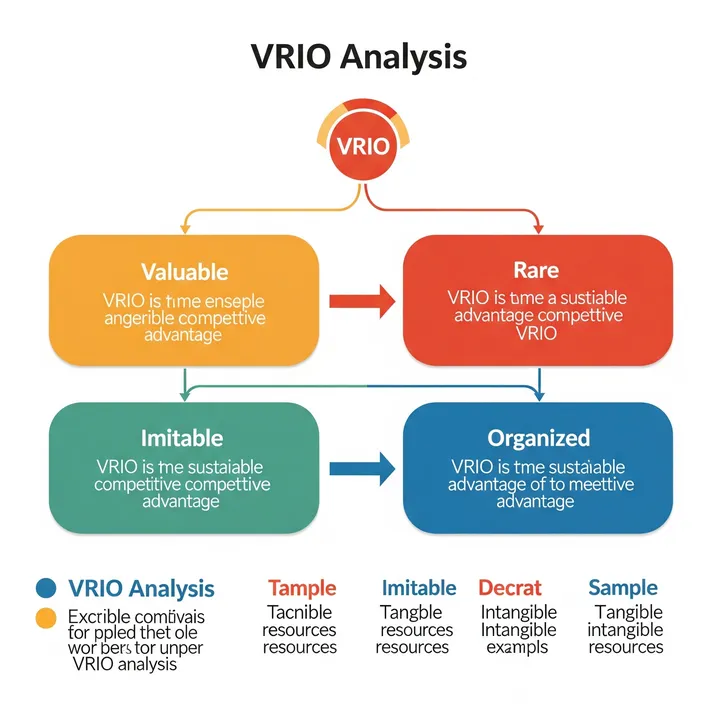
Detective's Note: A four-letter cipher known as "VRIO Analysis" secretly employed by strategic consultants and corporate planning departments. This internal resource analysis methodology, formed by the initials of Value, Rarity, Imitability, and Organization, allegedly possesses the power to scientifically uncover the fundamental reasons why companies "can defeat competitors" or "cannot win." However, reports consistently indicate that many companies overlook their true competitive advantages, thinking "we don't have any special strengths" or "competitors are doing similar things." Why do so many companies fail to discover their own treasures, and how do these four questions expose a company's essential strengths? We must uncover the true identity of this diagnostic mechanism.
What is VRIO Analysis - Case Overview
VRIO Analysis (Value/Rarity/Imitability/Organization) - a resource analysis methodology based on the "Resource-Based View (RBV)" proposed by American management scholar Jay Barney in the 1990s. This technique diagnoses whether a company's resources and capabilities can become sources of sustainable competitive advantage through four sequential questions. While recognized among our clients as "the definitive internal analysis," voices from the field frequently report: "too theoretical for practical use" and "inability to objectively assess our own strengths."
Investigation Memo: Resource value diagnosis through four sequential questions. Seemingly academic, yet behind this lies the answer to the essential management mystery: "Why can certain companies maintain high profitability over long periods?" We must uncover the essence of internal analysis that pairs with external 5F analysis.
Basic Structure of VRIO Analysis - Evidence Analysis
Primary Evidence: The Four-Stage VRIO Diagnosis
Value - Economic Value Creation
"Does this resource/capability create economic value?"
・Value creation for customers
・Contribution to cost reduction
・Contribution to revenue improvement
・Opportunity exploitation and threat neutralization
・YES → Next question / NO → Competitive disadvantage
Rarity - Differentiation from Competitors
"Is this resource/capability rare?"
・Not possessed by competing firms
・Limited existence in the market
・Difficult to acquire or develop
・Limited alternative means
・YES → Next question / NO → Competitive parity
Imitability - Ensuring Sustainability
"Is this resource/capability difficult to imitate?"
・Physical difficulty of imitation
・Causal ambiguity
・Social complexity
・Path dependence (historical accumulation)
・YES → Next question / NO → Temporary competitive advantage
Organization - Utilization System Preparation
"Is the organizational system prepared to exploit this resource/capability?"
・Organizational structure compatibility
・Management system preparation
・Consistency with corporate culture
・Reward system integration
・YES → Sustainable competitive advantage / NO → Unutilized resource
Evidence Analysis: The brilliance of VRIO analysis lies not simply in "what you have" but in its structure that systematically demonstrates "why it becomes competitive advantage." The four questions are not independent—only when all receive YES answers is sustainable competitive advantage achieved through this rigorous diagnostic system.
VRIO Analysis Implementation Process - Investigation Methods
Investigation Discovery 1: Concrete VRIO Analysis Example (Automotive Manufacturer Case)
Case Evidence (Toyota Production System):

Value: YES
・Improved capital efficiency through inventory reduction
・Enhanced customer satisfaction through quality improvement
・Market responsiveness through lead time reduction
・Comprehensive cost competitiveness achievement

Rarity: YES
・Unique systems of "Just-in-Time" and "Jidoka"
・Long-term trust relationships with suppliers
・Organizational permeation of improvement culture
・Complete replication difficult for other companies

Imitability: YES
・Historical accumulation over 40+ years (path dependence)
・Complex social relationships (supplier networks)
・Tacit knowledge accumulation (shop floor wisdom)
・Complexity of causal relationships (unclear why it functions)

Organization: YES
・Organizational structure supporting production system
・HR systems promoting continuous improvement
・Shop floor-focused corporate culture
・Management systems supporting global expansion

Conclusion: Source of sustainable competitive advantage
Investigation Discovery 2: Failure Case Analysis (Companies with Technical Skills but Unable to Utilize)
Case Evidence (Company with excellent engineering talent):

Value: YES
・Industry-leading technical capabilities
・Rich accumulation of patents and intellectual property
・Continuous innovation in R&D

Rarity: YES
・Advanced technologies difficult for others to develop
・Technical accumulation from years of R&D
・Concentration of excellent talent

Imitability: YES
・High level of technical expertise
・Technical know-how containing much tacit knowledge
・Accumulation of experience and learning

Organization: NO
・Technology-biased with market needs disconnect
・Inadequate sales and marketing systems
・Lack of organizational capability to commercialize technology
・Evaluation systems emphasizing short-term performance

Conclusion: Unutilized resources (waste of treasures)
Investigation Discovery 3: Resource and Capability Classification
Types of resources and capabilities for analysis:

Tangible Resources:
・Financial resources (funding power, creditworthiness)
・Physical resources (facilities, location, raw material access)
・Technical resources (patents, know-how, systems)

Intangible Resources:
・Human resources (excellent personnel, teamwork)
・Organizational resources (corporate culture, brand, reputation)
・Information resources (customer databases, market information)

Organizational Capabilities:
・Research and development capability
・Marketing capability
・Operations capability
・Organizational learning capability
The Power of VRIO Analysis - Hidden Truths
Alert File 1: Discovery of True Company Strengths Objectively identify "strengths too obvious to notice" that many companies overlook. Scientifically diagnose unique sources of competitive advantage that competitors cannot easily imitate.
Alert File 2: Clear Investment Priority Setting Provide decision criteria for concentrating limited management resources in areas that truly create competitive advantage. Promote shift from emotional and political decisions to logical judgment.
Alert File 3: Avoiding Dangers of Imitation Strategy Clarify the dangers of superficially imitating competitors' success factors. Enable calm assessment of why other companies succeed and whether replication is possible for your own company.
Alert File 4: Organizational Capability Development Guidelines Demonstrate the importance of organizational systems that utilize resources, not just accumulating them. Highlight the necessity of organizational design to convert technology and know-how into competitive advantages.
Limitations and Cautions of VRIO Analysis - Potential Dangers
Alert File 1: Subjective Judgment Contamination Risk of evaluation bias based on analyst's subjectivity. In self-analysis particularly, "wishful thinking" and "underestimation" easily infiltrate—objective third-party perspective is essential.
Alert File 2: Static Analysis Limitations Confined to single-point resource and capability analysis, inadequately addressing dynamic changes. In the digital age's rapid environmental shifts, yesterday's strengths risk becoming tomorrow's weaknesses.
Alert File 3: Insufficient Integration with External Environment Risk of neglecting relationships with external environmental changes due to focus on internal resource analysis. Integrated utilization with PEST and 5F analysis is essential.
Alert File 4: "Grass is Greener" Syndrome Tendency to focus only on resources and capabilities the company "lacks," undervaluing existing strengths. Seeking perfect resources while missing realistic competitive advantage building opportunities.
Alert File 5: Organizational Factor Neglect The final O (Organization) in VRIO tends to be treated formally. Neglecting the reality that superior resources and capabilities cannot lead to competitive advantage without organizational systems to leverage them.
Evolution of VRIO Analysis and Related Methods - Related Case Files
Related Evidence 1: Integrated Use with 5F Analysis
5F (External Environment) + VRIO (Internal Resources) = Comprehensive Strategic Analysis
Integration of external opportunities/threats with internal strengths/weaknesses
More detailed and logical analysis than SWOT possible
Related Evidence 2: Integration with Core Competence Theory
VRIO → Analysis of individual resources and capabilities
Core Competence → Analysis of integrated capabilities
Multi-layered strength analysis through combination
Related Evidence 3: Digital Era VRIO Evolution
・Value assessment of data and AI assets
・Platform capability analysis
・Network effect sustainability evaluation
・Agility as organizational capability
Related Evidence 4: Application in M&A and Alliance Strategy
・True value assessment of acquisition targets
・Synergy effect prediction through integration
・Cultural integration success factor analysis
・Objective criteria for partner selection
Related Evidence 5: Integration with Human Resource Strategy
・Clarification of human resource requirements supporting organizational capabilities
・Identification of priority areas for recruitment and development strategy
・Analysis of HR system and competitive advantage relationships
・Assessment of organizational culture contribution to competitive advantage
Conclusion - Investigation Summary
Final Investigator Report:
VRIO Analysis represents "a precision instrument for scientifically diagnosing a company's true strengths." The sequential diagnosis through four questions—Value, Rarity, Imitability, and Organization—possesses the power to transform self-analysis that relies on intuition and wishful thinking into objective, logical analysis.
The most impressive aspect revealed in this investigation was the "rigor" of VRIO analysis. The strict standard that sustainable competitive advantage is only achieved when all four questions receive YES answers forces many companies to face reality. Particularly, questioning the importance of "Organization" last clearly demonstrates that superior resources and technology become wasted treasures without organizational systems to leverage them.
However, the reality that many companies overlook their true strengths also emerged clearly. The difficulty of objectively identifying "strengths too obvious to notice" and "uniqueness that competitors cannot imitate." To address this challenge, actively utilizing external perspectives (customers, partners, consultants, etc.) becomes crucial.
It also became evident that VRIO analysis demonstrates its true value in combination with 5F analysis. Understanding industry structure through external environment analysis (5F) and identifying company strengths through internal resource analysis (VRIO). Only with both wheels can effective competitive strategy formulation become possible.
The necessity for evolution in the digital age was also an important discovery. Response to new resources and capabilities such as data, AI, and platform capabilities that traditional VRIO cannot fully capture is required. However, the value of VRIO as a fundamental thinking framework should be inherited across eras.
Competitive Advantage Maxim: "True strengths are hidden in what you consider ordinary but others can never imitate."
Case Closed


