
ROI【🔏CLASSIFIED CASE FILE】 No. X020 | What is Empathy Map
- What is Empathy Map - Case Overview
- Basic Structure of Empathy Map - Evidence Analysis
- Empathy Map Implementation Process - Investigation Methods
- The Power of Empathy Map - Hidden Truths
- Limitations and Cautions of Empathy Map - Potential Dangers
- Applications and Related Methods of Empathy Map - Related Case Files
- Conclusion - Investigation Summary
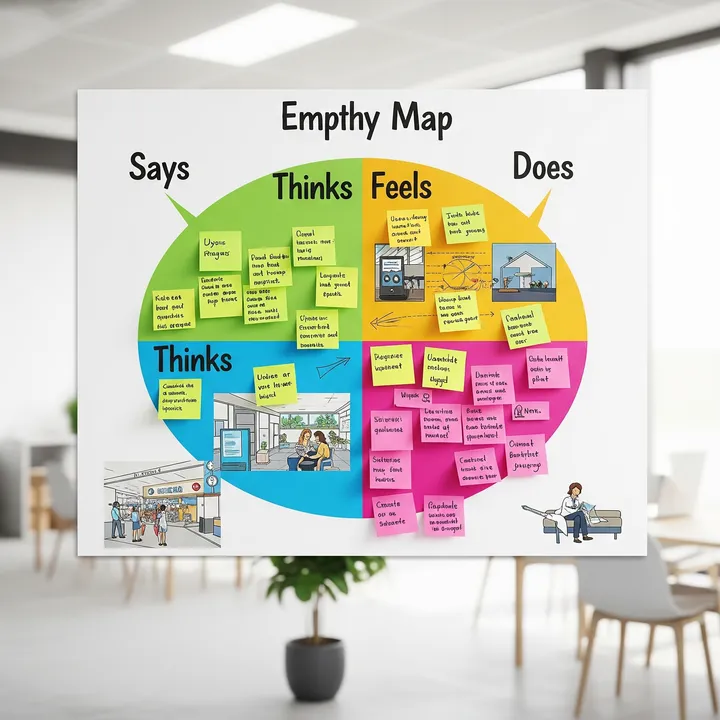
Detective's Note: A methodology secretly employed in design thinking and UX design fields - the "Empathy Map." This customer understanding framework, depicted through six domains of Think & Feel, Hear, See, Say & Do, Pain, and Gain, allegedly possesses the power to decode "customers' inner minds" beyond superficial customer data. However, reports consistently indicate that many companies fall into states of "filling with imagination only" or "ending with superficial observation," failing to reach innovative service development based on true customer empathy. Why is "empathy" important? We must uncover the psychological decoding mechanism of how these six domains expose customers' true feelings versus public statements, conscious versus unconscious thoughts.
What is Empathy Map - Case Overview
Empathy Map - systematized as a customer understanding tool by Dave Gray of design consulting firm XPLANE in the 2010s. Recognized among our clients as "a fundamental tool of design thinking," this methodology structures customers' thoughts, emotions, behaviors, and environment into six domains to visualize the inner world of customers invisible through data or surveys. However, in actual practice, most companies report "creation through team imagination" and "one-time creation and done," with insufficient coordination with continuous customer observation or hypothesis validation, unable to utilize it for innovation creation based on true customer insights.
Investigation Memo: Customer inner world structuring through six domains. Seemingly subjective, yet behind this lies clear purposes: "inferring deep psychology from customers' surface behaviors" and "unifying customer understanding within teams." We must uncover why empathy is important and the conversion mechanism from observation to insight.
Basic Structure of Empathy Map - Evidence Analysis
Primary Evidence: The Six Domains of Empathy Map
Think & Feel
"What's happening in the customer's inner world"
・What they really think and feel
・Worries, anxieties, fears
・Expectations, hopes, dreams, desires
・Values, beliefs, priorities
・Emotional factors influencing decision-making
Hear
"Information sources influencing the customer"
・Opinions from family, friends, colleagues
・Media, advertisements, expert voices
・Industry rumors, word-of-mouth, reputation
・Instructions and demands from superiors and subordinates
・Social media and online information
See
"Environment and situations surrounding the customer"
・Scenes at workplace, home, public spaces
・Products and services being used
・Competitor trends and market environment
・Behaviors and reactions of surrounding people
・Physical and digital environments
Say & Do
"Externally observable behaviors"
・What they actually say
・Attitudes and behaviors in public
・Purchasing and usage behaviors
・Social media posts and shares
・Recommendations or criticisms to others
Pain
"Problems and dissatisfactions customers face"
・Current dissatisfactions, stress, obstacles
・Challenges and worries to solve
・Risks and losses to avoid
・Waste of time, money, energy
・Future anxieties and fears
Gain
"Value and results customers seek"
・Goals and results to achieve
・Benefits and advantages to gain
・What would make them happy if resolved
・Ideal states and experiences
・Success definitions and measurement criteria
Evidence Analysis: The brilliance of Empathy Map lies in its structure enabling staged exploration from customers' "surface behaviors" to "deep motivations." Through inference from externally observable domains (See, Hear, Say & Do) to inner worlds (Think & Feel, Pain, Gain), it incorporates design for discovering true customer needs.
Empathy Map Implementation Process - Investigation Methods
Investigation Discovery 1: Concrete Empathy Map Example (Work-from-Home Mother)
Case Evidence (30s Mother with Children Working from Home):

Think & Feel:
・Anxiety about balancing childcare and work
・Frustration about career stagnation
・Desire to value family time
・Sense of responsibility for financial stability
・Craving for social connections

Hear:
・Household task sharing discussions with husband
・Work style advice from mom friends
・Remote work instructions from supervisor
・"Play with me" requests from children
・Information from same-generation women on SNS

See:
・Cluttered home workspace
・Children's growth and school events
・Working mothers in the neighborhood
・Colleagues' expressions in online meetings
・Household and childcare information websites

Say & Do:
・Says "It's okay, we'll manage somehow"
・Works intensively during late nights/early mornings
・Searches for efficiency tools and services
・Makes decisions prioritizing family time
・Networks with people in similar situations

Pain:
・Lack of focused work time
・Limited career growth opportunities
・Mental burden of household/childcare tasks
・Social isolation and information shortage
・Vague anxiety about the future

Gain:
・Quality time spent with family
・Freedom through flexible work arrangements
・Skill development and growth satisfaction
・Financial independence and contribution
・Connections with people sharing same values
Investigation Discovery 2: Service Development Application Example
Insights from Empathy Map:

Deep Need Discovery:
・"Securing focused time" more important than "time-saving"
・Seeking "empathy and connections" rather than just "information"
・Values "balance" over "perfection"

Service Development Ideas:
・App supporting short-duration focused work
・Matching service for people in similar situations
・Family sharing tool for "visualizing" household/childcare tasks
・Micro-learning for spare time utilization
・Corporate solutions supporting flexible work styles

Marketing Strategy Application:
・Empathy appeal to "trying mothers" not "perfect mothers"
・Emphasis on emotional empathy over logical benefits
・Importance of community features and testimonials
・Simple information provision understandable in short time
Investigation Discovery 3: Creation Process
Step 1: Persona and Target Customer Setting
・Setting specific individual customer image
・Organizing basic attributes and background information
・Team consensus on target customer

Step 2: Information Gathering and Observation
・Customer interviews and surveys
・Behavioral observation and ethnography
・Utilizing existing data and research results
・SNS and online behavior analysis

Step 3: Team Map Creation
・Information placement into six domains
・Discussion and consideration among team members
・Clarification of hypotheses and assumptions
・Information organization and structuring

Step 4: Insight Extraction
・Pattern and theme discovery
・Contradiction and gap identification
・Deep need and motivation inference
・Idea and opportunity creation

Step 5: Validation and Updates
・Hypothesis validation through customer dialogue
・Updates with new information
・Continuous observation and learning
・Reflection in services and strategies
The Power of Empathy Map - Hidden Truths
Alert File 1: Insight from Surface Behavior to Deep Psychology Can infer true motivations and emotions behind customers' surface behaviors and statements. Discovers gaps between "true feelings" and "public statements" invisible through surveys or data, enabling identification of genuine needs.
Alert File 2: Unified Customer Understanding Within Teams Unifies different customer images held by members from various departments and roles, building common customer understanding. Enables consistent service delivery through shared customer vision across product development, marketing, and sales.
Alert File 3: Hypothetical Thinking Promotion Develops hypothetical thinking and validation mindset through the process of inferring customers' inner worlds from limited information. Promotes mental shift from "assumptions" to "hypothesis→validation" cycles.
Alert File 4: Innovation Opportunity Discovery Can discover latent needs customers aren't conscious of or opportunities competitors overlook. Deep understanding of Pain (challenges) and Gain (value) enables innovative solution creation.
Limitations and Cautions of Empathy Map - Potential Dangers
Alert File 1: Subjective Speculation Risks Most critical caution. Cases of creating maps solely through team imagination without actual customer observation or dialogue. Risk of constructing customer images disconnected from reality through infiltration of assumptions and biases.
Alert File 2: Generalization and Stereotype Traps Potential to overgeneralize specific customer images, overlooking differences among diverse customer segments. Risk of undervaluing individual diversity through superficial attribute-based assumptions about age, gender, occupation.
Alert File 3: Static Snapshot Limitations Confined to single-point customer understanding, unable to capture customer changes due to time passage or environmental shifts. Particularly potential inability to respond to rapid behavioral changes in digital era.
Alert File 4: Fixation Due to Insufficient Validation Risk of using created Empathy Maps statically without validation, expanding divergence from actual customers. Continuous customer dialogue and observation-based updates are essential.
Alert File 5: Cultural and Regional Biases Risk of inadequate understanding of customers from different cultures or regions due to creator's cultural background or regional characteristic biases. Particular attention needed during global expansion.
Applications and Related Methods of Empathy Map - Related Case Files
Related Evidence 1: Integration with Persona Setting
Persona (Basic Attributes) + Empathy Map (Psychology/Behavior):
・More three-dimensional and specific customer images
・Integration of attribute data with emotions and motivations
・Deepened utilization in marketing and development
・Enhanced customer understanding sharing within teams
Related Evidence 2: Coordination with Customer Journey Maps
Empathy Map → Customer Journey:
・Detailed customer emotions at each touchpoint
・Consistent customer understanding throughout journey
・Time-series mapping of Pain/Gain points
・Clear prioritization for experience improvement
**Related Evidence 3: Combination with 3C Analysis and RFM Analysis **
Integration of Quantitative Analysis + Qualitative Understanding:
・Customer segment identification through RFM Analysis
・Empathy Map creation for each segment
・Customer understanding from both data and emotion perspectives
・More accurate strategic planning
Related Evidence 4: Utilization in Design Thinking Process
Core tool in Empathize phase:
・Information provision for Define phase
・Foundation for Ideate phase
・Direction for Prototype phase
・Validation items for Test phase
Related Evidence 5: Integration with Agile Development and Lean Startup
Utilization in Hypothesis→Validation→Learning cycles:
・Customer hypothesis setting for MVP development
・Validation items for user testing
・Customer understanding foundation for pivot decisions
・Continuous customer learning accumulation
Conclusion - Investigation Summary
Final Investigator Report:
Empathy Map represents "a detective technology for scientifically inferring customers' inner minds." The structuring through six domains—Think & Feel, Hear, See, Say & Do, Pain, and Gain—functions as a precise observation and inference system for reaching true customer understanding beyond superficial customer data.
The most impressive aspect of this investigation was the "empathy enhancement" effect of Empathy Map. Rather than mere customer data organization, the process of imagining emotions and thoughts from the customer's perspective improves the entire team's empathy and customer understanding capabilities. This becomes the foundation for creating "human value" beyond technical excellence in product development and service design.
However, the "subjective speculation risks" that many companies fall into also emerged clearly. Cases frequently occur where maps are created solely through team imagination without actual customer observation or dialogue. The true value of Empathy Map lies not in "creating" but in "continuously validating and updating through ongoing customer dialogue and observation."
The importance of integrated utilization with other customer understanding methods also became apparent. Combining with quantitative segmentation through RFM analysis and market environment understanding through 3C analysis enables comprehensive approaches understanding customers from both data and emotional perspectives.
The potential for evolution in the digital age is also significant. Through new technologies like SNS analysis, behavioral data analysis, and AI emotion analysis, more accurate Empathy Map creation becomes possible. However, regardless of technological advancement, the essential value of "humans understanding humans" through empathetic processes remains unchanged.
The most important discovery is that Empathy Map functions beyond a "customer understanding tool" as an "organizational empathy enhancement system." Through processes of imagining customers' inner minds, team discussions, hypothesis formation, and validation, customer-centric thinking and empathy culture are fostered organization-wide. This represents the true power of this thinking support tool.
Customer Understanding Maxim: "Superior products and services understand and respond to true desires deep in customers' hearts, not their superficial demands."
Case Closed


