
ROI【🔏CLASSIFIED CASE FILE】 No. X023 | What is TOC (Theory of Constraints)
- What is TOC (Theory of Constraints) - Case Overview
- Basic Structure of TOC - Evidence Analysis
- TOC's Five Steps - Investigation Methods
- Concrete TOC Implementation Examples - Investigation Cases
- The Power of TOC - Hidden Truths
- Limitations and Cautions of TOC - Potential Dangers
- Applications and Related Methods of TOC - Related Case Files
- Conclusion - Investigation Summary
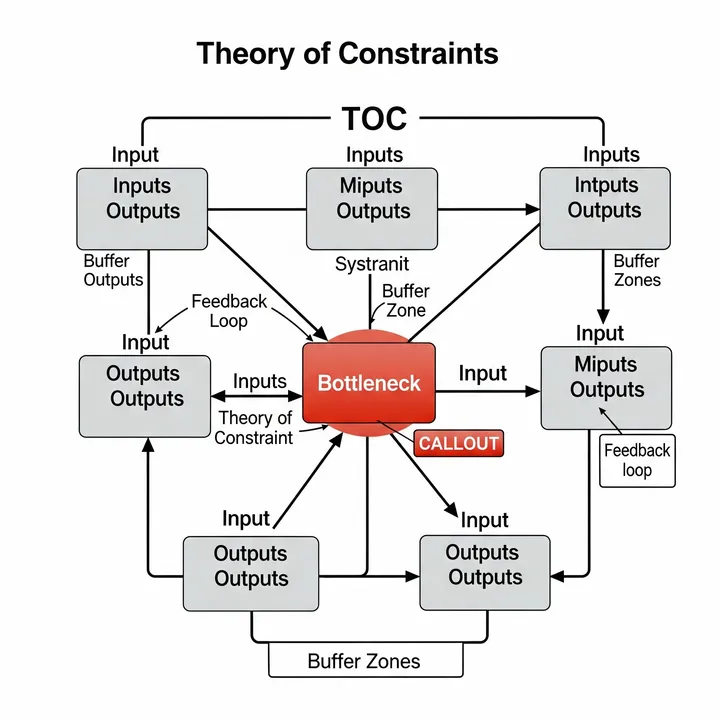
Detective's Note: A three-letter cipher demonstrating power in manufacturing and process improvement - "TOC (Theory of Constraints)." This management philosophy, formed by the initials of Theory of Constraints, was developed by Israeli physicist Eliyahu Goldratt in the 1980s. It allegedly possesses the power to promote organizational transformation through the sharp insight that "overall system performance is determined by its weakest part (constraint)." However, reports consistently indicate that many companies are satisfied with merely "finding bottlenecks," failing to demonstrate the original power of continuous improvement and overall optimization. Why is focusing on "constraints" important? We must uncover the true identity of the breakthrough mechanism and how five steps achieve overall system performance improvement.
What is TOC (Theory of Constraints) - Case Overview
TOC (Theory of Constraints) - a management philosophy and improvement methodology developed by Israeli physicist Dr. Eliyahu Goldratt in the 1980s. Recognized among our clients as a theory for improving overall system performance through constraint identification, utilization, and improvement, based on the fundamental principle that "overall system performance is determined by its weakest part (constraint/bottleneck)." However, in actual practice, most companies use it fragmentarily as a "bottleneck-finding tool," unable to fully utilize the original value of continuous improvement processes and overall optimization thinking.
Investigation Memo: Overall optimization through constraint identification and utilization. Seemingly simple, yet behind this lies deep insight: "avoiding the trap of partial optimization and achieving true improvement through systems thinking." We must uncover why focus on constraints is important and the mechanism by which five steps promote organizational transformation.
Basic Structure of TOC - Evidence Analysis
Primary Evidence: Core Principles of TOC
Fundamental Principle
"Chain strength is determined by its weakest link"
・Overall system performance = Constraint capacity
・Improvements outside constraints don't contribute to overall results
・One hour at constraint = One hour for entire system
・One hour saved elsewhere = Mirage (meaningless)
Types of Constraints
Physical Constraints:
・Equipment and machinery capacity shortages
・Personnel and skill shortages
・Physical space limitations
・Raw material and component supply shortages

Policy Constraints:
・Limitations from rules, procedures, customs
・Organizational structure and authority constraints
・Evaluation system and incentive problems
・Decision-making process constraints

Market Constraints:
・Demand limits and market size restrictions
・Competitor presence
・Customer requirements and expectations
・Price and cost competitiveness constraints
Evidence Analysis: The brilliance of TOC lies in concentrating complex system improvement on a single point—"constraints"—to achieve effective and efficient overall optimization. It incorporates structure that integrates dispersed improvement efforts to generate maximum impact.
TOC's Five Steps - Investigation Methods
Investigation Discovery 1: TOC Improvement Process
Step 1: Identify the Constraint
"Find the system's constraint (bottleneck)"

Physical Constraint Identification Methods:
・Process-wise capacity and utilization analysis
・Wait time, stagnation, inventory accumulation locations
・Frequent overtime and holiday work departments
・Quality problem and rework frequent locations

Policy Constraint Identification Methods:
・Approval and decision process delays
・Ambiguous responsibility and authority between departments
・Misalignment between evaluation systems and objectives
・Rigidity from customs and precedent-following

Market Constraint Identification Methods:
・Divergence between demand forecasts and results
・Competitive analysis and market share trends
・Customer satisfaction and dissatisfaction surveys
・Price competitiveness and cost structure analysis
Step 2: Exploit the Constraint
"Maximize utilization of constraint capacity"

Physical Constraint Exploitation:
・Ensure 100% utilization of constraint process
・Minimize setup time and preparation time
・Reduce rework through quality improvement
・Prevent troubles through preventive maintenance

Policy Constraint Exploitation:
・Review and delegate decision-making authority
・Simplify and parallelize approval processes
・Improve evaluation system goal alignment
・Standardize best practices

Market Constraint Exploitation:
・Focus on high-profit products and customers
・Differentiation and added value improvement
・Deep dive and response to customer needs
・Marketing and sales capability enhancement
Step 3: Subordinate Everything Else to the Constraint
"Adjust non-constraint parts to align with constraint"

Non-constraint Process Adjustment:
・Production planning aligned with constraint process pace
・Stop excessive efficiency improvements in non-constraint processes
・Priority resource allocation to constraint process
・Inter-departmental coordination prioritizing overall optimization

Organization/Process Subordination:
・Decision-making prioritizing constraint resolution
・Organizational restructuring to support constraints
・Business flow review aligned with constraint process
・Performance evaluation from constraint perspective
Step 4: Elevate the Constraint
"Improve the constraint's capacity itself"

Physical Constraint Elevation:
・Equipment investment, expansion, renewal
・Staff augmentation and skill improvement
・Technology innovation and process improvement
・External outsourcing

Policy Constraint Elevation:
・Fundamental review of systems and rules
・Organizational structure and authority system changes
・Efficiency through IT and digitalization
・Corporate culture and mindset transformation

Market Constraint Elevation:
・New market development and segment expansion
・New product and service development
・Brand power and competitiveness improvement
・Strategic alliances and M&A
Step 5: Go Back to Step 1, but Beware of Inertia
"Transition to new constraints and perform continuous improvement"

New Constraint Identification:
・Discover new bottlenecks after previous constraint resolution
・Confirm constraint movement throughout system
・Continuous monitoring and analysis

Overcoming Inertia:
・Avoid fixation on past successes
・Adapt to new realities
・Maintain continuous problem awareness and improvement motivation
・Organizational learning and knowledge accumulation
Concrete TOC Implementation Examples - Investigation Cases
Investigation Discovery 2: Manufacturing Industry Application Example
Case Evidence (Automotive Parts Manufacturing Plant):

Step 1: Constraint Identification
Analysis revealed heat treatment process as constraint:
・Heat treatment process 90% utilization vs. 70-80% for other processes
・Chronic work-in-progress inventory accumulation before heat treatment
・80% of delivery delays caused by heat treatment process delays

Step 2: Constraint Exploitation
Heat treatment process improvements implemented:
・Setup time reduced from 60 to 30 minutes
・Quality improvement reduced defect rate from 5% to 2%
・Enhanced preventive maintenance reduced breakdown downtime by 50%
→ Heat treatment process actual utilization improved to 95%

Step 3: Subordinate Everything Else
Company-wide adjustments:
・Changed production planning to heat treatment capacity baseline
・Suppressed overproduction in upstream processes
・Increased heat treatment operators and skill development
・Concentrated quality control before and after heat treatment

Step 4: Elevate the Constraint
Equipment investment executed:
・Added one heat treatment furnace (1.5x capacity)
・Introduced automation line to eliminate human constraints
・Built real-time monitoring system with IoT sensors

Step 5: Go Back to Step 1, Beware of Inertia
New constraint discovery:
・After heat treatment constraint resolution, assembly process became new constraint
・Established continuous improvement cycles
・Embedded TOC thinking in organizational culture
Investigation Discovery 3: Service Industry Application Example
Case Evidence (Call Center Operations):

Step 1: Constraint Identification
Analysis revealed veteran operators as constraint:
・Veteran utilization 95%, newcomer utilization 60%
・Complex inquiries concentrated on veterans
・Customer satisfaction declined due to waiting for veteran response

Step 2: Constraint Exploitation
Maximized veteran utilization:
・Priority assignment of complex cases
・Optimized veteran break times
・Reduced veteran load through enhanced manuals and FAQs

Step 3: Subordinate Everything Else
Organization-wide adjustments:
・Newcomers specialized in simple cases
・Built support system for veterans
・Redesigned training and education centered on veteran know-how

Step 4: Elevate the Constraint
Skill improvement and staffing:
・Enhanced newcomer guidance by veterans
・External training and certification support
・Aggressive mid-career hiring of experienced personnel

Step 5: Go Back to Step 1, Beware of Inertia
Response to new constraints:
・After veteran shortage resolution, system processing capacity became constraint
・IT infrastructure enhancement and business system improvement
・Continuous skill improvement and human resource development
The Power of TOC - Hidden Truths
Alert File 1: Overall Optimization Realization Concentrates organizational improvement activities prone to partial optimization on overall system performance improvement. Clear guidance that improvements outside constraints are meaningless enables most effective resource allocation to limited areas.
Alert File 2: Improvement Effect Maximization 1% improvement in constraints directly translates to 1% improvement in entire system, creating large impact even with small improvements. Enables high ROI improvement activities and achieves continuous performance enhancement.
Alert File 3: Organizational Focus Unification Different departments and functions collaborate toward common goal of constraint resolution. Eliminates inter-departmental conflicts and blame-shifting, promoting unified organizational improvement activities.
Alert File 4: Continuous Improvement Systematization Five steps naturally cycle through constraint resolution → new constraint discovery → next improvement. Builds system for continuous organizational capability improvement rather than one-time improvements.
Limitations and Cautions of TOC - Potential Dangers
Alert File 1: Constraint Misidentification Most dangerous problem. Cases of concentrating improvement efforts on wrong areas by misidentifying true constraints. Risk of overlooking fundamental constraints by mistaking surface phenomena for constraints.
Alert File 2: Constraint Complexity Underestimation Risk of over-focusing on single constraints in complex systems where multiple constraints interact. Particularly in service industries and knowledge work, constraint identification and improvement are often less clear than in manufacturing.
Alert File 3: Short-term Thinking Bias Risk where long-term organizational capabilities and competitive advantage construction are neglected due to seeking immediate constraint resolution effects. Risk of neglecting strategic investment and human resource development while focusing on immediate constraint resolution.
Alert File 4: Organizational Politics and Resistance Neglect Cases where improvement doesn't progress due to organizational politics and resistance to change when constraints are identified as specific department or individual problems. Consideration of human and organizational factors essential beyond technical solutions.
Alert File 5: System Boundary Ambiguity When analysis target system boundary setting is ambiguous, constraint identification and improvement effect evaluation become difficult. Clear system boundary definition crucial especially in complex organizations and supply chains.
Applications and Related Methods of TOC - Related Case Files
Related Evidence 1: Integration with AARRR Model
TOC Application at Each AARRR Stage:
・Growth funnel bottleneck identification
・Concentration on most effective improvement points
・Inter-stage constraint relationship analysis
・Overall growth engine optimization
Related Evidence 2: Coordination with Value Chain Analysis
Value Chain × TOC:
・Constraint identification in value creation processes
・Inter-activity constraint relationship analysis
・Value creation efficiency and optimization
・Competitive advantage source identification
Related Evidence 3: Integration with PDCA Cycle
Plan: Constraint identification and improvement planning
Do: Constraint exploitation and elevation initiative execution
Check: Improvement effect measurement and evaluation
Action: Transition to new constraints and continuous improvement
Related Evidence 4: Combination with Lean Production and Six Sigma
・Lean: Waste elimination × TOC: Constraint optimization
・Six Sigma: Quality improvement × TOC: Overall performance improvement
・Integrated operational improvement approach
・Comprehensive improvement system in manufacturing
Related Evidence 5: Digital Era TOC Evolution
・AI-based automatic constraint identification
・Real-time monitoring through IoT and sensors
・Digital twin simulation
・Predictive analysis for proactive constraint measures
Conclusion - Investigation Summary
Final Investigator Report:
TOC (Theory of Constraints) represents "a strategic methodology for scientifically identifying weaknesses that determine overall system performance and concentrating improvements." Over 40 years have passed since Dr. Eliyahu Goldratt developed it in the 1980s, yet the value of improvement approaches based on the physics insight that "constraints dominate entire systems" remains undiminished.
The most impressive aspect of this investigation was the power of TOC's "overall optimization thinking." It avoids the partial optimization trap that many organizations fall into, concentrating improvement efforts on constraints directly connected to overall system performance enhancement. This clear focus creates maximum impact with limited resources and beautifully designs structure for continuous organizational capability improvement.
The completeness of the continuous improvement cycle through five steps also deserves attention. The circulation of constraint identification → exploitation → subordination → elevation → new constraint discovery builds permanent organizational improvement capability rather than one-time improvements. This goes beyond mere problem-solving methodology to become an organizational transformation mechanism.
However, the fatal trap many companies fall into—"constraint misidentification"—also emerged clearly. Cases frequently occur where surface phenomena are mistaken for constraints while true constraints are overlooked. TOC success depends on accurate constraint identification, and errors at this stage risk making all improvement efforts wasteful.
Integrated utilization with other improvement and strategic methods was also an important discovery. Combining growth bottleneck identification through AARRR Model, value creation process optimization through Value Chain Analysis, and continuous improvement through PDCA Cycle enables construction of more comprehensive and effective improvement systems.
The potential for evolution in the digital age is also significant. New technologies like AI, IoT, and digital twins enable more advanced and preventive TOC operations: automatic constraint identification, real-time monitoring, predictive improvements.
The most important discovery is that TOC functions beyond an "improvement methodology" as a "thinking method." Constraints Thinking represents universal thinking technology that consolidates complex problems into the most critical single point and derives effective solutions. This possesses power to improve problem-solving capabilities of all organizations and individuals, not limited to manufacturing productivity improvement.
Constraint Breakthrough Maxim: "True improvement means identifying the weakest part constraining the entire system and achieving dramatic overall enhancement through concentrated effort on that point."
Case Closed


