
ROI【🔏Classified File】 No. X051 | What Are the 7 Wastes of TPS
- What Are the 7 Wastes of TPS - Case Overview
- Basic Structure of the 7 Wastes - Evidence Analysis
- Implementation Process for the 7 Wastes - Investigation Methods
- Power of the 7 Wastes - Utilization Value
- Limitations and Caveats - Investigation Warnings
- Related Case Files - Internal Links
- Industry-Specific Cases - Diverse Applications
- Investigation Summary - Detective's Conclusion
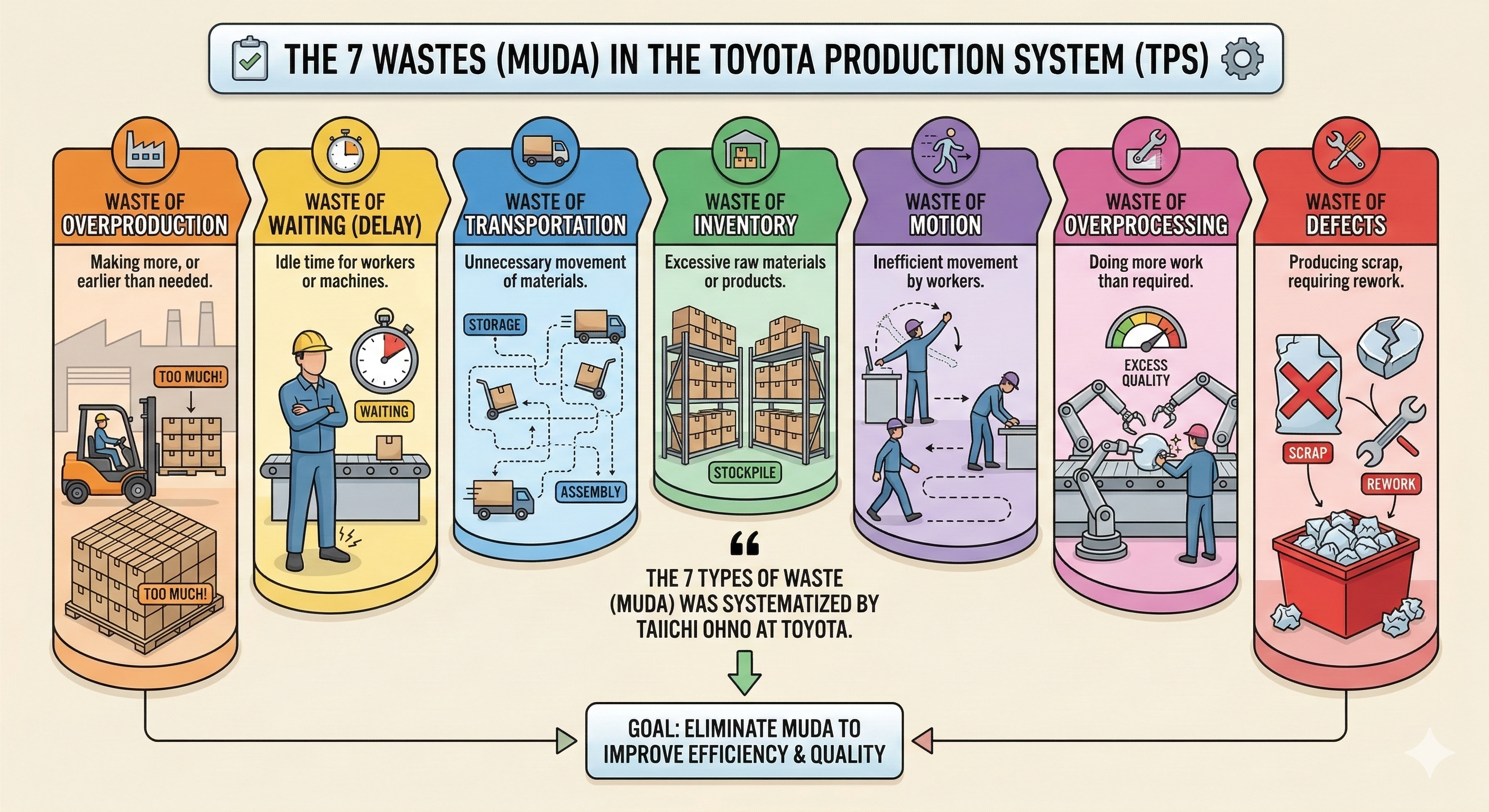
Detective's Memo: The secret to Toyota Motor Corporation's reign as the world's most formidable manufacturer: "TPS (Toyota Production System)". Many are distracted by superficial techniques like "Just-in-Time" and "Kanban", but the true identity lies in "maximizing value creation through the systematic elimination of 7 Wastes". Why can Toyota achieve twice the productivity with half the inventory of competitors, and why do non-manufacturing companies like Amazon, Apple, and Spotify adopt TPS? Overproduction, waiting, transportation, overprocessing, inventory, motion, defects—seven perspectives that expose hidden costs lurking in every operation. Why does Taiichi Ohno's philosophy of eliminating "Muda, Mura, Muri" (Waste, Unevenness, Overburden) remain valid worldwide 70 years later? Uncover the true nature of universal efficiency principles that originated in manufacturing but now extend to software development, marketing, and management strategy.
What Are the 7 Wastes of TPS - Case Overview
The 7 Wastes of TPS (Toyota Production System), formally recognized as "a systematic elimination methodology through categorization of all non-value-adding activities", represent a production philosophy systematized by Toyota's Taiichi Ohno from the 1950s. Through seven categories—overproduction, waiting, transportation, overprocessing, inventory, motion, and defects—clients understand it as a framework to visualize and eliminate all work that doesn't provide value to customers. However, in actual practice, it's often narrowly understood as "an outdated manufacturing technique", with most organizations failing to grasp its strategic value as a universal principle applicable to lean startup software development, marketing optimization, and even personal time management.
Investigation Memo: TPS isn't merely an "efficiency technique" but "a philosophy that questions what value truly means". Why does "working busily" ≠ "creating value", and why is "idle time" the greatest waste? We must uncover the modern business efficiency foundation that doesn't contradict the Realization First Principle's "realization over efficiency" and complements Agile Development's iterative improvement.
Basic Structure of the 7 Wastes - Evidence Analysis
Fundamental Evidence: Seven Categories of Non-Value-Adding Activities
Waste 1: Overproduction
Definition: Producing more than needed, or earlier than needed
Manufacturing Examples:
Bad Practice:
- Making 120 units when ordered 100
- Producing next month's quota this month
- Making extras "just in case"
- Overproducing to maximize machine utilization

Consequences:
- Excess inventory accumulation
- Warehouse space compression
- Capital immobilization
- Obsolescence risk
Software Development Examples:
Bad Practice:
- Implementing unused features
- Building features that might be needed someday
- Over-engineering design documentation
- Sophisticated implementation users don't want

Consequences:
- Wasted development effort
- Increased maintenance costs
- Release delays
- Time shortage for truly needed features
Marketing Examples:
Bad Practice:
- Sending emails uniformly to unresponsive segments
- Mass-producing unread whitepapers
- Creating massive content before measuring effectiveness
- Expanding ads with unclear targets

Consequences:
- Wasted content production costs
- Customer information fatigue
- Brand image deterioration
- Underinvestment in effective initiatives
Why Overproduction Occurs:
Psychological Factors:
- "Since we're making it anyway" mentality
- Misconception that 100% utilization is good
- Anxiety about wanting buffers
- Resistance to stopping production

Organizational Factors:
- Evaluation based on output quantity
- Culture that doesn't tolerate idle machines/people
- Inaccurate demand forecasting
- Pursuit of local optimization
TPS Solution:
Just-in-Time:
- What is needed
- When it is needed
- In the amount needed

Concrete Implementation:
- Kanban system (pull from downstream)
- Small-lot production
- Demand leveling
- Pull production (not push)
Waste 2: Waiting
Definition: People or machines idle, waiting for the next task
Manufacturing Examples:
Bad Practice:
- Workers waiting due to upstream delays
- Production line stopped from machine breakdown
- Work halted pending approvals
- Waiting for material delivery

Consequences:
- Wasted labor costs
- Delivery delays
- Productivity decline
- Motivation decrease
Software Development Examples:
Bad Practice:
- Development stopped awaiting code review
- Engineers idle awaiting specification finalization
- Next development blocked awaiting deploy approval
- Waiting for QA team confirmation

Consequences:
- Decreased development velocity
- Inefficiency from context switching
- Increased lead time
- Developer frustration
Office Work Examples:
Bad Practice:
- Work stopped pending supervisor approval
- Waiting for responses from other departments
- Idle until meeting start time
- Waiting for system processing completion

Consequences:
- Time wastage
- Decreased concentration from parallel tasks
- Delivery delays
- Delayed value delivery to customers
TPS Solution:
Standardized Work:
- Uniform work timing
- Identify and improve bottleneck processes
- Multi-skilling (different work during waiting)

Jidoka (Automation with Human Intelligence):
- Automatic stop on abnormality
- Humans focus on exception handling
- Delegate to machines what can be automated
Waste 3: Transportation
Definition: Moving materials or information (non-value-adding)
Manufacturing Examples:
Bad Practice:
- Long-distance movement within factory
- Warehouse and factory separation
- Multiple loading/unloading transfers
- Circuitous layouts

Consequences:
- Transportation costs
- Time wastage
- Damage/loss risk
- Increased lead time
Software Development Examples:
Bad Practice:
- Copy-pasting data between multiple tools
- Manual file transfers
- File sharing via email
- Duplicate information entry

Consequences:
- Time wastage
- Human errors
- Information fragmentation
- Version control chaos
Office Work Examples:
Bad Practice:
- Circulating paper documents between departments
- Moving for approval stamps
- Travel time to meeting rooms
- Walking to retrieve distant materials

Consequences:
- Wasted movement time
- Document loss risk
- Process delays
- Reduced time for essential work
TPS Solution:
Layout Improvement:
- U-shaped lines (minimize movement distance)
- Optimal workstation placement
- Needed items within arm's reach

Single-Piece Flow:
- One piece at a time, not bulk transport
- Batch size reduction
- Intermediate inventory elimination
Waste 4: Overprocessing
Definition: Building in more quality/features than necessary
Manufacturing Examples:
Bad Practice:
- Processing to precision customers don't require
- Excessive finishing of invisible parts
- Unnecessary inspection steps
- Over-specification

Consequences:
- Increased processing time
- Rising costs
- Delivery delays
- Reduced price competitiveness
Software Development Examples:
Bad Practice:
- Implementing sophisticated features users won't use
- Excessive abstraction/design pattern application
- Unnecessary performance optimization
- Creating detailed documentation nobody reads

Consequences:
- Wasted development time
- Increased complexity
- Higher maintenance costs
- Lack of focus on essential value
Critical Insight:
❌ Not about lowering quality
✅ Precisely matching customer-required quality

Key Points:
- Don't make it 100% when 80% suffices
- Eliminate work not directly tied to customer value
- [MVP](/behind_case_files/articles/X036_MVP) philosophy
- Avoiding the perfectionism trap
Waste 5: Inventory
Definition: Holding more materials, work-in-progress, or products than necessary
Manufacturing Examples:
Bad Practice:
- Excess inventory "just in case"
- Materials sleeping in warehouses
- Large finished goods stockpiles
- Dead stock

Consequences:
- Warehouse costs
- Capital immobilization
- Obsolescence/deterioration risk
- Problem concealment (inventory masks issues)
Software Development Examples:
Bad Practice:
- Unreleased completed features
- Accumulation of unused code
- Implemented but untested features
- Bloated backlog

Consequences:
- Maintenance costs
- Delayed discovery of integration issues
- Obsolescence (market changes make it unnecessary)
- Delayed feedback
TPS Solution:
Just-in-Time:
- Zero inventory as ideal
- Single-piece flow production
- Pull from downstream process

Revealing Problems Hidden by Inventory:
- Reduce inventory → problems become visible
- Solve problems → reduce inventory further
- Continuous improvement cycle
Waste 6: Motion
Definition: Non-value-adding human movement
Manufacturing Examples:
Bad Practice:
- Searching for tools
- Turning around, bending down
- Changing grip
- Working in unnatural postures

Consequences:
- Time wastage
- Fatigue accumulation
- Workplace injury risk
- Productivity decline
Office Work Examples:
Bad Practice:
- Back-and-forth between mouse and keyboard
- Eye movement between multiple screens
- Time spent searching for documents
- Repetitive copy-pasting

Consequences:
- Accumulated micro time losses
- Decreased concentration
- Physical fatigue
- Increased errors
TPS Solution:
Principles of Motion Economy:
- Use both hands simultaneously
- Symmetrical movements
- Shortest distance
- Rhythmic motion

5S Activities:
- Sort (discard unnecessary items)
- Set in order (place needed items for immediate access)
- Shine (clean)
- Standardize (maintain cleanliness)
- Sustain (make it habitual)
Waste 7: Defects
Definition: Rework, backtracking, corrections occurring
Manufacturing Examples:
Bad Practice:
- Defective products
- Inspection failures
- Customer complaint handling
- Recalls

Consequences:
- Double consumption of materials/labor
- Delivery delays
- Loss of customer trust
- Brand damage
Software Development Examples:
Bad Practice:
- Bug occurrence
- Rebuilding due to misunderstood specifications
- Problems from insufficient testing
- Production environment troubles

Consequences:
- Debugging effort
- Customer impact
- Team morale decline
- Lost opportunities
TPS Solution:
Poka-Yoke (Error-Proofing):
- Mechanisms that prevent mistakes
- Physical design allowing only correct methods
- Checklist utilization

Jidoka:
- Stop immediately on detecting abnormality
- Don't pass defects to next process
- Investigate and address root causes immediately
Evidence Analysis: The revolutionary nature of the 7 Wastes lies in their rigorous customer-centric philosophy that distinguishes "busyness" from "value creation" and visualizes/eliminates all activities except those delivering value to customers.
Implementation Process for the 7 Wastes - Investigation Methods
Investigation Discovery 1: Amazon Warehouse Case Study
Case Evidence (Logistics Revolution Through Waste Elimination):
Phase 1: Transportation Waste Elimination
Traditional Warehouse:
Problems:
- Workers walk to products
- 10-20km walking per day
- 70% of picking time spent moving

Results:
- Low productivity
- Worker fatigue
- Long delivery times
Amazon's Solution:
Kiva Robots Introduction (now Amazon Robotics):
- Shelves come to workers
- Workers pick from fixed positions
- Robots transport via optimal routes

Effects:
- 75% reduction in movement time
- 50% increase in warehouse capacity
- Half the order processing time
Phase 2: Waiting Waste Elimination
Problem:
Traditional:
- Can't pack until all items gathered
- Can't ship until packing complete
- Waiting time between processes
Solution:
Anticipatory Picking:
- Position products nearby before order confirmation
- Start packing moment order placed
- Parallel processing of multiple orders

Effects:
- Hours from order to shipment
- Next-day delivery for Prime members
Phase 3: Inventory Waste Elimination
Problem:
Traditional Retail:
- Large store inventory
- Unsold inventory risk
- Obsolescence
Amazon's Solution:
FBA (Fulfillment by Amazon):
- Consolidate seller inventory in Amazon warehouses
- Data-driven demand forecasting
- Optimal regional inventory placement

Effects:
- Dramatically improved inventory turnover
- Reduced seller risk
- Shortened delivery times
Investigation Discovery 2: Spotify's 7 Wastes Elimination in Development
Case Evidence (TPS Application to Software Development):
Overproduction Elimination:
Problem:
- Implementing unused features
- Large-scale releases

Solution:
- Squad system (small autonomous teams)
- Small, fast releases
- Validate with A/B testing before scaling

Effects:
- Increased development velocity
- Minimized failure costs
Waiting Elimination:
Problem:
- Release delays pending approvals
- Dependencies on other teams

Solution:
- Autonomous deployment authority
- Microservices architecture
- Continuous Delivery

Effects:
- 100+ deployments per day
- Dramatic feature addition acceleration
Defect Elimination:
Problem:
- Bug discovery in production
- Large-scale failures

Solution:
- Comprehensive automated testing
- Canary releases
- Immediate rollback mechanisms

Effects:
- Minimized failure impact scope
- Confident high-velocity releases
Power of the 7 Wastes - Utilization Value
Power 1: Dramatic Productivity Improvement
Toyota's Track Record:
For same production volume:
- Inventory: 1/10 of competitors
- Production lead time: 1/2 of competitors
- Defect rate: 1/5 of competitors
- Factory floor space: 2/3 of competitors

Results:
- Overwhelming profit margins
- Price competitiveness
- Market share expansion
Power 2: Early Problem Detection
Effects of Inventory Reduction:
High Inventory State:
- Problems covered by inventory
- Issues remain hidden
- Root causes unclear

After Inventory Reduction:
- Problems immediately surface
- Immediate response
- Continuous improvement
Power 3: Cash Flow Improvement
Inventory Reduction:
- Decreased fixed assets
- Cash preservation
- Created investment capacity

Lead Time Reduction:
- Improved turnover rate
- Better cash cycle
Power 4: Flexibility Acquisition
Small-Lot Production:
- Immediate response to demand changes
- Multi-product capability
- Easy customization

Results:
- Market adaptability
- Competitive advantage
Limitations and Caveats - Investigation Warnings
Warning 1: The Trap of Efficiency Becoming the Goal
❌ Wrong Application:
"Cost cutting for waste elimination"
→ Reducing value creation

✅ Correct Understanding:
"Waste elimination for value creation"
→ Customer value takes priority
Warning 2: Excessive Inventory Reduction Risk
Problems:
- Supply chain disruption vulnerability
- Unable to respond to demand spikes
- Supply stoppage from disasters/pandemics

Countermeasures:
- Balance with risk analysis
- Maintain strategic inventory
- Supplier diversification
Warning 3: Balancing with Realization First Principle
Initial Phase:
- First realize (ignore efficiency)
- Manual work acceptable
- Even 100 copy-pastes tolerated

Maturity Phase:
- After identifying bottlenecks
- Improve with 7 Wastes
- Gradual efficiency enhancement

Critical: Don't mistake the timing
Warning 4: Importance of Culture & Mindset
Failure from Technique-Only Introduction:
- Kanban system introduced
- But push production continues
- TPS in form only

Keys to Success:
- Organization-wide improvement culture
- Shop floor autonomy
- Top management commitment
Related Case Files - Internal Links
- X037_Realization First Principle - Principle prioritizing realization before efficiency (TPS applies in improvement phase after realization)
- X036_MVP - Minimum viable value delivery (same philosophy as overprocessing elimination)
- X038_Agile Development - Small-batch, iterative development (overproduction elimination)
- X028_RCD Model - Problem visualization through recording (quantitative waste measurement)
- X022_AARRR - Growth acceleration through waste elimination at each stage
Industry-Specific Cases - Diverse Applications
Software Development:
Lean Software Development:
- Overproduction → MVP, staged releases
- Waiting → CI/CD, automation
- Defects → TDD, automated testing
Marketing:
Growth Hacking:
- Overproduction → Small-scale experiments
- Overprocessing → Simple landing pages
- Inventory → Immediate content publication
Healthcare:
Hospital Operations:
- Waiting → Optimized appointment systems
- Transportation → Electronic medical records
- Motion → Improved traffic flow design
Investigation Summary - Detective's Conclusion
The 7 Wastes of TPS, born from manufacturing floors 70 years ago, remain universally applicable efficiency principles across all industries worldwide today. Their essence lies in the thorough customer-centric philosophy of "eliminating all activities that don't generate customer value".
Critical Discoveries:
- Waste Visualization - Invisible waste cannot be improved
- Small-Batch, High-Frequency - Single-piece flow over mass production
- Immediate Problem Response - Don't hide with inventory, improve immediately
- Organization-Wide Improvement - Shop floor as protagonist
- Continuous Evolution - No final form, eternal improvement
But most important is understanding that TPS is not a "technique" but a "mindset and culture". Even with Kanban introduction, even while chanting Just-in-Time, without the attitude of continuously asking "what is waste?", true TPS cannot be realized.
Stop on the shop floor and ask yourself: "Does this work deliver value to customers?" That question is the starting point for eliminating the 7 Wastes.
【🔏Classified File - Investigation Complete】