
ROI Case File No.467 'The Tool That Couldn't Reach Everyone'

The Tool That Couldn't Reach Everyone
Chapter 1: Thirty People Who Had It
"We want all employees using it, but it's only reached thirty. That gap has been bothering me."
Daisuke Kimura, DX Promotion Manager at Innovatech, looked at his laptop screen as he spoke. An internal AI tool usage dashboard was open. Licenses: 30. Total headcount: 150. Utilization rate: 20%.
"When did you introduce Copilot?" I asked.
"A year ago," Kimura answered. "We started with a pilot of 30 people. The effect is real. Document creation time shortened, meeting summaries became easier—feedback from the users is positive. The problem is the math when we try to expand company-wide."
"What's the monthly per-user cost?" Claude confirmed.
"¥4,500," Kimura answered. "For 30 people, that's ¥135,000/month. For 150 people, it becomes ¥675,000/month. Over ¥8 million a year. I proposed it to management, but couldn't explain the cost-benefit clearly enough to get approval."
"You mentioned security as a second issue," Gemini continued.
"The concern is whether confidential materials entered into AI get used to train the model," Kimura said. "Legal has raised concerns about letting AI learn from business content. Particularly from departments that handle customer data or products under development—there are voices saying they're hesitant to use it."
"Cost and security—two walls stopping full deployment," I summarized.
"That's right," Kimura nodded. "I don't even know which to address first."
"Let's begin with six questions," Claude said quietly.
Chapter 2: The Six Walls 5W1H Demands
"This case calls for 5W1H."
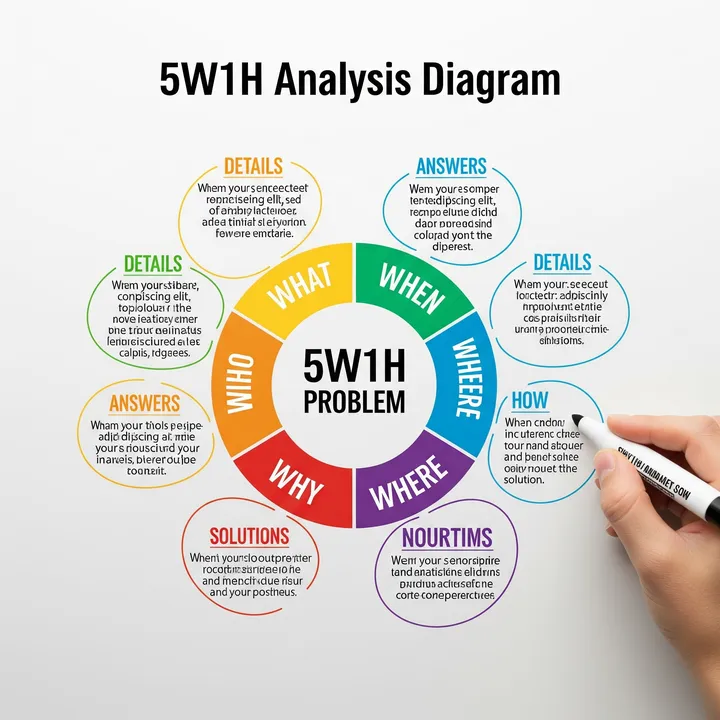
Claude wrote six questions on the whiteboard: What, Why, Who, When, Where, How.
"5W1H is a framework that dissects a problem through six questions: what, why, who, when, where, and how," I explained. "The two walls—cost and security—look like separate problems. But when dissected through six questions, the underlying structure emerges. Changing that structure is the path to full deployment."
"Let's organize the current cost picture," Gemini said, opening ROI Polygraph and entering the tool usage logs and work-hour records Kimura had provided.
The numbers returned.
"The productivity savings for the 30 current Copilot users is in," Gemini read. "Each user averages 30 minutes of work saved per day. At ¥2,800/hour, that's ¥28,000/month per user. Total for 30 users: ¥840,000/month in productivity impact. Against a license cost of ¥135,000/month: a 6.2x return."
Kimura leaned forward. "I'd never presented those numbers to management."
"Let's project the full company scenario as well," Gemini continued. "Rolling Copilot out to all 150 people: expected monthly productivity improvement of ¥4,200,000. Subtract the ¥675,000 license cost: net improvement of ¥3,525,000/month. The cost problem existed because cost was being seen in isolation. Paired with impact, the numbers reverse."
"Then let's dissect with 5W1H," I said.
[What — What Is the Problem?]
"There are two problems," Claude said. "First: full-company deployment looks like it costs ¥8M per year. Second: concerns about confidential data being used for AI training are suppressing adoption. These look like separate problems, but they share a common thread: neither has the right information in front of it."
"On the cost side," Gemini continued, "there are alternative tools on the market that are both cheaper and capable of meeting security requirements. At around ¥1,200/month per user, enterprise plans guarantee contractually that input data will not be used for training. Full 150-person deployment cost: ¥180,000/month—less than a quarter of Copilot's full-deployment cost."
[Why — Why Has the Problem Persisted?]
"Why hadn't you considered alternative tools until now?" I asked Kimura.
"Because Copilot integrates with our existing Microsoft environment, there was internal resistance to looking at alternatives," Kimura answered. "And on the security side, rather than getting into specifics, Legal raised 'there's a risk' and the conversation stopped there."
"That's the Why," Claude said. "The problem has persisted not because of cost or security, but because there was no setting in which accurate information was brought together to make a decision. Legal's concern is legitimate—but if the concern is never specified, everything freezes."
[Who — Who Should Be Involved in the Decision?]
"Who is currently part of the full-deployment decision?" Gemini confirmed.
"Just DX Promotion and management," Kimura answered. "Legal and IT are raising concerns, but they're not in the room where solutions are being shaped."
"That is the bottleneck," Claude said. "Change the Who design. Bring Legal and IT from the concern-raising side to the solution-building side. Specifically: include them in the tool evaluation team, have Legal write the security requirements checklist. Only tools that pass the checklist become candidates. In this design, Legal's concerns become selection criteria, not obstacles."
[When — When to Start What?]
"Design the deployment timeline," I continued. "Trying to roll out to 150 people at once makes both cost and risk look large. Staging the rollout distributes both investment and learning cost."
"Phase 1 (1 month): Legal and IT jointly develop the security evaluation checklist. Select and evaluate three alternative tool candidates. Phase 2 (month 2): Pilot expand to an additional 50 people with the selected tool. Measure effectiveness with the existing 30 plus 80 total. Phase 3 (month 3): Expand to remaining 70. Full 150-person deployment complete."
[Where — Where Is the Impact Largest?]
"A blanket rollout to all employees means spending on departments where impact is thin," Claude said. "First identify where impact is greatest. Departments with high document creation volume, high routine work volume—prioritize there. Deciding Where maximizes return on investment."
"If you have per-department effectiveness data from the current 30 Copilot users," Gemini added, "you can see which department saw the most time saved. That data becomes the rationale for the next deployment priority."
[How — How to Deploy?]
"The final How is deployment design," I concluded. "Handing over a tool is not enough—it won't be used. In the first two weeks, set one concrete use case per department. Sales: first draft of proposal documents. HR: job posting creation. Presenting the use case in the department's own language determines adoption rate."
Chapter 3: Six Questions, One Answer
"Let's compile the final projections in ROI Proposal Generator," I said, stepping to the whiteboard.
Alternative tool full-deployment scenario vs. Copilot full-deployment scenario side by side.
- Alternative tool full deployment: Monthly cost ¥180K; productivity improvement ¥4.2M/month; net improvement ¥4.02M/month; annualized ¥48.24M
- Copilot full deployment: Monthly cost ¥675K; productivity improvement ¥4.2M/month; net improvement ¥3.525M/month; annualized ¥42.3M
- Additional savings from choosing alternative tool: approx. ¥5.94M/year
"The license cost difference alone creates a ¥6M annual gap," Gemini summarized. "Meeting security requirements while cutting cost to less than a quarter. Running 5W1H's six questions revealed that the core issue wasn't 'Copilot or not'—it was 'accurate information wasn't in the room to make accurate choices.'"
Kimura exhaled deeply. "I can rebuild the management proposal. Not as a cost conversation—as an options and impact conversation."
"This week, propose to Legal that you jointly build the security evaluation checklist," Claude added. "Pull the people with concerns into the solution-building side. That one move opens the first door to full deployment."
Kimura nodded. "I'll set up a meeting with Legal's manager tomorrow."
Chapter 4: The Day It Reached Everyone
Four months later, a report arrived from Kimura.
The tool selection process with Legal and IT in the evaluation team completed in three weeks. Legal's manager, who had helped write the security evaluation checklist, said: "We made the criteria ourselves, so we can use it with confidence," the report noted.
In the additional 50-person pilot with the alternative tool, each user's monthly productivity savings matched the existing 30 users' track record at ¥28,000/month. The management presentation placed the annual net improvement and the per-option comparison projections side by side—approval came in twenty minutes.
After full 150-person deployment, monthly tool utilization reached 87%. Because per-department use cases had been defined at the outset, "I don't know what to use it for" was never heard, Kimura wrote.
The final line of the report read: "5W1H showed me that the two walls—cost and security—were actually information walls. With the right information, talking to the right people, walls become doors. The day the tool that couldn't reach everyone reached everyone, one chapter of our DX journey completed."
The tool that couldn't reach everyone reached everyone.
"Problems don't always live where they appear to be. What looked like a cost problem was an information problem. What looked like a security problem was a people problem. The six questions 5W1H demands—what, why, who, when, where, how—illuminate the back of what's visible. Answer all six, and the real problem reveals itself. For every question, there is a door."
Related Files
Tools Used
- ROI Polygraph — AI tool usage labor and cost effectiveness measurement
- ROI Proposal Generator — Per-tool full-deployment cost and productivity improvement comparison


