
ROI Case File No.469 'What a Hundred Calls a Day Was Taking'

What a Hundred Calls a Day Was Taking
Chapter 1: Every Ring Stopped the Work
"Every time the phone rings, work stops. I asked staff if they'd ever counted how many times a day it happens. They shook their heads. Said they couldn't count."
Yuji Maeda, Operations Manager at AutoServe Solutions, took out a single record sheet as he spoke. He'd asked staff to log incoming calls for one week as a trial. Monday through Friday averaged 113 calls per day. Saturday: 148.
"What type of calls come in most?" I asked.
"Vehicle inspection bookings, by far," Maeda answered. "Next, oil changes and service appointments. Regular customers calling to book their next visit. Third: breakdown and accident inquiries. Those require nuanced responses—staff have to handle them. The problem is that booking calls and inquiry calls all come to the same number."
"Do mechanics take calls too?" Claude confirmed.
"They do," Maeda said with a rueful smile. "When the phone rings during pit work, they stop, pull off their gloves, and walk over to answer. A three-minute call, then walk back. Just the back-and-forth takes over five minutes. When that happens multiple times a day—our senior mechanic told me he can't get his focus back."
"Does a call in progress ever cause delays with in-person customers?" Gemini asked.
"Yes," Maeda answered. "When front desk staff are on a call, walk-in customers have to wait. The call can't be cut short, but the customer can't be kept waiting either—every day, that choice is being made over and over. The stress on staff is building quietly."
"What the hundred calls are taking isn't just time," I said.
Maeda nodded. "It's focus. And the slack in our staff."
Chapter 2: The Customer Psychology AIDMA Demands
"This case calls for AIDMA."
Claude wrote five letters on the whiteboard: A, I, D, M, A.
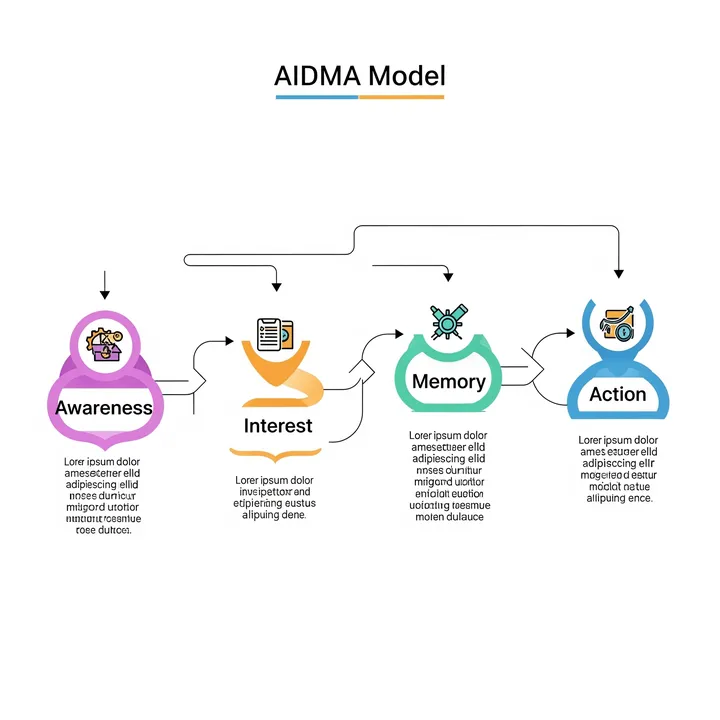
"AIDMA stands for Attention, Interest, Desire, Memory, and Action—a framework that maps the psychological process a customer goes through before taking action," I explained. "Before deploying an AI phone system, we need to understand why customers are calling in the first place. Design a system that ignores customer psychology, and automated responses become something customers hate—and customers leave. AIDMA is the map for designing from the customer's perspective."
"At the same time, let's measure what staff are losing in cost terms," Gemini said, opening ROI Polygraph and entering the call logs and staff operational records Maeda had provided.
The numbers returned.
"Monthly call-handling labor is in," Gemini read. "With eight staff members splitting 100 calls a day, pure handling time: 200 hours/month. Interruption recovery time: approximately 67 hours/month. Total: 267 hours/month consumed by phone-related work. At an average ¥2,350/hour: ¥626,745/month, approximately ¥7,520,000 annualized."
Maeda's jaw dropped slightly. "I had never once calculated the cost of handling calls."
"Then let's dissect customer psychology with AIDMA," I continued.
[A — Attention: The Moment a Customer Notices AutoServe Solutions]
"First, think about what's happening before a customer picks up the phone," Claude said. "A customer approaching inspection time is triggered by a postcard or email from the dealer or shop. A customer with a sudden breakdown acts from sudden anxiety. The reason for calling is completely different between these two."
"The inspection-booking customer," Gemini continued, "knows the timing and wants to lock in a date. The information they need is limited: available slots, estimated time, rough cost. Three pieces of information, and the call is done. AI can answer this call."
"The breakdown or accident customer," Claude continued, "calls carrying anxiety and urgency. Routing this state to an automated voice turns anxiety into anger. This is a call a human must answer."
"In other words," I summarized, "splitting calls into two types is the starting point for design. Bookings and standard inquiries go to AI; emergency and emotional calls go to humans. That triage needs to happen in the first 30 seconds of a call."
[I — Interest: The Condition Under Which Customers Tolerate Automation]
"What's the biggest reason automated responses get rejected?" I asked Maeda.
"I think it's the feeling of being bounced around," Maeda answered. "Press a number, press another number, and five minutes later you finally get a human—I've heard customers say they never want to use that system again."
"The Interest point isn't whether AI can handle the call—it's whether the customer reaches their goal in a short time," Claude said. "Three design principles: maximum three options presented, response within 30 seconds, human transfer maximum once. Following these three rules significantly reduces dropout rates from automated systems."
[D — Desire: The Customer's Desire to Complete a Booking]
"What the inspection-booking customer wants most is for the appointment to be confirmed on the spot," Gemini said. "AI presents available slots in real time and the booking can be made right then. 'We'll call you back' doesn't satisfy the customer's desire. Integration with the booking system is the core of this design."
"How is booking managed now?" I asked Maeda.
"Paper ledger and the staff member's memory," Maeda answered. "When someone calls, the staff member checks the ledger and quotes available times. If the staff member who picks up the call doesn't have the ledger in hand, they put the call on hold and go find it. The customer waits."
"Digitizing appointment management needs to happen alongside AI deployment," Claude said. "Without a digital booking system, AI can't quote available slots. That is the prerequisite for this system."
[M — Memory: The Memory That Brings Customers Back]
"From a Memory perspective, think about whether this call experience leads to another visit," Gemini continued. "A smooth booking experience creates a memory of wanting to call this shop again next time. Conversely—calls not getting through, long holds, slow callbacks—these drive customers to competitors."
"Are there times when calls go unanswered now?" I asked.
"Yes," Maeda answered. "During peak periods in the morning, there are stretches when everyone is unavailable. Calls that come in during those windows just ring and ring until they drop."
"When AI takes calls, missed calls during busy hours or outside business hours disappear," Claude said. "The memory of a call not getting through is replaced by the memory of always getting through—and that customer retention impact is real."
[A — Action: Can the Customer Complete Their Purpose?]
"The final Action is whether the call's purpose is fulfilled," I concluded. "For a booking call, the booking is completed. For an inquiry call, the answer is received. If neither happens, the customer calls again. Repeat calls are double-counted labor. AI completing the loop the first time improves both customer satisfaction and staff workload."
Chapter 3: Triaging a Hundred Calls
"Let's project the investment plan through ROI Proposal Generator," I proposed.
AI phone system deployment costs and savings were laid out side by side.
- Initial cost: AI phone system deployment and booking system digitization: ¥1.2M total
- Monthly cost: System usage fee ¥60K/month
- Automation rate: 70% of bookings and standard inquiries handled by AI
- Monthly savings: ¥626,745 × 70% = ¥438,722
- Net monthly savings: ¥438,722 − ¥60,000 = ¥378,722
- Payback period: ¥1.2M ÷ ¥378,722 = approx. 3.2 months
"Payback in three months," Gemini summarized. "Add the revenue contribution from eliminating after-hours missed calls and the effective payback shortens further."
Maeda reviewed the numbers and said, "If payback is in three months, there's no reason not to deploy."
"One thing I want to confirm," Claude said. "How will you communicate this deployment to staff?"
Maeda thought for a moment. "They might think their jobs are being taken."
"Tell them they're being freed from phone calls," Claude said quietly. "Mechanics can focus on pit work. Front desk staff can face walk-in customers. What AI takes over are the repetitive booking calls. Calls that require judgment continue to be handled by humans. Not taken away—given back. Time to focus is being given back."
Maeda's expression softened slightly. "I'll use that language when I talk to them."
Chapter 4: The Day the Mechanics' Hands Didn't Stop
Four months later, a report arrived from Maeda.
From the first month of AI phone operation, 73% of all incoming calls were resolved through automated response. Booking call completion rate: 91%. "We'll call you back" responses dropped from a monthly average of 120 to 11.
A survey of the eight mechanics found seven saying "interruptions have decreased" and six saying "I have more time to focus." One senior mechanic said "I no longer have to think about the phone while I'm working," the report noted.
After-hours missed calls dropped to zero after AI started receiving them. Callback requests generated 37 cases per month on average the next morning—and "they called me back to confirm the next morning" began appearing in customer reviews.
The final line of Maeda's report read: "Mapping customer psychology through AIDMA changed the design of the system. Rather than letting AI handle all calls, we first decided which calls AI would handle. That triage is what allowed both customer satisfaction and staff workload relief to be achieved at the same time. The hundred calls haven't changed. What changed was how we answer them."
What a hundred calls a day had been taking came back to the staff.
"A phone call is the result of a customer's action. Before the action came attention, interest, desire, and memory. What AIDMA asks is how to design those five stages. Design a system without understanding why customers call, and automated response becomes a wall. Design it knowing why they call, and automated response becomes a bridge. Triaging a hundred calls is triaging the psychology of a hundred customers. Only customers who cross the bridge call again."
Related Files
Tools Used
- ROI Polygraph — Call handling labor and work interruption cost visualization
- ROI Proposal Generator — AI phone system deployment payback simulation


