
ROI Case File No.471 'The Day the Red Pen Disappeared'

The Day the Red Pen Disappeared
Chapter 1: Chaos Every Two Weeks
"Every time we publish a flyer, someone ends up apologizing."
Misaki Ishii, Marketing Manager at AthleticGear, gestured toward a stack of files on her desk as she spoke. Layers of printed proof sheets, each covered in red-pen annotations. Some had been scanned to PDF, emailed, and then printed out again.
"How often do you publish flyers?" I asked.
"Every two weeks," Ishii said. "We post them on our e-commerce site and official app. Mostly seasonal sale announcements and new product arrivals. The sports gear industry moves fast—publish late and it's already irrelevant."
"How many production vendors are involved?" Claude asked.
"Two design firms and one print-and-data-processing company—three vendors total," Ishii continued. "The problem is that their tools are completely different. Vendor A uses Figma, Vendor B uses Illustrator, and the processing company manages copy in Excel. Because there's no unified internal workflow, every exchange requires format conversion."
"How often do errors appear in the published content?" Gemini asked.
Ishii paused. "Last month we had one. An old price was submitted for a product and ended up on the e-commerce site. We had to contact each affected customer individually and apologize. It took well over thirty minutes."
"And that happens every month," Claude confirmed quietly.
"Not every month—irregularly. And the irregular part is what scares me most," Ishii answered. "Because we never know when it'll happen, every proofreading cycle runs under tension. And we're running that tense proofreading through analog red-pen markups and scanned PDFs."
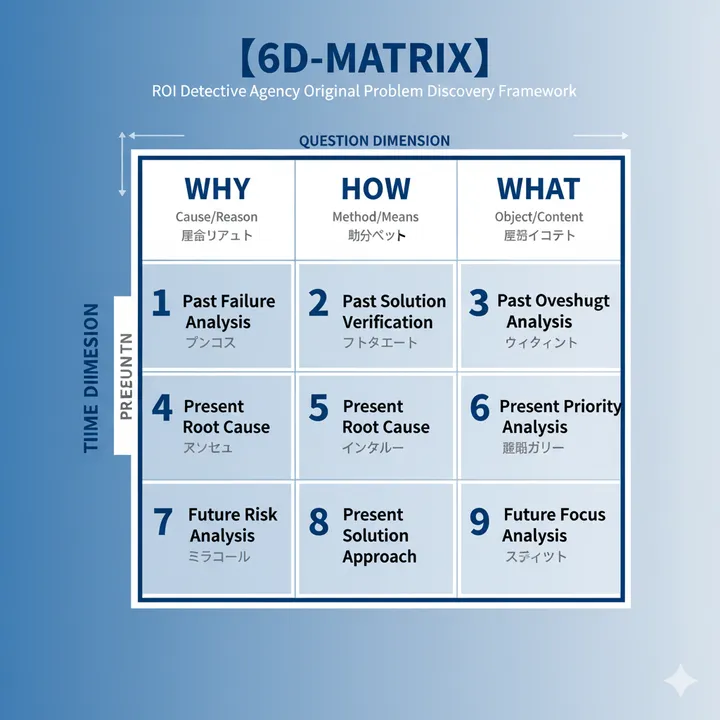
Chapter 2: The Six Axes of the 6D MATRIX
"This case calls for the 6D MATRIX."
Claude wrote six words on the whiteboard: Present, Future, Past, WHY, HOW, WHAT.
"The 6D MATRIX is a framework for clarifying the current state and the ideal state across six dimensions," I explained. "What is happening now, what do we want in the future, what happened in the past, why did we get here, how can we change it, and what should we do—filling in these six axes simultaneously reveals both the full scope of the problem and the direction of the solution. It's especially effective for issues that involve multiple stakeholders, like a flyer production workflow."
"Let's start by measuring the current cost," Gemini said, opening ROI Polygraph. Production records and internal time logs provided by Ishii were entered.
"The monthly cost of proofreading-related work is in," Gemini read aloud. "Two internal staff members spend an average of forty hours per month on proofing checks, correction instructions, and back-and-forth—at an hourly rate of ¥2,900, that's ¥116,000 per month. Error-response work—apologies, re-submissions, and stakeholder coordination—averages five hours per incident, one incident per month, totaling ¥29,000. Format conversion overhead runs ten hours per month, another ¥29,000. Combined, ¥174,000 per month is being consumed by inefficiencies tied to this flyer production workflow. That's ¥2,088,000 annually."
Ishii exhaled quietly. "So on top of the actual production costs, we're spending that much."
"Management costs hide in the shadow of production costs," I continued. "Now let's map this through the 6D MATRIX."
[Present — What Is Happening Now]
"Three vendors are each using different tools. Internal copy management runs through Excel. Proofing happens via red-pen markups on paper, scanned to PDF, and shared by email. This structure generates conversion costs and confirmation errors," Claude summarized.
"Have you ever counted how many rounds of review a single flyer requires?" I asked Ishii.
"An average of four back-and-forths per flyer," she answered. "Initial proof, post-correction re-check, detail revision, final confirmation—each round takes one to two days."
"Four rounds at an average of 1.5 days each means six days consumed by proofreading alone," Gemini added. "In a two-week cycle, one-third of the time goes to confirmation."
[Future — What Do We Want?]
"Please describe the ideal state," Claude said to Ishii. "Remove all constraints. What would flyer production look like if it were working perfectly?"
Ishii thought for a moment. "A state where typos and price mismatches are automatically detected during proofreading. And—no matter which vendor we use, the workflow on our receiving end stays the same."
"Those two things are the goals for this engagement," Claude said. "Automated detection and workflow unification. We'll select our solution along these two axes."
[Past — What Happened]
"Please compile past error incidents by count and cause," I asked Ishii. A week later, she returned with the analysis.
Over two years: six errors. Breakdown: three from missed price updates, two from inconsistent product name formatting, one from an incorrect publication period. Five of the six occurred during concurrent management of multiple files.
"The cause is clear," Gemini said. "Data isn't centralized, and multiple people are touching multiple files simultaneously. That's the structural cause of the errors."
[WHY — How Did We Get Here?]
"Can you walk us through how you ended up with three vendors?" I asked.
"We started with one," Ishii answered. "When deadlines stacked up during peak season, we added a second. Then we needed a different design aesthetic and brought in a third. The workflow grew with each addition."
"A structure built up out of operational convenience is now generating inefficiency," Claude said quietly. "Understanding WHY reveals the solution. Workflow unification doesn't mean reducing vendors—it means consolidating the receiving end into a single channel."
[HOW — How Do We Change It?]
"The solution has three phases," I summarized. "First, introduce an AI-powered proofreading tool connected to the product master to automatically cross-check prices and product names. Second, unify the production request, proofing, and approval workflow on a cloud platform—regardless of what tools the vendors use, our receiving end stays in one place. Third, migrate copy management from Excel to a cloud-based system so the latest version always lives in one location."
[WHAT — What Specifically Do We Do?]
"Let's run an ROI projection with ROI Proposal Generator," Gemini proposed.
Tool implementation costs and savings were laid out side by side.
- Initial cost: AI check tool + cloud workflow implementation — ¥800,000
- Monthly cost: Tool subscription — ¥35,000/month
- Monthly savings: 60% reduction in proofing hours = ¥69,600; zero error-response cost = ¥29,000; format conversion eliminated = ¥29,000; total = ¥127,600/month
- Net monthly savings: ¥127,600 − ¥35,000 = ¥92,600/month
- Payback period: ¥800,000 ÷ ¥92,600 = approx. 8.6 months
"Recovery within nine months," Gemini summarized. "Additionally, the risk of brand damage from errors decreases. That's hard to quantify—but each apology avoided also reduces the psychological cost on the team."
Ishii reviewed the numbers and said, "I hesitated on tool adoption because I could see the cost. Today is the first time I've seen the savings as a number too."
Chapter 3: Making the Workflow One
"We'll move on the three actions identified in WHAT, starting with the highest priority," I said, standing at the whiteboard.
"The first thing to tackle is migrating copy management to the cloud," Claude said. "The AI check tool won't function unless the source data is in order. Having the product master centralized in one place is a prerequisite. If you get the sequence wrong, the tool goes in but never gets used."
"I've seen that happen at a previous company," Ishii said. "The tool came first, and the data never caught up."
"Data first. Then workflow. Then tools," I answered. "In that order, the tool goes live in a state where it can actually be used."
Ishii nodded. "Next week I'll start cleaning up the product master. I'll go through the current Excel with my team and do an audit."
"Let us know when that's done," Gemini said. "From there we'll build the unified request format for the vendors together."
Chapter 4: The Day the Red Pen Disappeared
Seven months later, a report arrived from Ishii.
The migration to cloud-based copy management completed in four weeks. The product master integration tool was deployed in week six. On the first automated cross-check test, two previously missed price discrepancies were detected. "The tool found the errors, and humans confirmed them," Ishii wrote in her report.
The request format to all three vendors was unified, and the internal receiving workflow was consolidated into a single process. The average number of proofing rounds dropped from four to 1.8. Monthly proofing hours fell from forty to eighteen.
Zero errors had occurred since the migration.
The final lines of Ishii's report read: "The red-pen proofing wasn't inherently wrong. But something was always slipping through—in the scan, the email, the interpretation, the correction round-trip. Moving to a digital flow wasn't about the tools. It was about eliminating the slippage. Now, confirmation is finished two days before the flyer goes live."
The two-week rhythm had finally found its footing.
"The inefficiency in flyer production is neither a vendor problem nor a staff problem. It's a structural problem—data isn't centralized, and the workflow isn't unified. The six axes of the 6D MATRIX—Present, Future, Past, WHY, HOW, WHAT—draw the full picture of a multi-stakeholder problem onto a single map. Without the map, it's impossible to see who should do what and when. With the map, the order of tool implementation becomes clear. When the order is clear, tools go live in a state where they'll actually be used. On the day the red pen disappeared, the flyer published on schedule."
Related Files
Tools Used
- ROI Polygraph — Visualizing proofing hours and error-response costs
- ROI Proposal Generator — Simulating ROI on AI check tool implementation


