
ROI Case File No.475 'Drawing the Spaghetti Map'

Drawing the Spaghetti Map
Chapter 1: The Arrows on the Integration Diagram Float in Air
"We have a system integration diagram. But nobody knows what's actually happening at the end of those arrows."
Kosuke Murata, Head of Administration at Spectra Systems, spread an A3 sheet on the table. A flow chart showing data moving from ticket machines, window terminals, and gates through multiple subsystems into statistical and settlement outputs. Seventeen arrows. Four of them had "details unknown" written in pen.
"How long has this system been running?" I asked.
"The core has been operational for twelve years," Murata answered. "Functions were added, connections grew, staff turned over—and this is where we ended up. When we try to change something, it affects something else. Because we can't read the impact, we don't touch it. And the costs just keep accumulating."
"How many subsystems are currently running?" Claude asked.
"Nine, as far as we know," Murata answered. "There may be more we're not aware of."
"Do you have costs broken down by system?" Gemini asked.
"Partially," Murata continued. "But we've never totaled them. The invoices come from different companies—we've never seen them all on one page."
"That's the first problem," I said. "The reason you can't figure out where to start is that the full cost picture isn't visible."
Murata nodded quietly. "We've been trying to plan integration for two years, but we've been stuck on where to start."
Chapter 2: The Two Axes of PPM
"This case calls for PPM."
Claude drew two axes on the whiteboard. Vertical: "Market Growth Rate," horizontal: "Relative Market Share"—then immediately reframed. "When applied to system integration, the vertical axis becomes 'Business Impact,' and the horizontal becomes 'Ease of Integration.'"
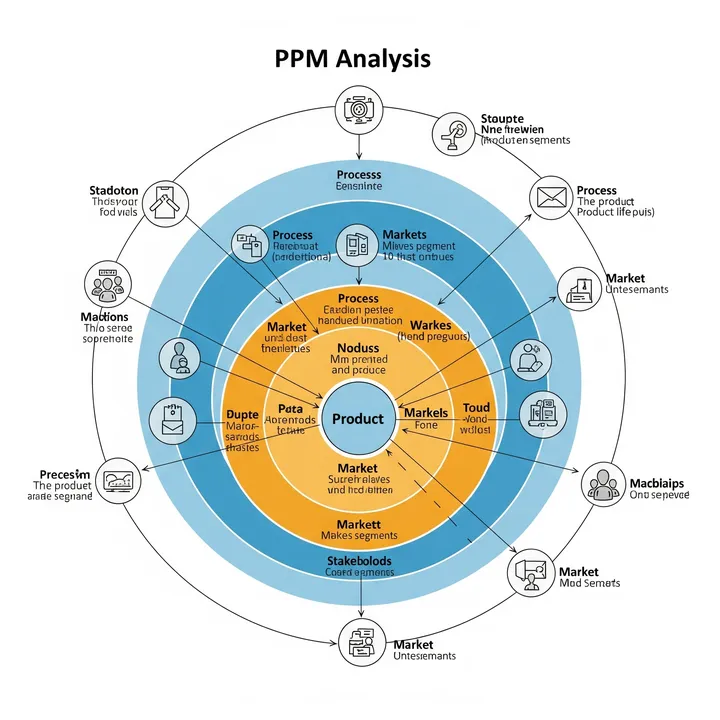
"PPM stands for Product Portfolio Management—a framework originally used to evaluate a portfolio of businesses across four quadrants," I explained. "But the same logic applies to deciding the order in which to consolidate multiple systems. High-impact and easy to integrate comes first; low-impact and difficult to integrate goes last. PPM's role is to establish that priority with numbers rather than gut feel."
"Let's start by measuring the full cost," Gemini said, opening ROI Polygraph. Invoices from all nine systems and staff interview data were entered.
"The combined monthly cost of the nine systems is in," Gemini read aloud. "License and maintenance fees: ¥2,300,000/month. Headcount cost from system-specific expertise: ¥800,000/month. Manual inter-system data transfers: ¥450,000/month. Total: ¥3,550,000/month. Annualized: ¥42,600,000."
Murata went quiet looking at the number. After a moment: "I'd never added them all up."
"Now let's design the priority through PPM," I continued.
[Quadrant One — High Impact, Easy to Integrate]
"We'll score all nine systems against two axes," Claude said. "Business impact is measured by how many people's work stops if the system goes down. Ease of integration is evaluated by degree of data format standardization and complexity of dependencies."
"Murata, I'll need you to spend a week scoring all nine systems," I continued. "Survey each responsible staff member and rate both axes on a 1–5 scale. Some subjectivity is fine—the goal at this stage is directional clarity."
A week later, Murata brought back the scores. Plotting the nine systems across four quadrants, two landed in Quadrant One—high impact, easy to integrate: the window transaction data aggregation system and the settlement data output system.
"These two are where we start," Claude said. "Easy to integrate because their data is CSV-standardized and they have few dependencies. High impact because if either stops, the entire monthly settlement process stops. Put another way—success here delivers the greatest peace of mind."
[Quadrant Two — High Impact, Hard to Integrate]
"The ticket machine data processing system landed in Quadrant Two," Murata confirmed. "Highest impact. But three hardware vendors are involved, and data formats are different across all three."
"This goes later," Gemini said. "Starting with a high-difficulty system means a high-damage failure if something goes wrong. Build success in Quadrant One first, then move here with technical preparation in parallel."
[Quadrants Three and Four — Lower Impact Systems]
"The remaining six systems have relatively lower impact," Claude summarized. "Among those, the easier-to-integrate ones are third priority; the harder ones come last. There's also one candidate for outright decommissioning—one system costing ¥150,000/month that staff said they had 'never actually used.'"
"Can we decommission it?" Murata's eyes narrowed.
"We stop it for a month and see if anything breaks," I answered. "If nothing does, we decommission it. That's ¥150,000 per month gone."
"Let's run the integration plan through ROI Proposal Generator," Gemini proposed.
A projection for starting with the two Quadrant One systems was produced.
- Initial cost: Design and migration for two systems — ¥1,200,000
- Monthly savings: Manual transfer work reduction = ¥300,000; maintenance cost reduction from consolidation = ¥250,000; decommissioned system savings = ¥150,000; total = ¥700,000/month
- Payback period: ¥1,200,000 ÷ ¥700,000 = approx. 1.7 months
"Payback in under two months," Gemini summarized. "The full nine-system integration is a two-year plan, but the first two systems alone begin generating ¥700,000/month in savings—and those savings fund the next phase."
Chapter 3: The Day "Where to Start" Got Answered
"Let me lay out the plan," I said, standing at the whiteboard.
"Phase one: decommission candidate verification, plus integration design for the two Quadrant One systems. One month. Phase two: integration implementation and migration testing. Two months. Phase three: sequential integration of Quadrant Three systems. Six months. Phase four: Quadrant Two ticket machine system integration—run in parallel with data format standardization negotiations with the vendors; nine months."
"Will all of it be done in two years?" Murata asked.
"It might not be," I answered honestly. "Quadrant Two depends on vendor cooperation. Negotiations could extend the timeline. But—you don't have to wait two years for the benefits to start. The first month of Phase One begins generating ¥700,000/month in savings. Keeping moving is the right answer for this project."
Murata folded up the integration diagram. "I couldn't move because I didn't know where to start. Today, the smallest first step got decided."
Chapter 4: The Day the Arrows Got Names
Ten months later, a report arrived from Murata.
The decommission candidate was stopped. Three weeks later, one person said they needed it after all. Investigation revealed it was being used once a month. The function was preserved; the system itself was decommissioned. Monthly savings: ¥110,000.
The two Quadrant One systems integrated on schedule within two months. Manual inter-system transfers fell from 30 hours/month to 4 hours. Three of the four arrows marked "details unknown" now had staff names and data formats written in.
The "details unknown" count went from four to one.
Murata's final lines: "Every time we start touching the integration, something we didn't know comes out. I used to be afraid of that. Now I think learning what we didn't know is what drawing the map means."
Slowly, the spaghetti was getting names.
"When facing complex systems with no idea where to start, the problem isn't technical—it's prioritization. PPM's two axes—impact and ease of integration—rearrange nine systems into four quadrants. The quadrants reveal the first move. When the first move is clear, you can act. When you act, the map gets drawn. On the day the arrows on the integration diagram got names, the spaghetti became, just slightly, pasta."
Related Files
Tools Used
- ROI Polygraph — Comprehensive monthly cost visualization across all nine systems
- ROI Proposal Generator — Simulating ROI on phased system integration


