
ROI Case File No.495 'Who Is Putting What Into Which AI'

Who Is Putting What Into Which AI
Chapter One: The Unmonitored Internal AI Usage
"As a company, we adopted Gemini. But we're hearing from multiple departments that employees are using ChatGPT for work."
Sawako Miyoshi, IT department section manager at Globex Corporation, opened the internal survey results. According to the AI tool usage survey, 42 percent of employees said they use Gemini, 31 percent ChatGPT, 8 percent Claude, and several others. "Tools we haven't officially adopted are being used for work."
"Do you track what's being entered into external AI?" Claude confirmed.
"We don't," Miyoshi answered. "70 percent of survey respondents said they enter 'work-related content.' We haven't gathered specifically what was entered. The possibility of customer information or confidential materials being included can't be denied."
"Why is Gemini usage stalled at 42 percent?" Gemini asked.
"Many say they don't know the features or how to use it," Miyoshi answered. "We held one implementation training and didn't follow up. As a result, some employees flowed to the more familiar ChatGPT. The company wants people to use Gemini, but forcing it would cause backlash. The balance is difficult."
"Before deciding policy, we need to look one level deeper at what's happening," Claude said. "OODA begins with observation."
Chapter Two: OODA Asks About Observation-First Decision Making
"This case requires OODA."
Claude wrote four letters on the whiteboard: O, O, D, A.
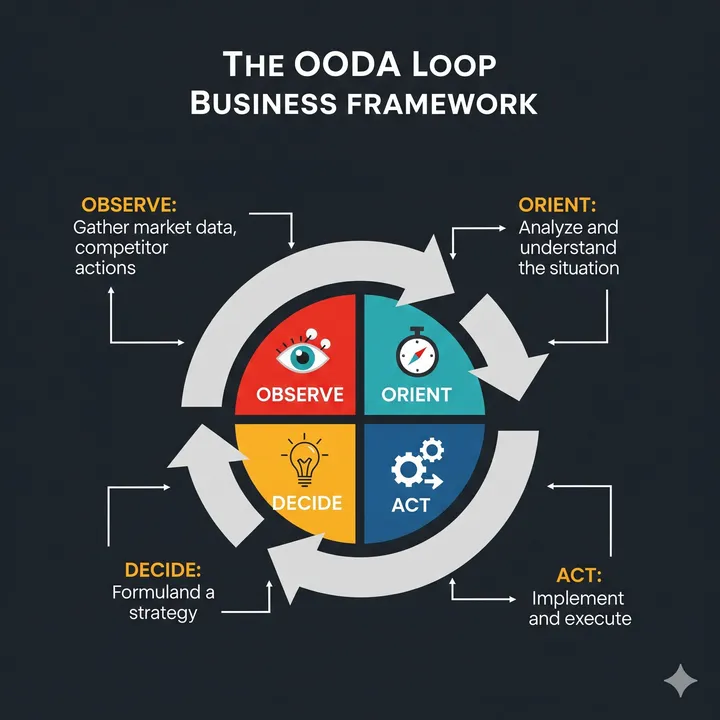
"OODA is a decision-making framework that rapidly cycles through four stages: Observe, Orient, Decide, and Act," I explained. "Where PDCA starts from planning, OODA starts from observation. It suits situations where the environment is fluid and current state grasp is needed before planning. AI tool usage is an area where both market and employee needs change on a monthly basis. Rather than fixing rules upfront, designing to update policy through repeated observation fits better."
"Let's first measure current costs," Gemini said, opening ROI Polygraph. She entered the data Miyoshi had provided.
"Monthly risk and opportunity cost are out," Gemini read. "Risk of confidential information input to external AI tentatively placed at 300,000 yen monthly—the expected value of response cost if a leak occurs. Opportunity cost from low Gemini usage estimated at 600,000 yen monthly—unrecovered return on implementation investment. Workload from inquiries and judgment hesitation due to absent AI usage rules: 40 hours, equaling 128,000 yen. Employee independent AI tool subscription costs averaging 80,000 yen monthly—personal credit card subscriptions and duplicate department-level contracts. Total: 1,108,000 yen monthly. Annualized: approximately 13.3 million yen."
Miyoshi stared at the figures. "Including not just risk expectation but opportunity loss, the scale is different."
"Now let's design with OODA," I continued.
[O—Observe: Observe Reality]
"First, we observe employee AI usage reality," Claude said. "Surveys only show the surface. Conduct department-by-department interviews with representatives, listening specifically about which AI is used for what purpose, and what's being entered. Extract typical patterns from observation."
"How long should the observation period be?" Miyoshi asked.
"Two weeks of intensive work," Gemini answered. "AI usage is a fast-moving area, and a long observation period means the situation will change. Conduct interviews with 30 people across 10 departments × 3 each within two weeks."
[O—Orient: Orient to the Company's Context]
"We map observed data to Globex's context," I continued. "Gathering other companies' AI guideline cases doesn't guarantee fit for your company. Your industry, the confidentiality of information you handle, employee IT literacy, the existing asset of Gemini already implemented—the policy is determined by these combinations."
"How do we narrow the orientation lens?" Miyoshi confirmed.
"Three points," Claude answered. "First, confidential information protection—clarify what shouldn't be entered into external AI. Second, Gemini utilization promotion—recover existing investment. Third, respect for employee autonomy—provide judgment material rather than prohibition. We create a policy that satisfies these three."
[D—Decide: Decide the Guideline Skeleton]
"In the decision stage, we create the guideline skeleton," Gemini continued. "Not as a list of prohibitions, but as a presentation of judgment axes. 'Don't input this information into external AI,' 'Prioritize Gemini for this kind of work,' 'Apply for external AI use in this case'—like a three-color signal, give employees the material to judge for themselves."
"Not a prohibited list?" Miyoshi asked.
"Prohibited lists can't keep up with updates," I answered. "New AI tools come out monthly. If you prohibit by individual tool name, list maintenance can't keep pace. Creating a judgment axis based on information type works longer-term."
[A—Act: Pair Training with Continuous Observation]
"In the execution stage, training and monitoring proceed in parallel," Claude continued. "Simultaneously with guideline publication, conduct department-specific Gemini practical training. Training content is usage demos relevant to each field's work. Not one-off, but monthly. Combined with that, continue quarterly AI usage reality surveys, and update the guidelines."
[Calculating Investment Recovery]
"Let's run the numbers with ROI Proposal Generator," Gemini suggested.
- Initial cost: Observational interviews, guideline development, department-specific training, monitoring foundation construction. Total: 3.8 million yen
- Monthly cost: Continuous training, monitoring operation: 100,000 yen
- Monthly improvement: Confidential information risk reduction = 220,000 yen (resolving 70% of risk expectation), business efficiency from improved Gemini utilization = 420,000 yen (utilization 42% → 70%), reduction in judgment workload from absent AI rules = 100,000 yen, consolidation of duplicate contracts = 70,000 yen. Total: 810,000 yen monthly
- Net monthly improvement: 810,000 − 100,000 = 710,000 yen
- Payback period: 3,800,000 ÷ 710,000 = approximately 5.4 months
"Payback within six months," Gemini summarized. "What matters is that guidelines aren't built once and done. Continuing quarterly observation and updates allows tracking AI market changes. Operating evolving rules rather than fixed rules is the design."
Miyoshi confirmed the figures and said, "Creating the guidelines and stopping there has been our failure pattern. Designing on the premise of continued observation—I'm convinced."
Chapter Three: Provide Judgment Material, Not Prohibition
"Let me organize the approach," I said, standing at the whiteboard.
"Weeks 1–2—Interview 30 people and observe usage reality. Week 3—Organize observation data, extract typical patterns. Week 4—Draft guidelines, executive review. Week 5—Company-wide guideline publication, first round of Gemini utilization training. Weeks 6–12—Sequential rollout of department-specific training. Week 13 onward—Quarterly AI usage reality surveys and guideline update cycle."
"Is monthly training frequency adequate?" Miyoshi confirmed.
"Monthly is sufficient," Claude answered. "However, keep changing the content. Latest Gemini new features, field practical examples, common failures—make each month's training a 'place to learn something new.' Repeating the same content drops attendance."
Miyoshi took notes and said, "AI training isn't something that ends in one session."
Chapter Four: The Day Applications Became a Practice Ground for Judgment
Nine months later, a report arrived from Miyoshi.
The effect of guideline publication and department-specific training raised Gemini utilization from 42 percent to 78 percent. Employees who said they use ChatGPT for work decreased from 31 percent to 8 percent. "The policy of providing judgment material rather than prohibition pushed the migration forward," the report noted.
The biggest change was in the operation of external AI use applications. An average of 15 applications came in monthly, and reviewing the contents showed most were necessary for work. "By looking at the content of applications, we came to understand what the field is asking for," Miyoshi wrote. Applications began functioning as a dialogue ground between employees and the IT department.
Quarterly reality surveys observed one or two new AI tool usages added each time. With each emergence of new tools, the guidelines were fine-tuned. The design of "rules that update rather than fixed rules" produced resilience to market change. "AI tools keep increasing, but the judgment axis doesn't change—the structure became visible," the report noted.
Awareness about confidential information input to external AI also took root. In post-training surveys, 83 percent of employees said they "began judging before inputting business information." Based on risk expectation calculations, an estimated 25,000 yen worth of information leak risk was reduced monthly.
As a secondary effect, examples of business efficiency starting from Gemini began being shared cross-departmentally. Sales department meeting summaries, HR application document organization, legal department contract drafts—concrete examples accumulated on the internal portal, generating organic knowledge sharing. "Sharing among employees themselves takes root faster than teaching through training," Miyoshi wrote.
The end of the report read: "From a policy of enforcing rule compliance to a policy of growing people who can judge. As long as OODA observation continues, the policy doesn't grow stale."
Who is putting what into which AI had become visible.
"AI guidelines aren't something you create once and finish. Fixed rules grow stale in six months. What OODA asks is the resolve to continue observing. By rapidly cycling the four stages of observe, orient, decide, and act, the rules themselves track market change. From the mindset of creating prohibited lists to the mindset of providing judgment material. Guidelines designed on the premise of trusting employees become material for employees to think with themselves, lifting the organization's judgment capacity. The visible state of who is putting what into which AI was achieving both organizational safety and efficiency."
Related Files
Tools Used
- ROI Polygraph — Visualizing AI usage risk, opportunity loss, and judgment workload
- ROI Proposal Generator — Investment recovery simulation for AI guideline operation


