
ROI Case File No.503 'Who Was Fixing the Misaligned Columns in the PDFs?'

Who Was Fixing the Misaligned Columns in the PDFs?
Chapter One: The PDFs Were Slightly Different Each Time
"They're supposed to be the same format, but the columns in the PDFs are subtly misaligned."
Atsushi Shinonome, Design Division Manager at GeoTech Solutions, laid out several geotechnical survey PDFs as he spoke. Depth, N-value, soil classification—the column names were the same, but the column widths and positions on the page differed slightly between survey companies. "We transcribe these into Excel. Either by hand, or by importing through a PDF conversion tool and then cleaning up."
"What conversion tool are you using?" Claude asked.
"iLovePDF," Shinonome answered. "It's free, but accuracy drops when columns are misaligned. We always end up needing time in Excel to fix the output by hand. Thirty minutes to an hour per file. Our design engineers are spending time on something that isn't their actual design work, every day."
"You've adopted a new design method, I understand," I confirmed.
"Six months ago, we switched to a method that loads geotechnical survey data directly into design simulations," Shinonome answered. "The simulation requires clean Excel data. We process about forty survey PDFs a month. At thirty minutes each, that's twenty hours a month, divided across six design engineers—each spends more than three hours a month on PDF cleanup alone."
"Do you have tool candidates?" Gemini asked.
"I've looked into some," Shinonome answered. "But I don't have a basis for judging which one fits our work. Even if I make a performance comparison sheet, there's no deciding factor."
"You don't have a decision axis because you don't have an evaluation framework," I replied. "Let's structure this with 5F."
Chapter Two: 5F Asks—Reading Selection Through Five Forces
"This case calls for 5F."
Claude wrote "5F" on the whiteboard.
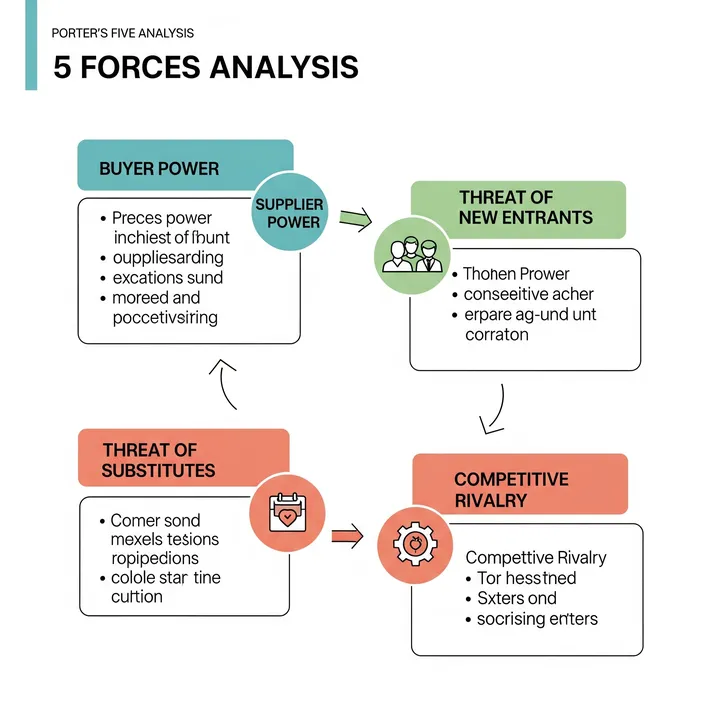
"5F refers to Five Forces—Porter's framework for analyzing the structure of an industry through five forces," I explained. "It was originally a competitive-strategy tool, but it also applies to decision-making like tool selection where you have to choose the best from multiple candidates. In this case, we don't read the five forces as an industry structure but as five evaluation axes a PDF conversion tool faces. Threat of new entrants: accuracy of emerging tools. Threat of substitutes: limits of manual entry and existing tools. Buyer power: strength of the in-house requirements. Supplier power: vendor flexibility. Industry rivalry: competitive landscape across accuracy, cost, and functionality. These five axes give us a decision framework."
"First, let's measure the current cost," Gemini said, opening ROI Polygraph. He input the data Shinonome provided.
"The monthly PDF-processing cost has come out," Gemini read. "Six design engineers' PDF cleanup labor averages 120 hours per month at 4,500 yen per hour, or 540,000 yen monthly. Simulation rerun costs from cleanup errors average 300,000 yen monthly—missed misalignments lead to bad data being loaded and odd simulation results. Opportunity cost from design work blocked while waiting for simulation results averages 200,000 yen monthly. Cleanup work is concentrated in specific individuals, making junior staff onboarding longer—training cost of 100,000 yen monthly. Total: 1.14 million yen monthly. Annualized: approximately 13.6 million yen."
Shinonome stared at the figures. "I had no idea the cost of cleanup errors was this big."
"Now let's design with 5F," I continued.
[F1—Threat of New Entrants: Measuring Emerging Tool Accuracy]
"Over the past two years, there's been a major shift in PDF conversion tools," Claude said. "Tools combining OCR with AI-based structure recognition have emerged. They can interpret a column's meaning by context even when alignment is off. Three vendors look promising. We'll send your actual PDF samples through each one and compare accuracy."
[F2—Threat of Substitutes: Limits of Manual Entry and Existing Tools]
"Manual entry and iLovePDF are the comparison baseline for any new tool," Gemini continued. "Manual entry is 100% accurate but enormously labor-intensive. iLovePDF is fast but low-accuracy. A new tool must aim at speed and accuracy together. Because substitutes exist, the new tool must show clear superiority over them."
[F3—Buyer Power: Clearly Articulating In-House Requirements]
"We document the in-house requirements," I continued. "Geotechnical PDF-specific formatting, frequency of misalignment, required accuracy level, the Excel format the simulation requires—we put all of this into an RFP and send it to the three vendors. The clearer the requirements, the higher the quality of the vendor proposals."
[F4—Supplier Power: Assessing Vendor Flexibility]
"Vendor responsiveness is also an evaluation axis," Claude continued. "Will they support your custom formatting? Does the API integrate with other systems? What's their support like for issues? Beyond price, operational longevity is also a factor."
[F5—Industry Rivalry: A Three-Vendor Total Comparison]
"Finally, we compare the three vendors overall," Gemini continued. "Score them across four items—sample-PDF accuracy, price, support, and integration—and rank them by total. Sample test results carry the most weight."
[Estimating the Payback]
"Let's run it through ROI Proposal Generator," Gemini proposed.
- Initial cost: 1.8 million yen (tool selection project, sample tests, contract, operational design, training for all design engineers)
- Monthly cost: 120,000 yen (selected tool subscription)
- Monthly savings: PDF cleanup reduction = 420,000 yen (80% reduction assumed); cleanup error reduction = 240,000 yen; reduced simulation wait time = 160,000 yen; training cost reduction = 70,000 yen. Total: 890,000 yen monthly
- Net monthly savings: 890,000 − 120,000 = 770,000 yen
- Payback period: 1.8 million yen ÷ 770,000 yen ≈ 2.3 months
"Just over two months for payback," Gemini summarized. "For an improvement to one workflow, that's a short payback. The point is that design engineers can return to their actual design work. Cleanup time was low-value time."
Shinonome looked at the numbers. "Once I structure the selection process with 5F, I feel like we can decide it ourselves."
"Decompose into five forces and you can build a decision axis," I replied.
Chapter Three: A Selection Plan Along Five Axes
"Here's the implementation plan," I said, standing at the whiteboard.
"Week 1: document in-house requirements, select sample PDFs. Weeks 2–3: send RFPs to three vendors and request sample tests. Week 4: receive proposals, compare conversion accuracy on samples. Week 5: four-item scoring, vendor interviews. Week 6: selection and contract. Weeks 7–8: implementation, training for design engineers, parallel running. Week 9: production rollout."
"How many sample tests?" Shinonome confirmed.
"Twenty," Claude replied. "Typical misalignments, special formats, multi-page surveys—we deliberately include a variety. The variations production will throw at the tool should be covered at the selection stage."
Shinonome took notes. "Building a decision axis with 5F when the organization has no experience selecting tools—that's logical."
Chapter Four: The Day Columns Aligned Themselves
Five months later, a report arrived from Shinonome.
Three months after the new tool went live, PDF cleanup labor fell 85% versus baseline. What had taken thirty minutes to an hour per file now took an average of five minutes or less. "The AI structure recognition interprets misaligned columns by context. Manual fix-ups have nearly disappeared," Shinonome wrote.
Simulation reruns due to cleanup errors dropped sharply. From an average of eight per month, the rerun count fell to one. "The tool handles the formatting, so there's no space for human error to enter," the report said.
The most surprising change appeared in the engineers' time allocation. The three-plus hours per person per month that had been lost to PDF cleanup compressed to under twenty minutes per month. That freed time went to deeper simulation work and site-level design discussions. "Change one tool, and the quality of the work changes," Shinonome wrote.
As a side effect, the junior-engineer development process changed. Previously, "learn PDF cleanup before moving to actual design" had been a stage in onboarding; with the cleanup task gone, juniors could touch design simulations earlier. "Time to productivity is shorter," the report said.
The tool-selection expertise also accumulated. The selection framework structured with 5F was reused in subsequent system selections. "Build a decision axis once, and the next selection moves faster," Shinonome wrote.
The final line of the report read: "Before comparing tools, building the decision axis mattered. The moment we broke it down with 5F, what to look at was decided. The quality of tool selection is decided in the process before you select."
The day no one was hand-fixing misaligned columns in PDFs was the day designers got their real work back, the report said.
"Tool selection looks like comparing tools, but it's the design of decision axes. Without one, no comparison sheet produces a conclusion. 5F asks for structural decomposition through five forces. New entrants, substitutes, buyers, suppliers, industry rivalry—view tools along each, and fit to your situation becomes visible. The process of someone hand-fixing every misaligned PDF wasn't a cleanup problem—it was a selection problem. The day aligned columns became ordinary, what had disappeared wasn't time but the delay in deciding."
Related Files
Tools Used
- ROI Polygraph — Visualizing PDF cleanup labor, cleanup errors, and simulation wait time
- ROI Proposal Generator — Payback simulation for PDF conversion tool selection


