
ROI Case File No.504 'Why Wedding Inventory Was Locked on Paper'

Why Wedding Inventory Was Locked on Paper
Chapter One: Locking on Paper Was Preventing Tampering
"We record the expected inventory on paper. So it can't be altered."
Misa Tominaga, Finance and Accounting Director at OpulentWeddings, held up a stack of inventory sheets. Handwritten items and quantities. "Dresses are managed by RFID, so they're fine. The problem is everything else—accessories, props, food, beverages. All visual counts."
"Why on paper?" Claude asked.
"Internal controls," Tominaga answered. "For audit purposes, we need to show that the entered values can't be rewritten later. Paper is filled in and signed on the spot. With electronic data, even with logs, there are situations where it lands in a gray area. That's why systemization stalled."
"What does the count workload look like?" I asked.
"240 hours per month across all locations," Tominaga answered. "Eight branches nationally, three staff each spending half a day counting, transcribing to paper, then double-entering to Excel—the same numbers written three times. Inventory counts happen frequently: monthly, year-end, and pre-ceremony. Back-office productivity is a company-wide priority, but this area has been untouched."
"How many SKUs besides dresses?" Gemini asked.
"About 600 accessories, 200 props, and an average of 400 SKUs for food and beverages with seasonal variation," Tominaga answered. "Over 1,200 SKUs managed through paper and Excel."
"You need a structure that reconciles internal control with efficiency," I replied. "Let's rebuild it from external forces with PEST."
Chapter Two: PEST Asks—Four External Pressures
"This case calls for PEST."
Claude wrote four letters on the whiteboard. P, E, S, T.
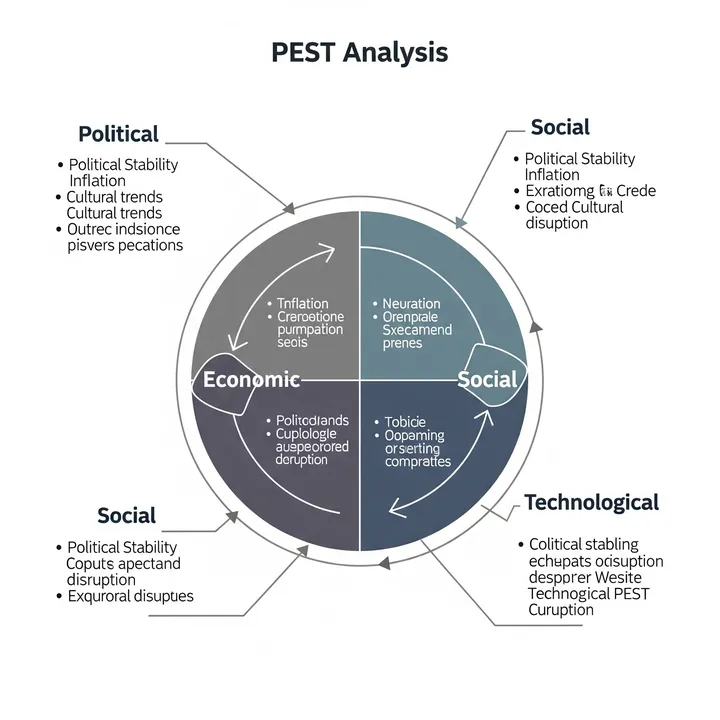
"PEST analyzes the environment through four external factors: Politics, Economy, Society, and Technology," I explained. "It's a strategic framework, but it's also valuable for selecting operational systems. The system you choose reflects external demands—regulatory requirements, economic rationality, social expectations, and technology trends. Designing solely from internal considerations leads to obsolescence in two or three years."
"First, let's measure the current cost," Gemini said, opening ROI Polygraph. He input the inventory data Tominaga provided.
"The monthly inventory-count cost has come out," Gemini read. "Total count labor across eight branches is 240 hours per month at 3,000 yen per hour, or 720,000 yen monthly. Re-entry labor—writing the same numbers to paper and Excel—averages 80 hours per month, or 240,000 yen monthly. Discrepancy investigation labor when inventory differences arise averages 100 hours per month, or 300,000 yen monthly. Overtime pay for emergency counts before ceremonies averages 180,000 yen monthly. Dead stock—small props held in long-term storage without use—costs 120,000 yen monthly. Total: 1.56 million yen monthly. Annualized: approximately 18.7 million yen."
Tominaga looked at the figures. "Including dead stock, it's larger than I expected."
"Now let's design with PEST," I continued.
[P—Political: What Regulation and Control Require]
"First, the political and regulatory perspective," Claude said. "Internal control reporting, accounting audits, tax investigations—every scenario demands tamper-resistant inventory records. As a replacement for paper, the system must offer blockchain-style log management or strict separation of editing permissions. We need to technically guarantee that records cannot be rewritten after the fact."
[E—Economic: Investment Efficiency and Operational Continuity]
"From an economic standpoint, operating cost matters more than initial cost," Gemini continued. "Inventory counts are monthly. Over a year, labor outweighs system costs. Choosing a slightly more expensive system with RFID or handheld-scanner support pays off in long-term economic rationality. Many accessories have high per-unit cost, so the loss-prevention effect is also relevant."
[S—Social: The Wedding Industry's Particular Characteristics]
"On the social side, wedding industry specifics," I continued. "Last-minute operations before ceremonies, peaks and lulls, per-customer customization—the system must accommodate all of this. Generic retail inventory systems don't fit cleanly. We prioritize vendors with implementation experience in the wedding industry."
[T—Technological: Combining RFID and Handhelds]
"On the technology side, we decide whether to extend the dress RFID to accessories or to use handheld scanners," Claude continued. "Accessories number in the hundreds and are small. RFID-tagging all of them isn't cost-justified. Combining barcode labels with handheld scanners shifts visual counting to automated counting. Food handling is connected with a separate expiration-date management system."
[Estimating the Payback]
"Let's run it through ROI Proposal Generator," Gemini proposed.
- Initial cost: 6.2 million yen (inventory management system, barcode label printing, handheld scanners across eight branches, food expiration-date integration, edit-permission log foundation, training across all branches)
- Monthly cost: 180,000 yen (system subscription)
- Monthly savings: count labor reduction = 480,000 yen (70% reduction assumed); double-entry reduction = 220,000 yen; discrepancy investigation reduction = 200,000 yen; overtime reduction = 120,000 yen; early dead stock detection = 80,000 yen. Total: 1.1 million yen monthly
- Net monthly savings: 1.1 million − 180,000 = 920,000 yen
- Payback period: 6.2 million yen ÷ 920,000 yen ≈ 6.7 months
"Just over half a year for payback," Gemini summarized. "Once tamper resistance is technically guaranteed, the rationale for paper disappears. The alternative—partially systemizing while keeping paper—should be avoided. Halfway dual operation inherits the weaknesses of both."
Tominaga looked at the numbers. "I never considered replacing the reasons for paper with technology."
"PEST is also a method for tracing why current operations exist back to external forces," I replied.
Chapter Three: A Staged Rollout Across Eight Branches
"Here's the implementation plan," I said, standing at the whiteboard.
"Months 1–2: select the system, run a PoC, agree on internal control requirements. Month 3: design barcode label printing, prepare the item master. Month 4: pilot at one branch, handheld scanner training. Month 5: adjust based on pilot results, add two more branches. Months 6–7: staged rollout to the remaining five branches. Month 8: production rollout to all branches, retire the paper process."
"Not all branches at once but staged?" Tominaga confirmed.
"Each of the eight branches has its own operational quirks," Claude replied. "Piloting one branch lets us understand actual run patterns and adjust the system before rolling out, raising adoption. Simultaneous rollout to all eight carries too much risk."
Tominaga took notes. "Being able to frame 'replace the paper lock with technology' is the major shift."
Chapter Four: The Day the Stack of Paper Disappeared at Audit
Nine months later, a report arrived from Tominaga.
Two months after full rollout, count labor fell 73% versus baseline. From 240 hours per month to 65. "Scanning barcodes with a handheld finishes the job. Both paper transcription and double Excel entry are gone," Tominaga wrote.
The internal control perspective drew even higher praise than expected. During the accounting audit, presenting the edit-permission logs led auditors to judge tamper resistance as higher than paper. "Paper relies on trusting human signatures. System logs technically prevent rewrites. The auditor said this is preferable to paper," the report said.
The most surprising change appeared in the structure of inventory discrepancies. The number of discrepancies fell, but more importantly, root-cause tracing accelerated dramatically. Scan history and logs reveal when, who, where, and what was scanned. "Before, when discrepancies appeared, we couldn't find the cause and just reconciled. Now we can identify root causes," Tominaga wrote.
Dead stock detection also advanced. Accessories not scanned for long periods are auto-extracted in the monthly report. About seventy small props that hadn't moved in six months were cleared. "Items we'd been holding as inventory but had stopped using became visible," the report said.
As a side effect, new-staff training time shortened. Inventory work used to take months to learn; with a handheld, it's a day. "Operations are no longer person-dependent," Tominaga wrote.
The final line of the report read: "The paper process had a value I had believed only paper could safeguard. Decomposed with PEST, every part of that value could be replaced with technology. What constrained our thinking wasn't the process itself but our failure to reexamine the reasons behind it."
The day the stack of paper disappeared from audit materials, efficiency and control coexisted, the report said.
"Operational system selection isn't decided by internal factors alone. Regulatory requirements, economic rationality, social expectations, technology trends—four external forces shape system requirements. PEST asks what the structure looks like from the outside. Inventory once locked on paper can now be made tamper-resistant by technology. Wedding-industry specifics cannot be absorbed by generic systems. Using RFID and barcodes selectively is matching technology to the characteristics of the items. The day the stack of paper disappeared at audit, what disappeared wasn't paper but the reason for paper."
Related Files
Tools Used
- ROI Polygraph — Visualizing count labor, discrepancy investigation, and dead stock costs
- ROI Proposal Generator — Payback simulation for inventory management system across eight branches


