
ROI Case File No.520: The Day the Custodian Left, the Supplies Vanished

The day the custodian left, the supplies vanished
Chapter 1: Six Months Since the Custodian Left
"Six months have passed since the supplies management custodian left. No one has picked up the role."
Kana Kabashima, General Affairs Manager at InnoWare, said this as she walked through the supplies storage. Stationery, PC peripherals, guest supplies, machines for internal lending—types and storage locations were diverse. "The previous custodian managed everything in his head. Where things were, who borrowed what, when to reorder. With his departure, that knowledge disappeared."
"What's the current operation?" Claude asked.
"Three general affairs staff handle it ad hoc," Kabashima replied. "Daily inquiries of 'where is that supply' come in. We walk through storage to visually confirm. If inventory is out, we hurriedly reorder. We have no means to confirm whether borrowed items have been returned. Thirty percent of working hours disappears into supplies-related inquiries."
"And during busy seasons?" I asked.
"Catastrophic," Kabashima answered. "Inquiries triple during fiscal close or company-wide events. Other general affairs work suffers. The preparations for accepting next year's new graduates—work that should command focus—gets pushed back. We want to systematize but don't know where to start."
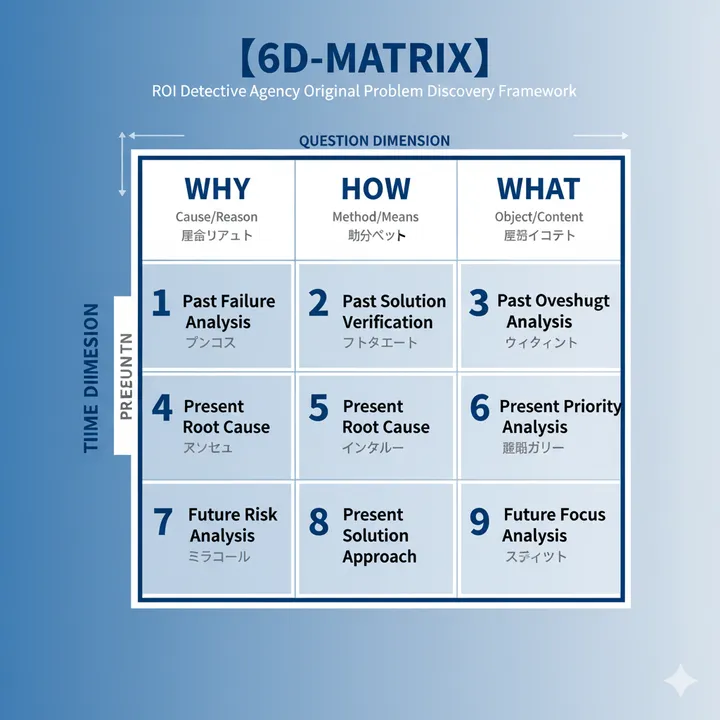
"Sounds like a need to organize across present, future, and past in all directions," I responded. "Let's break it down with 6D_MATRIX."
Chapter 2: 6D_MATRIX Asks to Render the Present in Six Dimensions
"This case calls for 6D_MATRIX."
Claude wrote six elements on the whiteboard. Current, Future, Past, Why, How, What.
"6D_MATRIX is a framework that analyzes a target in three dimensions across six axes: current, future, past, why, how, and what," I explained. "Beyond comparing current problems with future ideal states, you also include past context, causal structure, implementation means, and the target itself—organized multidimensionally. Rebuilding operations whose functions disappeared due to personalization needs this kind of three-dimensional view."
"Let's measure current costs first," Gemini said, opening ROI Polygraph. Kabashima's data went in.
"Monthly supplies management costs are out," Gemini read. "Three general affairs staff's supplies inquiry response and visual inventory confirmation labor averages 300 hours monthly at 3,200 yen/hour, or 960,000 yen/month. Order losses from stockouts or overstock average 400,000 yen/month—emergency reorders for stockouts, stagnant inventory from over-purchases. Cost of borrowed items going missing and being repurchased averages 300,000 yen/month. Opportunity loss from delays in general affairs' core work averages 600,000 yen/month—the impact of other work stopping due to supplies response. Bottleneck cost from inadequate response capacity during busy seasons averages 500,000 yen/month. Expected-value risk of personalized management recurring averages 200,000 yen/month—the dependence risk if a custodian is placed again. Total: 2.96 million yen/month. Annualized: roughly 35.5 million yen."
Kabashima looked at the numbers. "I'd thought it was just three general affairs staff's labor. Including delays in core work, the scale is different."
"Now let's design with 6D_MATRIX," I continued.
[Current — What's happening now]
"First, the current dimension," Claude said. "Management functions lost with the custodian's departure. Inventory by visual confirmation, borrowing without records, ad hoc ordering, verbal inquiry handling. Three general affairs staff spend 30% of working hours on supplies response. A structure where personalized management has fallen into dysfunction."
[Future — The ideal state]
"Next, the future dimension," Gemini continued. "A state where inventory levels, borrowing status, and ordering timing are visualized on the system in real time. Inquiries close in self-service confirmation; general affairs staff focus on judgment work. A structure where management runs not on personal memory but on organizational mechanism. That's the destination."
[Past — Why did it become this way]
"The past dimension," I continued. "The previous custodian ran the work with his own management know-how for over ten years. It was rational for him, but it wasn't documented or standardized. Because it functioned for so long, no one felt the need to standardize. A handover document wasn't prepared at departure. The very period during which personalization functioned dulled sensitivity to personalization risk."
[Why — The essence of the cause]
"The Why dimension," Claude continued. "The root cause of personalization being left in place is that management work was an 'invisible job.' From leadership's perspective, supplies management was 'a job that just needs to run,' and investment in systematization was postponed. The problem surfaced the moment the custodian left."
[How — Solution means]
"The How dimension," Gemini continued. "Cloud-based supplies management system introduction, QR code labeling for location management, automated reorder threshold alerts, digitized lending workflow, and embedding a self-service confirmation screen in the company portal. A design that replaces personal memory with rules and data on a system."
[What — Clarifying the target]
"Finally, the What dimension," I continued. "Define management targets explicitly. Consumables like stationery, long-use items like PC peripherals, lending supplies, guest supplies—management rules differ per category. Manage everything in the same system, but set rules per category. The source of confusion is ambiguity over 'what to manage.'"
[Combining six dimensions into a total design]
"Combining the six dimensions makes this a structural rebuild rather than fragmented initiatives," I continued. "Understand the past causes of personalization, then transform the current dysfunction into the future ideal. Clarify means and targets. That's the essence of 6D_MATRIX."
[Estimating investment recovery]
"Let's run ROI Proposal Generator," Gemini proposed.
- Initial cost: Supplies management system, QR code labeling, reorder alert configuration, lending workflow, portal integration, data migration, and field training: 4.8 million yen total
- Monthly cost: System usage and ongoing operation: 180,000 yen/month combined
- Monthly savings: Inquiry response labor reduction = 670,000 yen/month (70% reduction assumed), order-loss reduction = 280,000 yen/month, lending-loss reduction = 220,000 yen/month, recovery of core general affairs work = 420,000 yen/month, busy-season response capacity = 350,000 yen/month, personalization risk resolution = 150,000 yen/month. Total: 2.09 million yen/month
- Net monthly savings: 2.09 million yen − 180,000 yen = 1.91 million yen/month
- Payback period: 4.8 million yen ÷ 1.91 million yen = approximately 2.5 months
"Under three months," Gemini summarized. "Particularly large are inquiry response labor reduction and recovery of core general affairs work. The effect of working hours that had vanished into supplies response returning to focus work is large."
Kabashima checked the numbers. "I'd assumed a simple system-introduction conversation. Organized through 6D_MATRIX, a design that doesn't repeat past personalization is built in."
"6D_MATRIX is a tool for three-dimensional design that includes recurrence prevention," I responded.
Chapter 3: An Introduction Plan Built in Six Dimensions
"Let's lay out the path," I said at the whiteboard.
"Weeks 1–2: Inventory supplies categories; define management rules; verify past personalization factors. Weeks 3–4: Select the system; design QR code operation. Weeks 5–8: Configure the system, initial data registration, build the lending workflow. Week 9: Embed in the company portal; publish the self-service confirmation screen. Week 10: Pilot operation, gather feedback from three general affairs staff. Weeks 11–12: Company-wide rollout, internal announcement, training video distribution. Week 13 onward: Continuous optimization of reorder thresholds and refinement of operational rules from accumulated data."
"Cloud or on-prem?" Kabashima asked.
"Cloud, with no hesitation," Claude responded. "Owning the operational foundation in-house means that operation also gets personalized. Adopt a cloud service and focus internally on operational rules and data management. A structural choice that prevents personalization."
Kabashima took notes. "The idea of 'a design that doesn't repeat the same mistake' came from the Past dimension in 6D_MATRIX. Without looking at the past, you misjudge the future."
Chapter 4: Anyone Can Answer Where the Supplies Are
Nine months later, Kabashima's report arrived.
Supplies-related inquiries, three months after the system went live, were down 76% versus prior. Employees themselves could confirm inventory and locations on the portal, and confirmation calls and emails to general affairs nearly disappeared. "The 30% of working hours consumed by inquiry response dropped below 10%," Kabashima wrote.
The biggest change showed up in the recovery of general affairs' core work. New graduate intake preparation, in-house event operations, benefits review—core work that had been pushed back could now receive time investment. "General affairs staff began saying 'we can use time on forward-looking work now.' This is tied directly to morale," the report noted.
Personalization resolution was also realized. Supplies management knowledge was replaced by rules and data on the system, becoming a structure not dependent on any individual's memory. "Even if the next custodian rotates, operations don't stop. That's real risk resolution," Kabashima wrote.
Response capacity in busy seasons also improved substantially. The systematized operation handled the increase in supplies inquiries during fiscal close and company-wide events stably. "Fiscal close general affairs didn't panic for the first time in ten years," the report noted.
A side effect: discussions of supply optimization began. From the accumulated usage data, unused supplies, insufficient supplies, and supplies that could be shared became visible. "Annual supplies costs were compressed by about 4 million yen through data-driven review. Not adding inventory but optimizing was the change," Kabashima wrote.
Lending management changed dramatically too. Who borrowed what and when became viewable on screen, and automatic return-deadline reminders functioned. "'I don't know who I lent it to' completely disappeared. You can reserve supplies with the same feel as a conference room," the report noted.
A wave effect reached leadership too. As a success case of general affairs operational improvement, it was shared internally and accelerated the kickoff of personalization-resolution projects in other departments. "Accounting, legal, HR—every department has personalized work hiding. The general affairs case became the starting point for finding and resolving them," Kabashima wrote.
At the end of the report, Kabashima wrote: "I'd thought the custodian's departure was the problem. After 6D_MATRIX decomposition, I learned the problem lay in the organizational culture that tolerated personalization. A design that doesn't repeat the same mistake comes from designing the future after understanding the past structure."
The organization in which supplies locations existed only inside one person's head changed into an organization where they were visible on screen, and on that day, the departed custodian's desk was truly handed over to the next generation, she wrote.
"Personalization isn't a problem while it functions. The problem strikes the moment that function is lost. 6D_MATRIX asks for more than comparison of current and future. The past structure, the essence of the cause, implementation means, and clarification of the target—a three-dimensional view across six dimensions. Designs that don't repeat the same mistake are born from drawing the future after understanding the past. On the day management functions that disappeared the moment a custodian left were rebuilt as an organizational mechanism, what changed wasn't supplies management—it was the very culture that tolerated personalization."
Related Files
Tools Used
- ROI Polygraph — Visualizing inquiry response labor, core work delay cost, and personalization risk
- ROI Proposal Generator — Investment recovery simulation for a six-dimensional rebuild of supplies management


