
ROI Case File No.524: A Floor Told Only to 'Bring In AI'

A Floor Told Only to 'Bring In AI'
Chapter 1: No One Can Say What to Do
"A company-wide directive came down to advance DX and utilize AI. But the floor has no idea what to do."
Ryuji Unoki, corporate planning department manager at TechConstruct, said this while showing the company-wide policy material. A mid-sized firm in the construction industry. Top management had set DX promotion and AI utilization as company policy. "We've already brought in general-purpose AI tools. But tools specialized for field work like road paving—those aren't deployed. The top says, 'Don't fall behind other companies; bring me innovative proposals.' But no one knows what the field actually needs."
"Are problems coming up from the field?" Claude asked.
"That's just it—they don't come up," Unoki answered. "When we ask the field, the answer comes back, 'we're getting by with our current way.' Concrete needs aren't put into words. Meanwhile, management says, 'we expect proposals we couldn't have thought of ourselves.' Expectations run ahead, with no substance."
"Do you have enough information on what's possible with the latest AI?" I confirmed.
"We don't," Unoki answered. "We have no material for judging what the latest technology can do and how it applies to our own operations. Deploying tools has become an end in itself, and what problem they solve is left blank. In this state, even if we hear a vendor's proposal, we have no axis for evaluating it."
"If the problem can't be seen, you need to dig into why it can't be seen," I responded. "Let's descend to the true cause with 5WHYS."
Chapter 2: 5WHYS Asks 'Why' Five Times Over
"This case needs 5WHYS."
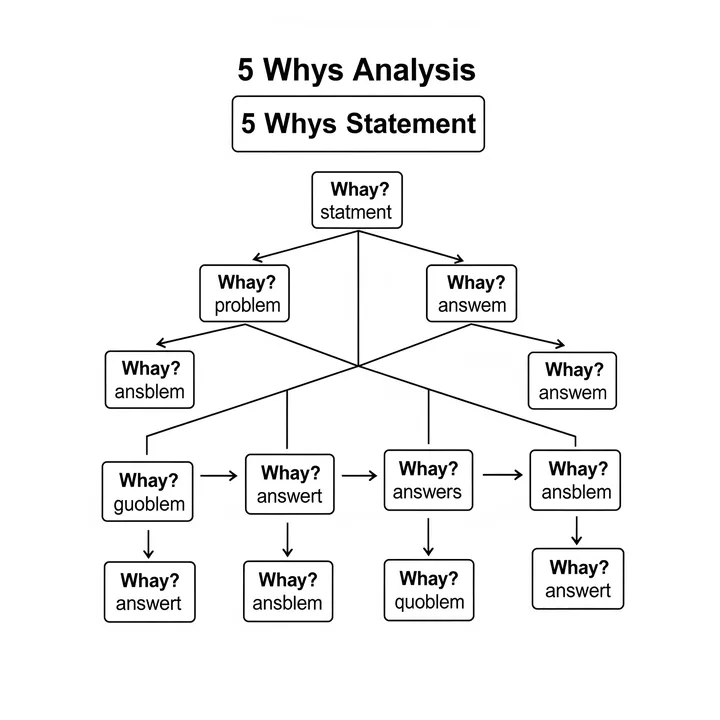
Claude wrote "Why?" five times down the whiteboard.
"5WHYS—the five-whys analysis—is a technique originating in the Toyota Production System, a framework that reaches the true cause by stacking 'why' five times on a single event," I explained. "If you put a countermeasure on the surface problem but the true cause remains, it recurs. Before the countermeasure of 'bring in AI,' we dig five levels into 'why can't the problem be seen.' The real reason construction DX doesn't advance turns out not to be a shortage of directives."
"First, let's measure the current cost," Gemini said, opening ROI Polygraph. He entered the data Unoki had provided.
"The monthly opportunity-loss cost came out," Gemini read aloud. "The labor of inefficient field work left un-digitized averages 420 hours a month; at an hourly rate of 4,200 yen, that's 1,764,000 yen a month. The corporate-planning labor spent spinning its wheels with no settled measures, because the DX policy is idling, averages 180 hours a month, or 900,000 yen. The wasted cost of trial-deploying tools with unclear purpose only to have them go unused averages 700,000 yen a month. The opportunity loss of falling behind competitors' DX progress averages 600,000 yen a month. The cost of stalled improvement from field needs going unverbalized averages 500,000 yen a month. The total is 4,464,000 yen a month. Annualized, that's about 53.56 million yen."
Unoki stared at the figures. "I had no idea even the corporate-planning labor of spinning our wheels would become a number. And the waste of purpose-unclear tool deployment—that certainly was happening."
"Then let's dig for the true cause with 5WHYS," I continued.
[The First Why—Why Is Company-Wide DX Promotion Necessary?]
"The first why," Claude said. "'Why promote DX?' The answer: 'to avoid falling behind other companies.' If you stop here, the goal becomes chasing competitors, severed from your own problems."
[The Second Why—Why Is Falling Behind a Problem?]
"The second level," Gemini continued. "'Why is falling behind other companies a problem?' The answer: 'because market competitiveness declines and customer satisfaction drops.' The abstract word 'competitiveness' appears, but we haven't yet descended to concrete operations."
[The Third Why—Why Does Competitiveness Decline?]
"The third level," I continued. "'Why does competitiveness decline?' The answer: 'because we can't utilize the latest technology, and field efficiency doesn't advance.' Here, for the first time, the problem links to field efficiency."
[The Fourth Why—Why Can't We Utilize the Latest Technology?]
"The fourth level," Claude continued. "'Why can't we utilize the latest technology?' The answer: 'because the concrete operational problems are unclear, and we don't know how to apply the technology.' The reason it won't advance despite the directive shows its face here."
[The Fifth Why—Why Are the Operational Problems Unclear?]
"The fifth level, the true cause," Gemini continued. "'Why are the operational problems unclear?' The answer: 'because no mechanism exists to draw up feedback from the field.' The true cause that DX doesn't advance turns out to be not a shortage of AI tools but the absence of a structural mechanism to gather the field's voice."
[The Move Against the True Cause—Before Deploying Tools, a Mechanism to Gather Voices]
"Once the true cause is clear, the move changes," I continued. "We don't bring in specialized AI right away. First we build a mechanism to gather field feedback. At a road-paving site, we draw up by data where time is consumed and where there's hesitation in judgment. Only against the gathered needs do we then apply specialized tools. The order had been reversed."
[Estimating the Investment Recovery]
"Let's estimate with ROI Proposal Generator," Gemini proposed.
- Initial cost: Building the field-feedback collection mechanism, a needs-visualization platform, specialized-AI-tool selection support, pilot deployment, and field training—7,400,000 yen total
- Monthly cost: Mechanism operation plus tool-usage ongoing cost—280,000 yen a month combined
- Monthly reduction effect: Labor reduction from digitizing field work = 1,020,000 yen a month (the effect of specialized deployment after needs are identified), elimination of corporate-planning wheel-spinning = 560,000 yen a month, reduction of purpose-unclear deployment waste = 600,000 yen a month, elimination of stalled improvement = 400,000 yen a month—2,580,000 yen a month total
- Monthly net reduction: 2,580,000 yen − 280,000 yen = 2,300,000 yen a month
- Payback period: 7,400,000 yen ÷ 2,300,000 yen = about 3.2 months
"Recovery in a little over three months," Gemini summarized. "What matters is that the first thing we invest in is not specialized AI but a mechanism to gather the field's voice. Because we invest in the true cause, the subsequent tool deployment is structured to always hit the mark. The waste of deploying with unclear purpose only to have it go unused disappears."
Unoki confirmed the figures and said, "Against the directive 'bring in AI,' I was searching for AI. When I dug five whys, what we should have been searching for was not AI but a mechanism to gather the field's voice."
"5WHYS is a tool for not mistaking where to apply the countermeasure," I responded.
Chapter 3: A Plan to Gather Voices First, Then Apply Tools
"Let me organize how we'll proceed," I said, standing before the whiteboard.
"Months one and two—building the field-feedback collection mechanism and beginning to draw up voices at major sites such as road paving. Month three—structuring the gathered needs and identifying priority problems. Month four—selecting specialized AI tools for the identified problems and evaluating vendor proposals. Months five and six—pilot deployment at high-priority sites and effect verification. Month seven—company-wide rollout from the areas that produced results. Month eight onward—making the feedback loop permanent and continuously drawing up and improving field needs."
"I think top management will demand AI-deployment results right away, though," Unoki confirmed.
"That's exactly why we should keep the order," Claude responded. "If you skip the true cause and bring in specialized AI, it won't mesh with field needs and won't be used. That's the structure that produced the waste of past trial deployments. If you gather voices first and then apply, the deployed tool will definitely be used. It looks like a detour, but this is the shortest path."
Taking notes, Unoki said, "Why, five times. It's simple, but I didn't expect the disconnect between the directive and the field to become this vivid."
Chapter 4: The Day the Field's Voice Became the Blueprint
Nine months later, a report arrived from Unoki.
Three months after the field-feedback mechanism went live, needs that had never been verbalized began pouring in. "From a field that had said 'we're getting by with our current way,' over a hundred concrete problems came up. There was simply no mechanism for how to ask; the dissatisfaction had existed all along," Unoki wrote.
The specialized AI tool deployment also hit the mark. Because we applied tools narrowly to the high-priority areas among the gathered needs, the adoption rate was high. "Before, we deployed with unclear purpose and it went unused. Now we deploy what the field says, 'this is what I wanted.' The usage rate is completely different," the report said.
The biggest change appeared in the relationship between management and the field. The disconnect of the top's abstract directive and the field's silence was bridged through data. "In management meetings, instead of 'do something with AI,' we can now have the concrete discussion of 'apply this tool to this field problem,'" Unoki wrote.
Corporate planning's wheel-spinning was also resolved. The labor of just producing materials with no settled measures shifted to execution based on clear needs. "Meetings that merely rephrased the policy disappeared. Because the moves are concrete, planning moves forward," the report said.
As a secondary effect, the field's initiative rose. Through the experience of their own voices leading to tool deployment, the field began putting forward improvement proposals. "It shifted from forced-on-us DX to our own DX. That was the biggest gain," Unoki wrote.
The lag behind competitors also substantially narrowed. Instead of wasting time on off-target deployments, resources could be concentrated on measures that work. "Counterintuitively, progress is faster than when we anxiously brought in anything and everything. That was the effect of investing in the true cause," the report said.
At the end of Unoki's report, he had written: "I was trying to respond to the directive 'bring in AI' by searching for AI. When I stacked five whys, I learned that what was truly lacking was a mechanism to gather the field's voice. Put a countermeasure on a surface instruction, and you'll always miss the mark."
It was recorded that the day a floor told only to 'bring in AI' turned its own voice into a blueprint, DX changed from a directive into field-born improvement.
"Many consultations about DX not advancing have mistaken where to apply the countermeasure. The directive exists but nothing moves; tools get deployed but go unused—because countermeasures are stacked on the surface problem. What 5WHYS asks is the true cause beyond stacking 'why' five times. Behind 'bring in AI' was a structure where problems weren't verbalized, and behind that was the absence of a mechanism to gather the field's voice. Invest in the true cause you dig out, and the subsequent moves always hit the mark. The day a floor told only to bring in AI turned its own voice into a blueprint, what changed was not the deployed tool but the very place where the countermeasure was applied."
Related Files
Tools Used
- ROI Polygraph — Visualizing field inefficiency labor, policy wheel-spinning cost, and purpose-unclear deployment waste
- ROI Proposal Generator — Investment-recovery simulation for true-cause-rooted DX promotion


