
ROI Case File No.535: The Production Floor on Paper Only Spoke Yesterday's Numbers
The Production Floor on Paper Only Spoke Yesterday's Numbers
Chapter 1: For Two Years, Productivity Improvement Has Ended at a Rallying Cry
"We want to raise factory productivity. It's been a management priority for two years, but the floor doesn't move."
Toshio Oikawa, manufacturing director at TechSolutions, spoke while showing photos of the floor. "The president has directed company-wide productivity improvement. But almost no improvement proposals come from the floor. Data visualization hasn't advanced, either."
"How do you manage the floor's data?" Claude asked.
"On paper," Oikawa answered. "Production results are recorded on paper and aggregated later. So in real time we know nothing. Building materials for results analysis and investment decisions is always behind. Yesterday's numbers only become clear today."
"What about the floor's mindset?" I confirmed.
"Honestly, low," Oikawa answered. "Resistance to changing operations is strong. 'We get by with the current way.' Only the rallying cry comes down from above, and the floor doesn't move. I feel we need both data visualization and a mindset shift."
"Rallying cries don't move people. Let's sort out, together with the floor, what to keep, what's a problem, and what to try," I responded. "Let's loop it with KPT."
Chapter 2: KPT Asks for Keep, Problem, and Try
"This case needs KPT."
Claude wrote "K・P・T" on the whiteboard.
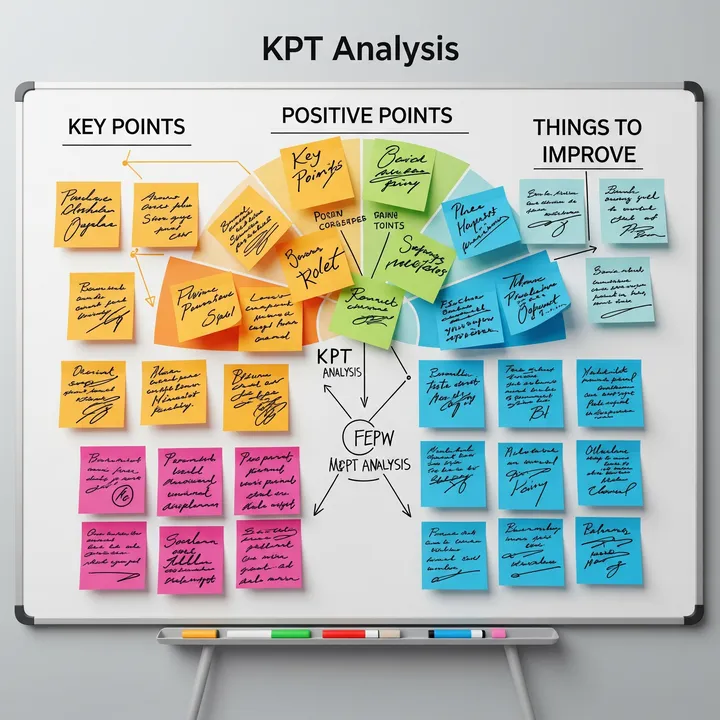
"KPT is a framework for reflecting through three things—Keep, Problem, and Try," I explained. "It's used in agile-development retrospectives, but it's strong for floor improvement. Rallying cries don't move people, but acknowledge 'what's going well now,' surface 'what's troubling us' in the floor's own words, and decide together 'what to try next,' and the floor becomes the owner. It's a tool for turning made-to-do improvement into our-own improvement."
"Let's measure the current cost first," Gemini said, opening ROI Polygraph and entering the data Oikawa had provided.
"The monthly productivity-loss cost is in," Gemini read out. "Results aggregation and document creation under paper operations averages 260 hours a month; at ¥3,800 an hour, that's ¥988,000 a month. Production loss from the inability to grasp things in real time averages ¥850,000 a month. The opportunity loss of stagnation where no improvement proposals come averages ¥600,000 a month. Opportunity loss from delayed investment decisions averages ¥450,000 a month. The expected value of key-person risk in floor know-how averages ¥500,000 a month. The total is ¥3,388,000 a month—roughly ¥40.66 million a year."
Oikawa stared at the figures. "I thought it was only the labor of paper aggregation. Monetize the production loss from delayed grasp and the stagnation of no proposals, and the weight of two years left to a rallying cry becomes visible."
"Then let's design it with KPT," I continued.
[Keep—Acknowledge What's Going Well Now]
"First, we pick up the Keeps," Claude said. "Thorough quality control, the fact that the president's directive has the whole company sharing the issue—we acknowledge what's going well now. Open with problems straight away and the floor braces. Acknowledge what should be kept first, and the floor takes its seat at the discussion. This is KPT's entrance."
[Problem—Surface the Troubles in the Floor's Own Words]
"Next, we surface the Problems," Gemini continued. "Data isn't visible in real time, improvement awareness is low, resistance to operational change is strong—we have the floor surface its troubles in its own words. Not the problems set by the top, but the problems the floor feels. A problem surfaced in the owner's own words connects to the motive to solve it."
[Try—Decide Together What to Try Next]
"We match the problems with things to try," I continued. "Adopting IoT devices and the cloud to realize real-time data management. An employee education program to raise awareness. Rather than ordering this from above, we decide the Try together with the floor as a response to the Problem. Once the thing-to-try becomes their own proposal, resistance turns into cooperation."
[Keep It Looping—Make the Retrospective a Regular Event]
"Finally, we make KPT a regular event," Claude continued. "Not run once and done; we reflect the result of Try into the next Keep and Problem and keep it looping. Visualized data becomes material for the retrospective. We embed an improvement cycle the floor runs itself—not a rallying cry."
[Estimating the Payback]
"Let's run the numbers with ROI Proposal Generator," Gemini proposed.
- Initial cost: IoT device deployment, building a cloud visualization base, automating data collection, and an employee education program—¥7.8 million total
- Monthly cost: base operation and device maintenance combined—¥300,000 a month
- Monthly savings: aggregation and document-creation hours cut = ¥740,000 a month (assuming 75% reduction); production loss cut = ¥580,000 a month; improvement-proposal stagnation resolved = ¥400,000 a month; investment decisions accelerated = ¥320,000 a month—¥2,040,000 a month total
- Net monthly savings: ¥2,040,000 − ¥300,000 = ¥1,740,000 a month
- Payback period: ¥7.8 million ÷ ¥1,740,000 = about 4.5 months
"Payback in four and a half months," Gemini summarized. "What makes it work is not separating visualization from the mindset shift. Just visualizing data won't move the floor. Because KPT has the floor surface problems in its own words and decide what to try together, the visualized data actually gets used. Moving the tool and the mindset at the same time is the key."
Oikawa said as he checked the figures, "I thought it would move if I kept issuing the rallying cry. Have the floor surface problems in its own words, and decide what to try together. The order was backward."
"KPT is a tool for turning made-to-do improvement into our-own improvement," I responded.
Chapter 3: A Rollout Plan the Floor Runs
"Let me lay out the approach," I said, standing at the whiteboard.
"Month one—run a KPT retrospective with the floor; confirm Keeps and extract Problems. Month two—design the Tries and select the IoT/cloud visualization base. Months three and four—build the base and automate data collection. Month five—pilot on a portion of the lines and start the employee education program. Month six—verify effect and make the KPT retrospective a regular event. Month seven onward—roll out to all lines, keep the retrospective cycle running, and accumulate floor-originated improvement proposals."
"Will the floor really start making proposals?" Oikawa confirmed.
"It will," Claude responded. "Proposals don't come not because the floor's drive is low. It's because there's no place to surface problems and no felt sense that it leads to a measure. Once the floor learns through KPT that its own words connect to things-to-try, it speaks up. Visualized data becomes the basis for proposals. Mindset changes not by a rallying cry but by a mechanism."
Oikawa said as he took notes, "I finally understand why it didn't move for two years."
Chapter 4: The Day the Floor Started Speaking in Its Own Numbers
Nine months later, a report arrived from Oikawa.
Three months after the visualization base went live, paper aggregation work was down 75% versus before. "Results became visible in real time. The behind-the-curve work of aggregating yesterday's numbers today disappeared," Oikawa wrote.
Production loss dropped too. With data visible on the spot, response to anomalies quickened. "Before, we noticed a problem the next day. Now we know on the spot. Acting got faster," the report said.
The biggest change showed up in the floor's mindset. Improvement proposals started coming, and the rallying cry turned into ownership. "A floor that did things 'because we were told' started saying 'I want to raise this number.' Learning through KPT that their own words become a measure was what worked," Oikawa wrote.
Investment decisions quickened too. The visualized data became the basis for judgment. "Materials for results analysis come out right away. Investment decisions stopped falling behind," the report said.
As a side effect, floor know-how became visible. Veterans' experience linked to data, and key-person dependency eased. "The parts that ran on 'that person's intuition' can now be explained in numbers," Oikawa wrote.
At the end of Oikawa's report, he had written this: "For two years I kept issuing the rallying cry and it didn't move. The cause wasn't the floor's drive but the absence of a place to surface problems. The moment KPT picked up the floor's words, the floor became the owner. Productivity isn't something that rises by command—it rises when the floor runs it itself."
The day a production floor that only spoke yesterday's numbers on paper became one where the floor itself speaks in its own numbers, productivity improvement had turned from a rallying cry from above into a retrospective the floor runs, the report read.
"Many companies see productivity improvement end at a rallying cry. The top directs, the floor doesn't move, and the data stays on paper speaking yesterday's numbers. The cause isn't the floor's low drive. It's the absence of a place to surface problems in one's own words, and of the felt sense that it leads to a measure. What KPT asks for is Keep, Problem, and Try. Acknowledge what's going well, pick up the troubles in the floor's words, and decide what to try together. The day a floor that only spoke yesterday's numbers started speaking in its own, what changed was not the visualization tool but the very perspective that hands improvement to the floor's hands."
Related Files
Tools Used
- ROI Polygraph — Visualizing paper-aggregation hours, production loss, and the opportunity loss of stalled improvement proposals
- ROI Proposal Generator — Payback simulation for floor-participatory visualization and a mindset shift


