
ROI Case File No.539: The More Convenient the AI, the More It Carried Secrets Outside

The More Convenient the AI, the More It Carried Secrets Outside
Chapter 1: The More We Use It, the More Data Goes Outside
"We want to deploy an AI-agent tool company-wide. But we're stuck on balancing business efficiency with data security."
Maki Azumi, in the management division at TechNova, explained the situation as she spoke. "Our parent company changed, and we're reviewing the back-office structure. We're already trialing another tool on thirty accounts, but we want to look for a better option."
"What's the problem with the current use?" Claude asked.
"It's per-individual use," Azumi answered. "Employees each use AI tools on their own. It's convenient, but when entering confidential information they redact it by hand every time. It's laborious. And with a general-purpose web service, the risk of data leaking outside is high. The more convenient the tool, the more it carries secrets outside."
"What's the issue for company-wide deployment?" I confirmed.
"We've reached the stage of going from individual use to company-wide," Azumi answered. "But take efficiency and safety is at risk; take safety and efficiency drops. It's this squeeze. Data migration between systems is manual too, and minutes formats are all over the place. The path to safe, efficient company-wide use isn't visible."
"You need to map the experience of how each employee uses the AI," I responded. "Let's break it down with JOURNEY."
Chapter 2: JOURNEY Asks Where the Usage Experience Trips Up
"This case needs JOURNEY."
Claude drew a path flowing left to right on the whiteboard.
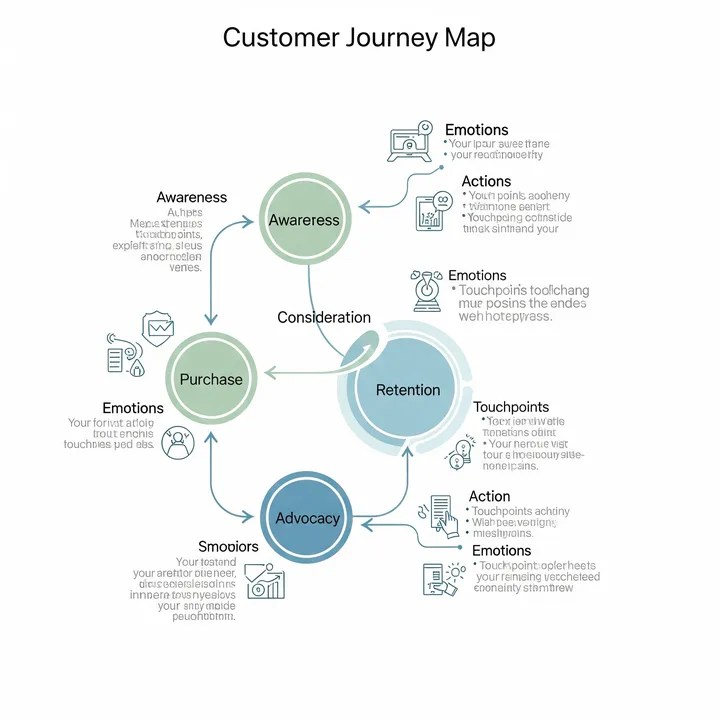
"JOURNEY is a framework that maps the experience from when a user touches a tool through putting it to work, as one continuous path, and visualizes where it trips up," I explained. "It's known as the customer journey, but it works for internal-tool deployment too. Rather than lumping 'company-wide deployment' together, you capture by stage where—in the path of an employee touching AI, entering data, and using the result—the redaction labor and leak risk arise. It's a tool for designing by the flow of experience, not by points."
"Let's measure the current cost first," Gemini said, opening ROI Polygraph and entering the data Azumi had provided.
"The monthly back-office cost is in," Gemini read out. "Manual data redaction averages 170 hours a month; at ¥4,000 an hour, that's ¥680,000 a month. Inefficiency from the duplication and non-standardization of per-individual AI use averages ¥550,000 a month. The expected value of data-leak risk from general-purpose web-service use averages ¥700,000 a month. Manual data migration between systems averages ¥450,000 a month. Rework from inconsistent formats for minutes and the like averages ¥320,000 a month. The total is ¥2,700,000 a month—roughly ¥32.4 million a year."
Azumi stared at the figures. "I thought it was only the labor of redaction. Add the leak risk and the inefficiency of everyone using it separately, and it comes to this much."
"Then let's design it with JOURNEY," I continued.
[Visualizing the Current Journey—Where Does It Trip Up]
"First, we map today's usage experience as a path," Claude said. "An employee opens the tool, redacts the confidential parts and enters them, receives the result, and uses it in their work. Trace this path and you see the redaction labor and leak risk concentrate at the 'input' stage. We pinpoint the stage where the tripping occurs, by the flow of experience."
[Requirements Definition—Set the Point Where Safety and Efficiency Coexist]
"Next, we define the requirements," Gemini continued. "At the 'input' stage that trips up most, to remove the redaction labor while preventing leaks, you need a closed environment where data doesn't go outside. Rather than giving up either safety or efficiency, we derive the requirements where both stand, from the path of experience."
[Tool Selection—Choose the Path That Fits the Requirements]
"We choose a tool that fits the requirements," I continued. "From the market's AI-agent tools, we select several that run in a closed environment and coexist with business efficiency. We compare with the tool trialed on thirty accounts. We choose by the criterion of whether it improves the path of experience. Not by abundance of features but by whether it erases the tripping."
[Migration Plan—Spread the Path Company-Wide]
"Finally, the migration plan," Claude continued. "From individual use to company-wide, we plan it including data migration and security measures. Not a wholesale switch but stage by stage, from the departments with the biggest tripping. We shape the path of the usage experience into a form that can be safely reproduced company-wide."
[Estimating the Payback]
"Let's run the numbers with ROI Proposal Generator," Gemini proposed.
- Initial cost: building a closed-environment AI-agent base, company-wide requirements definition, data migration, security design, and training—¥6.6 million total
- Monthly cost: base operation, licenses, and ongoing updates combined—¥320,000 a month
- Monthly savings: redaction hours cut = ¥540,000 a month (assuming 80% reduction); duplication and non-standardization resolved = ¥420,000 a month; leak risk reduced = ¥520,000 a month; data-migration hours cut = ¥340,000 a month—¥1,820,000 a month total
- Net monthly savings: ¥1,820,000 − ¥320,000 = ¥1,500,000 a month
- Payback period: ¥6.6 million ÷ ¥1,500,000 = about 4.4 months
"Payback in just under four and a half months," Gemini summarized. "What makes it work is making redaction itself unnecessary with a closed environment. If data doesn't go outside, there's no need to redact by hand every time. The labor for safety is erased by a safe environment. We solve the efficiency-safety trade-off through environment design."
Azumi said as she checked the figures, "I thought it was efficiency or safety, a binary choice. Seen by the path of the usage experience, change the input stage and both stand. The squeeze is solved."
"JOURNEY is a tool for finding the tripping in the usage experience by the path," I responded.
Chapter 3: A Rollout Plan That Spreads the Path Company-Wide
"Let me lay out the approach," I said, standing at the whiteboard.
"Month one—visualize the current usage-experience journey and pinpoint the tripping stage. Month two—define requirements that make safety and efficiency coexist. Month three—select a closed-environment AI tool and compare with the trialed tool. Months four and five—build the base, design security, and draft the data-migration plan. Month six—pilot in the department with the biggest tripping. Month seven onward—stage-wise company-wide rollout, unify minutes formats, and keep improving the usage journey."
"Is it all right not to switch the whole company at once?" Azumi confirmed.
"Stage by stage is safer," Claude responded. "Switch the whole company at once and the tripping erupts all at once. Because the path of the usage experience pinpoints 'which department's which stage is heavy,' we can move the heavy departments in order. Just after a parent-company change and a structural review, all the more reason to go stage by stage. Because the path is visible, we can choose the order."
Azumi said as she took notes, "I'd been agonizing over the efficiency-safety squeeze. Seen by the flow of experience, there was a way to solve it."
Chapter 4: The Day Secrets Stopped Going Outside
Nine months later, a report arrived from Azumi.
Three months after migrating to the closed environment, manual data redaction was down 80% versus before. "Because it's an environment where data doesn't go outside, there's no need to redact by hand every time. The very labor for safety disappeared," Azumi wrote.
Data-leak risk dropped sharply too. Entering confidentials into general-purpose web services stopped. "The structure where the more convenient the tool, the more it carried secrets outside, is gone. We can use it with peace of mind," the report said.
The biggest change showed up in the relationship between efficiency and safety. What had been a trade-off turned into coexistence. "We escaped the squeeze of 'take efficiency and safety is at risk.' Make it a closed environment, and the safer way was also the more efficient," Azumi wrote.
The non-standardization of individual use was resolved too. The scattered ways of using it were standardized company-wide. "The ways each employee improvised became a common form. Duplication and waste decreased," the report said.
As a side effect, material to explain to the parent company emerged. Putting a safe structure in place became a result of the structural review. "We built a structure where we can show the parent company 'we use it safely company-wide.' Within the structural review, this was a major result," Azumi wrote.
At the end of Azumi's report, she had written this: "I'd thought in the binary of efficiency or safety. But seen by the path of the usage experience, the tripping concentrated at the single 'input' stage. The moment we pinpointed that stage with JOURNEY and changed the whole environment, the squeeze was solved. Even what looks like a trade-off can coexist once recaptured by the flow of experience."
The day a company where the more convenient the AI, the more it carried secrets outside became one that makes work efficient without letting secrets out, AI use had turned from a tug-of-war with safety into work advancing along a safe path, the report read.
"AI-use consultations almost always carry the 'efficiency or safety' squeeze. Take efficiency and secrets go outside; take safety and labor increases. But is this trade-off truly a binary? What JOURNEY asks is the path of experience from when a user touches a tool through putting it to work. Visualize where the tripping arises, and you see the squeeze concentrate at a single stage. The day a company where the more convenient the AI carried out the more secrets could make work efficient safely, what changed was not the AI tool but the very perspective that recaptures a trade-off by the flow of experience."
Related Files
Tools Used
- ROI Polygraph — Visualizing redaction hours, data-leak risk, and the inefficiency of individual use
- ROI Proposal Generator — Payback simulation for company-wide AI-tool deployment starting from the usage-experience journey


