
ROI Case File No.541: The Floor's 'We're Struggling' Never Reached the Board Room

The Floor's "We're Struggling" Never Reached the Board Room
Chapter 1: The Need for DX Stopped at the Floor
"We want to push DX forward, but we can't get the company to agree on where to even start."
Tatsuhiko Washio, head of the business planning office at TechnoGlobal, said this as he spread out his materials. A manufacturing trading company founded in 1971. "We started with wholesaling screws, and now we span three business divisions—daily goods and nursing care, automotive-related, and an environmental newspaper—plus an overseas division. Each department is considering its own system independently, and it's all scattered."
"Does the floor feel DX is necessary?" Claude asked.
"They do," Washio answered. "Entry omissions, missed orders and missed order-taking—human error happens constantly, and the floor is exhausted. But management's priority is sales and profit, and the investment decision for DX never moves forward. The floor's 'we're struggling' never reaches the board room."
"Have you ever put the floor's pain into a form management can understand?" I confirmed.
"No," Washio answered. "The floor says 'it's hard,' and management replies 'so how much money will it make?' The conversation never connects, and it's been stalled for years."
"If the floor's pain doesn't reach management, then we first have to empathize with that pain and turn it into words and numbers," I responded. "Let's break this down with design thinking."
Chapter 2: What DESIGN_THINKING Asks—A Design That Begins With Empathy for the Floor
"This case needs DESIGN_THINKING."
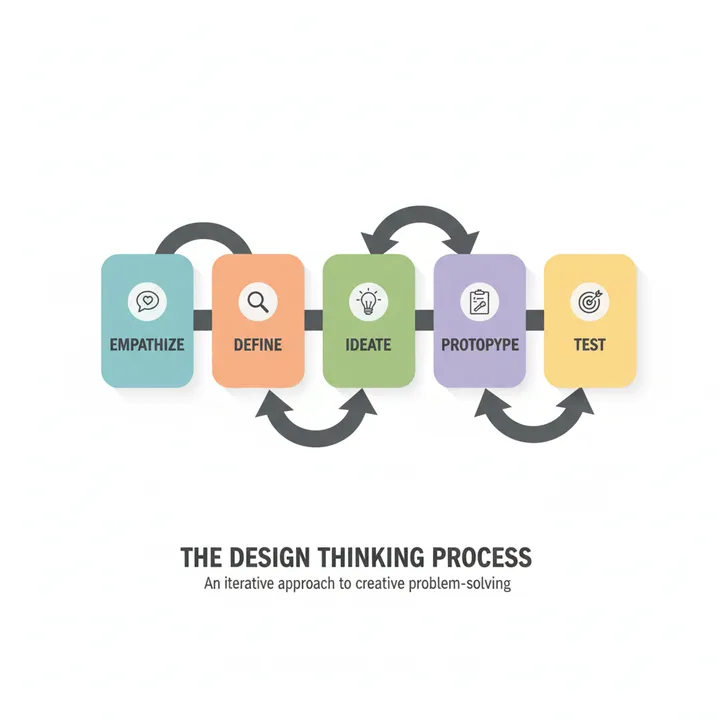
Claude wrote on the whiteboard: "Empathize, Define, Ideate, Prototype, Test."
"DESIGN_THINKING is a framework that builds solutions from the reality of the people who use them, across five stages: empathize, define, ideate, prototype, and test," I explained. "The crux is in that first stage, 'empathize.' You thoroughly observe what the floor is struggling with before you define the problem. Management can't act on DX because the floor's pain stays an abstract slogan. Start from empathy, and the pain turns into material for an investment decision."
"First, let's measure the current cost," Gemini said, opening the ROI Polygraph. He entered the data Washio had provided.
"The monthly cost is in," Gemini read out. "Inefficient labor from personnel-dependent handovers and the absence of standardization: 240 hours per month on average, at ¥4,000 per hour, ¥960,000 per month. Rework and losses from human error such as entry omissions and missed orders: ¥550,000 per month on average. Redundant maintenance and rework from systems fragmented by department and not interconnected: ¥420,000 per month on average. Wheel-spinning measures from the absence of DX priorities and the shortage of decision-making material: ¥500,000 per month on average. Opportunity loss from recruiting difficulty and lower retention caused by an outdated operational culture: ¥650,000 per month on average. A total of ¥3,080,000 per month. Annualized, about ¥36,960,000."
Washio stared at the figures. "What the floor could only call 'it's hard' comes to over ¥36 million. Turn the pain into a monetary amount, and it becomes language that passes in the board room."
"Now, let's design with DESIGN_THINKING," I continued.
[Empathize—Stick to the Floor's Daily Work]
"First, we attach ourselves to the floor and the managers of each division and observe," Claude said. "Where do they forget to enter data, where do orders slip through? Not through interviews—we trace the workflow and watch where the pain originates. Empathy isn't sympathy; it's observation that pinpoints the origin of the pain."
[Define—Narrow the Pain Into a Single Problem Statement]
"Next, we define the observed pain as a problem," Gemini continued. "'Lack of operational standardization,' 'personnel dependency,' 'system fragmentation by department'—we bundle the scattered pain into a single question to be solved. Leave the definition vague, and the solution scatters too."
[Ideate—Widen the Range of Solutions]
"For the defined problem, we generate solution candidates broadly," I continued. "A company-wide end-to-end operations system, automated checks that stop human error, DX education for management—generate breadth, not quality. We can narrow later, so we don't choose at this stage."
[Prototype—Build Small and Show It]
"We give shape to the promising solutions through prototypes," Claude continued. "We build a simplified version of an inter-departmental linkage system and a prototype checklist function. Not a finished product, but the smallest form the floor can touch. We show management the solution to the pain with something that moves, not a blueprint."
[Test—Run It in One Department and Verify]
"Finally, we run a trial in one department and verify," Gemini continued. "We measure the effect and feed the floor's reaction back into the next prototype. The numbers from the test become the final material that convinces management to roll it out company-wide."
[Calculating the Investment Recovery]
"Let's run the estimate with the ROI Proposal Generator," Gemini proposed.
- Initial cost: Floor-empathy research, problem definition, company-wide operations system prototype, automated check function build, and company-wide training—¥7,200,000 total
- Monthly cost: System operation and ongoing update fees combined, ¥280,000 per month
- Monthly reduction effect: Standardization of personnel-dependent work = ¥670,000 per month (assuming 70% reduction), human-error loss reduction = ¥440,000 per month, resolution of redundant maintenance and non-linkage = ¥420,000 per month, recruiting and retention improvement effect = ¥400,000 per month, totaling ¥1,930,000 per month
- Net monthly reduction: ¥1,930,000 − ¥280,000 = ¥1,650,000 per month
- Payback period: ¥7,200,000 ÷ ¥1,650,000 = approximately 4.4 months
"Recovery in just under four and a half months," Gemini summarized. "What works is that we don't build a company-wide system right away—we prototype starting from the origin of the pain that empathy identified. Show the effect of a prototype the floor can touch in numbers, and even management that prioritized sales can make the DX investment decision. Because we start from empathy, the investment doesn't miss."
Washio confirmed the figures. "The floor's pain and management's judgment were in separate languages. Start from empathy and turn it into numbers, and they sit on the same desk."
"DESIGN_THINKING is a tool that translates the floor's pain into management's language," I responded.
Chapter 3: A Deployment Plan Built Up From Empathy
"Let me organize the approach," I said, standing at the whiteboard.
"Months one and two—on-site observation of each division and pinpointing the origin of the pain, the empathy phase. Month three—defining the problem and fixing the question to be solved. Month four—ideation and prioritization. Months five and six—prototyping the inter-departmental linkage system and the automated check function. Month seven—trial operation in one department, effect verification, and reporting to management. Month eight onward—company-wide rollout based on the verification results, and expansion to the overseas division."
"Will management really move?" Washio confirmed.
"They will," Claude responded. "Management doesn't move because DX is abstract. Show the pain that empathy identified through the numbers of the prototype and trial operation. Present it as 'we can erase this pain, with this investment, in this period,' and the more management prioritizes sales, the faster the investment decision. We move them not with slogans but with verified numbers."
Washio said, taking notes, "We never had the sequence of beginning by empathizing with the floor. See the pain first, then define it, and the solution doesn't waver."
Chapter 4: The Day the Floor's Pain Became a Board Room Agenda Item
Nine months later, a report arrived from Washio.
The work that had been personnel-dependent saw standardization advance after the prototype system was rolled out company-wide. "Work that stalled with every handover became a procedure anyone can run. The tightrope walk of nothing moving without a specific person has eased," Washio wrote.
Human error also dropped sharply. The automated check function stopped entry omissions and missed orders before they happened. "Mistakes we'd prevented by 'people being careful' now stop by mechanism. The tension on the floor has eased," the report read.
The biggest change appeared in management's attitude. From a state where DX was placed below sales, it rose to an investment-decision agenda item. "When we showed the pain gathered through empathy in the numbers of the prototype, the air in the board room changed. 'So how much money will it make?' became 'which pain do we erase first?'" Washio wrote.
The wheel-spinning of measures was resolved too. DX, which had stalled with no decision on where to start, began moving with priorities attached. "DX that was stalled on slogans alone began moving in the order of empathy and definition," the report read.
As a secondary effect, the recruiting picture changed. With the outdated operational culture improved, the appeal to the next generation shifted. "We can now say 'we're a company that runs on mechanisms.' Young employees have started to stay," Washio wrote.
At the end of Washio's report it said: "The floor's pain, left as a sentiment, never reached management. The moment we began from empathy with design thinking, defined the pain, and turned it into the numbers of a prototype, it became a board room agenda item. Pain becomes investment only once it is translated."
The day a company whose "we're struggling" never reached the board room became a company that could turn pain into an investment decision, DX promotion had changed from a matter waiting beneath sales into a design built up from empathy as its starting point, the report noted.
"Companies where DX stalls share something in common. The floor's pain and management's judgment are spoken in separate languages. The floor says 'it's hard,' and management replies 'how much will it make?' What DESIGN_THINKING asks is a design that begins with empathy for the people who use it. Observe the origin of the pain, define it as a problem, show it with a prototype, and verify it. The day a company whose 'we're struggling' never reached the board room could turn pain into investment, what changed was not the DX tool but the very perspective that translates pain into management's language."
Related Files
Tools Used
- ROI Polygraph — Visualizing personnel-dependent labor, human-error loss, and wheel-spinning-measure cost
- ROI Proposal Generator — Investment-recovery simulation for empathy-rooted DX promotion


