
ROI Case File No.553: 'We Couldn't Tell Whether a Paper Asset Would Become a Weapon in Digital'
We Couldn't Tell Whether a Paper Asset Would Become a Weapon in Digital
Chapter 1: We Turn Paper into Digital, But Can We Win?
"We want to build a mobile app that turns our paper catalog into a digital one."
Takashi Makishima, marketing director at Globex Corporation, described his situation as he spoke. "But not just turning paper into digital. We want to keep the feel of flipping pages while adding digital convenience. We want to create a new purchasing experience."
"Why move now?" Claude asked.
"Because the risk of paper is rising," Makishima answered. "Commercial paper prices have spiked because of the situation in the Middle East, and supply is unstable. And a paper catalog can only be updated once a year. Even when prices or product information change, we can't fix it right away. Digital solves that."
"Will the catalog data and content your company has built over the years become a strength in digital, too?" I asked, to confirm.
"...That's where I can't be sure," Makishima answered. "The paper asset is certainly there. But will it become a weapon in digital? Won't competitors simply copy it the moment we make it, and that's the end? I can't tell whether it's worth investing in."
"We have to judge whether the paper asset becomes a weapon," I replied. "Let's break it down with VRIO."
Chapter 2: VRIO Asks—Value, Rarity, Imitability, Organization
"This case calls for VRIO."
Claude wrote "Value, Rarity, Imitability, Organization" on the whiteboard.
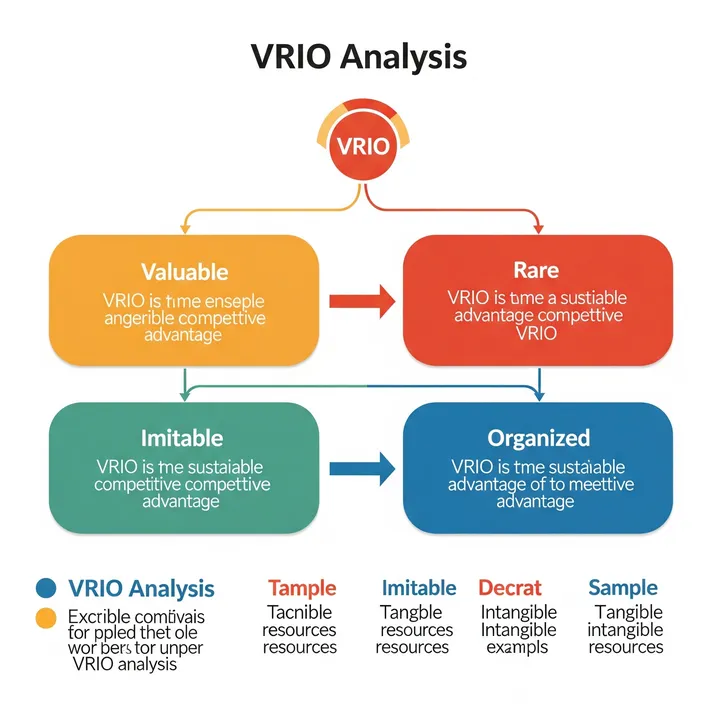
"VRIO—Value, Rarity, Imitability, Organization—is a framework for judging, through four questions, whether your own asset truly becomes a competitive advantage," I explained. "The key is passing through the four in order. There is value, it is rare, it is hard to imitate, and there is an organization that can use it—only when all four are satisfied does it become a lasting weapon. If even one is missing, the investment ends as a momentary advantage."
"Let's measure the current cost first," Gemini said, opening ROI Polygraph, and entered the data Makishima had provided.
"The monthly cost is in," Gemini read out. "The once-a-year paper-catalog production and proofreading hours convert to about 160 hours a month; at ¥4,000 an hour, that's ¥640,000 a month. Increased procurement cost from spiking and unstable commercial-paper supply averages ¥520,000 a month. Lost sales opportunity from being unable to respond promptly to price and product information because updates happen only once a year averages ¥480,000 a month. Information inconsistency and inquiry handling from the fragmentation across three media—paper, EC, and PDF—average ¥340,000 a month. Lost opportunity from missing younger customers due to the absence of a digital experience averages ¥360,000 a month. The total is ¥2,340,000 a month—roughly ¥28.08 million a year."
Makishima stared at the figures. "I thought it was just the production cost. Once you include the risk of paper and the cost of not being able to respond promptly, I never imagined it would be this much."
"Then let's design it with VRIO," I continued.
[Value—Confirm the value for the customer]
"First, we confirm the value of digitization," Claude said. "We can update prices and product information in real time and always deliver the latest to customers. The freshness that the once-a-year paper never delivered—this is the value for the customer."
[Rarity—Judge whether it is an experience the market lacks]
"Next, we judge the rarity," Gemini continued. "Keep the feel of flipping pages while adding digital convenience. It's neither mere PDF conversion nor just an EC site. This experience is scarce in the market—it has rarity."
[Imitability—Confirm how hard it is to imitate]
"After rarity, we confirm how hard it is to imitate," I continued. "A high-quality user experience that reproduces the feel of flipping requires accumulated technology and know-how. It can't be imitated overnight. The paper asset your company has built over the years works here."
[Organization—Ask whether there is a structure to use it]
"Finally, we ask about the organization that can use it," Claude continued. "Your company has a structure to reuse its existing catalog data and content. Rather than leaving the asset dormant, you convert it into a digital experience and keep it running. Because the organization is in place, the Value, Rarity, and Imitability persist."
[Estimating the payback]
"Let's run the numbers with ROI Proposal Generator," Gemini proposed.
- Initial cost: Mobile app development (page-flip experience UI), an existing-catalog-data utilization base, a real-time update feature, and three-media integration—¥6,300,000 total
- Monthly cost: App operations and ongoing update fees combined—¥260,000 a month
- Monthly savings: Paper production and procurement cost reduced = ¥580,000 a month; opportunity recovered by resolving the inability to respond promptly = ¥420,000 a month; inconsistency eliminated by integrating three media = ¥320,000 a month; effect of capturing younger customers = ¥340,000 a month; ¥1,660,000 a month total
- Net monthly savings: ¥1,660,000 − ¥260,000 = ¥1,400,000 a month
- Payback period: ¥6,300,000 ÷ ¥1,400,000 = about 4.5 months
"Payback in four and a half months," Gemini summarized. "What works is not merely digitizing but turning the paper asset into a weapon. Because it satisfies all four—Value, Rarity, Imitability, Organization—competitors can't simply copy it. It becomes a lasting advantage rather than a momentary trend, so the investment doesn't whiff."
Makishima said, checking the figures, "I'd only thought of turning paper into digital. Pass it through the four questions and you see that the paper asset becomes a weapon in digital."
"VRIO is the tool that judges whether an asset becomes a weapon," I replied.
Chapter 3: A Rollout Plan That Passes Through the Four Questions
"Let me lay out the approach," I said, standing at the whiteboard.
"Month 1—inventory the existing catalog assets and judge their Value and Rarity. Month 2—confirm Imitability and fix the core of differentiation. Months 3–4—develop the page-flip experience UI and the real-time update feature. Month 5—build the three-media integration and the existing-data utilization base. Month 6—pilot release and effect verification. Month 7 onward—deployment to both older and younger demographics, and settling in product-information operations."
"Will it really be safe from being copied by competitors?" Makishima asked, to confirm.
"It will hold up," Claude replied. "Getting copied and ending there happens because you build with value alone. With VRIO, we've confirmed Rarity and Imitability and put in place the organization that uses it. For competitors, rebuilding your company's paper asset from scratch takes time. A weapon that satisfies all four isn't easily caught up to."
Makishima said, taking notes, "Before digitizing, ask whether it becomes a weapon. I can see the order now."
Chapter 4: The Day a Dormant Asset Became a Weapon
Ten months later, a report arrived from Makishima.
The paper catalog data came alive after migration to the digital app. "Information we could only put out once a year can now be updated in real time. We can respond to price changes the same day," Makishima had written.
The procurement risk of paper dropped, too. As the weight shifted to digital, the impact of the paper price spike eased. "Being jerked around by paper prices went down. The tightrope of delayed publication due to supply anxiety disappeared," the report said.
The biggest change appeared in how the asset was seen. The paper accumulation we'd thought of as a cost turned into a weapon. "I'd felt the years of paper catalogs were like a liability. Passed through VRIO, it turned out to be an asset that's hard to imitate. What was dormant became a weapon," Makishima had written.
The customer base widened, too. Keeping the feel of flipping pages kept older customers from leaving, while digital convenience captured younger ones. "Customers used to paper and the smartphone generation—we grasped both with the same app," the report said.
As a secondary effect, the basis for investment judgment changed. The idea of judging whether something becomes a weapon through four questions took root inside the company. "We stopped moving on 'because it's trendy.' We came to judge by whether it passes Value, Rarity, Imitability, and Organization," Makishima had written.
At the end of his report, he wrote: "I thought digitizing the catalog meant replacing paper with digital. But the real question was whether the paper asset becomes a weapon in digital. The moment we passed the four through VRIO, the dormant asset turned out to be a lasting advantage. Before building, judging whether it becomes a weapon came first."
The day a company that couldn't tell whether a paper asset would become a weapon became a company that could judge it, digitization had changed from replacing paper into a design that judges the weapon by Value, Rarity, Imitability, and Organization, the report noted.
"Digitization requests usually come in the form of 'we want to turn paper into digital.' But there's something to ask before turning it. Does that asset become a weapon in digital? What VRIO asks is Value, Rarity, Imitability, and Organization. Only when all four are satisfied does it become an advantage that can't be imitated. The day a company that couldn't tell whether a paper asset would become a weapon could judge it, what changed wasn't the digital technology but the very perspective that re-asks whether an asset becomes a weapon."
Related Files
Tools Used
- ROI Polygraph — Visualizing paper-catalog production hours, increased procurement cost, and lost opportunity from the inability to respond promptly
- ROI Proposal Generator — Payback simulation for catalog digitization starting from Value, Rarity, Imitability, and Organization


