
ROI Case File No.563: 'Chasing the Giant, There Was No Way to Win'

Chasing the Giant, There Was No Way to Win
Chapter 1: I Want to Catch Up—but on the Same Battleground, We Can't Win
"The market leader launched AI demand forecasting. I want to bring in the same thing for us."
Kazuma Amari, corporate planning director at Global Sweets, described the situation. His company handles roughly 550 items, centered on chocolate confectionery. "The industry leader announced AI demand forecasting and the market moved. Fall behind and we get left. I want to bring the same system into our company."
"If you bring in the same thing as the leader, will you catch up?" Claude asked.
"...That's exactly what worries me," Amari answered. "Even on the same battleground, they're bigger and have more data. Do the same thing later, and by the time we catch up the gap will have widened."
"How do you run forecasting now?" I asked, to confirm.
"Our core system is an IBM AS/400, and forecasting is manual," Amari answered. "Accuracy is unstable. Veterans' know-how isn't passed to younger staff, and seasonal ordering is person-dependent, too. It's inefficient."
"Rather than chasing the giant, building a battleground where your own strengths fight gives you a way to win," I replied. "Let's break this down with BLUE_OCEAN."
Chapter 2: BLUE_OCEAN Asks—Reduce, Raise, Eliminate, Create
"This case calls for BLUE_OCEAN."
Claude wrote on the whiteboard: "Eliminate, Reduce, Raise, Create."
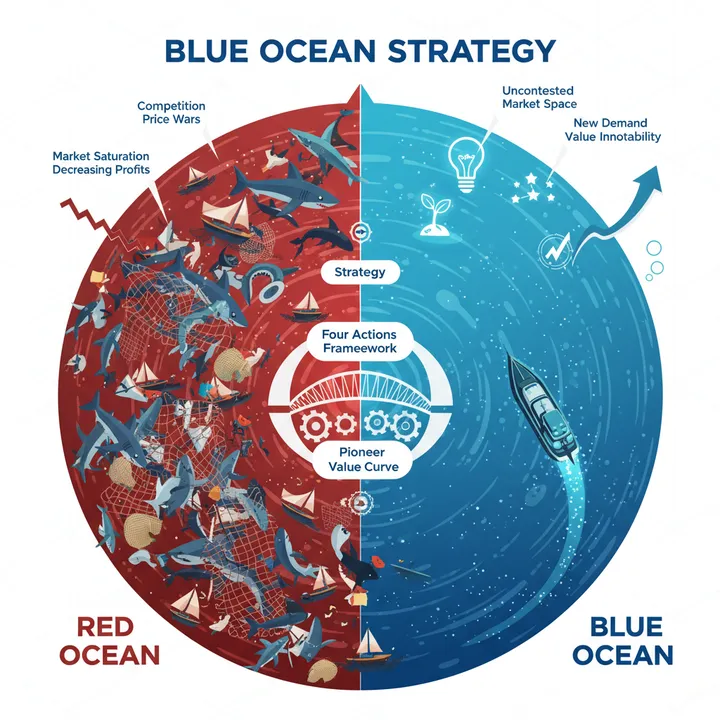
"BLUE_OCEAN—the blue ocean strategy—avoids the red ocean of attrition on the same battleground as rivals, recombining value factors by eliminating, reducing, raising, and creating, to build a battleground where no one competes," I explained. "The key is not to slug it out on the same performance as the giant. Rather than forcing up the factors where they're strong, recombine the factors you can leverage. It turns copying into your own battleground."
"First, let's measure the current cost," Gemini said, opening ROI Polygraph. The data Amari provided was entered.
"Here is the monthly cost," Gemini read out. "Unstable accuracy from manual demand forecasting—excess inventory and stockout losses: ¥680,000 per month. Expected value of the person-dependence and non-transferable-know-how risk of veterans: ¥400,000 per month. Variance in ordering accuracy from person-dependent seasonal judgment: ¥360,000 per month. Data-processing and aggregation labor from manual AS/400 operation: 140 hours per month on average, at ¥3,600 per hour, ¥504,000 per month. Inability to differentiate and price-competition risk from copying the giant: ¥300,000 per month. A total of ¥2,244,000 per month. Roughly ¥26.93 million per year."
Amari stared at the figures. "I was only thinking about the cost of catching up. Add the cost of never differentiating while copying, and it comes to this much."
"Then let's design it with BLUE_OCEAN," I continued.
[Eliminate—Abandon the battleground of manual work and person-dependence]
"First, eliminate," Claude said. "Manual demand forecasting and veteran-dependent, person-bound ordering. Fight the giant here and you lose. What you abandon is the very battleground of attrition."
[Reduce—Thin the general-purpose accuracy where you compete with the giant]
"Next, reduce," Gemini continued. "There's no need to aim for the leader's general-purpose accuracy across every item. Of the roughly 550 items, focus on those where seasonality and chocolate-specific variation matter. Reduce the pursuit of blanket accuracy and concentrate your force."
[Raise—Thicken the data-fication of seasonality and know-how]
"After eliminating, raise," I continued. "Accumulate veterans' know-how as digital data and have the AI learn it. Thicken forecasting accuracy that factors in seasonality, in the domain where you're strongest. Turn the firm-specific accumulation the giant doesn't have into a weapon."
[Create—Add a mechanism where younger staff run it at the same accuracy]
"Finally, create," Claude continued. "Move the veterans' know-how into the AI so younger staff can forecast at the same accuracy. Turn a person-bound strength into a battleground anyone can draw from. Not an ocean to fight over, but an ocean that's yours alone."
[Estimating the payback]
"Let's run the numbers on ROI Proposal Generator," Gemini proposed.
- Initial cost: building the AI demand-forecasting system, data-fication of veteran know-how, a seasonality-learning model, AS/400 data integration, and operational design for younger staff—¥5.6 million total
- Monthly cost: system operation and model updates combined, ¥230,000
- Monthly savings: inventory optimization from improved forecast accuracy = ¥500,000; easier handover from dissolving person-dependence = ¥380,000; improved seasonal-ordering accuracy = ¥340,000; automation of data processing and aggregation = ¥360,000; totaling ¥1,580,000 per month
- Net monthly savings: ¥1,580,000 − ¥230,000 = ¥1,350,000 per month
- Payback period: ¥5.6 million ÷ ¥1.35 million = about 4.1 months
"Just over four months to recoup," Gemini summarized. "What works is not slugging it out with the giant on the same battleground, but recombining value into the domain where you're strong. Chase blanket accuracy across all items and scale beats you. Focus on the data-fication of seasonality and know-how, and you build a battleground the giant doesn't have. The investment doesn't miss."
Amari checked the figures. "I was thinking of the same thing as the giant. Recombine the factors, and you can build a battleground where you don't fight."
"BLUE_OCEAN is a tool for avoiding attrition and building your own battleground," I replied.
Chapter 3: An Implementation Plan That Recombines the Battleground
"Let me lay out the approach," I said, standing at the whiteboard.
"Month one—analyze the current data flow and fix the elements to eliminate and reduce. Month two—inventory veteran know-how and extract seasonal factors. Months three and four—build the AI demand-forecasting system and the seasonality-learning model. Month five—AS/400 data integration and operational design for younger staff. Month six—trial operation and effect verification (measuring forecast accuracy). Month seven onward—continuously improve accuracy in the proprietary domain and expand the target items."
"Can we really stand against the giant?" Amari asked.
"The form of standing changes," Claude replied. "Compete on scale on the same battleground and you lose. But BLUE_OCEAN changes the battleground itself. Seasonality, chocolate-specific variation, veterans' know-how—move the firm-specific accumulation the giant lacks into the AI. Don't slug it out against their general accuracy; win in the domain where you're strongest. Rather than catching up, run ahead in a different ocean."
Amari took notes. "Before chasing the giant, build my own ocean. Now I see the order."
Chapter 4: The Day an Ocean of Its Own Came into View
Ten months later, a report arrived from Amari.
After the system went in, demand forecasting stabilized. "Forecasts that swung under manual work came into alignment, factoring in seasonality. Both excess inventory and stockouts dropped," Amari wrote.
The veterans' know-how remained, too. Person-bound judgment was learned by the AI and passed on. "The intuition I thought would vanish when the veterans left became data that younger staff could use," the report read.
The biggest change showed in how the giant was faced. From wearing down by copying, to fighting on one's own battleground. "I was anxious to have the same thing as the leader. Once we recombined the factors, we grew strong in the domain of seasonality and know-how they don't have," Amari wrote.
Younger staff's ordering accuracy rose as well. Person-bound seasonal judgment became something anyone could draw from. "Ordering that swung by who was in charge decreased," the report read.
As a side effect, the way competition was viewed changed. Not slugging it out on the same battleground took root in management. "We stopped chasing the giant. We started asking where the ocean is that we can win," Amari wrote.
At the end of Amari's report was this: "I thought the forecasting struggle was that we couldn't catch up to the giant. But the real problem was that we were trying to wear ourselves down on the same battleground. The moment we recombined the value factors with BLUE_OCEAN, an ocean with no fighting came into view. Before chasing the giant, building our own battleground came first."
The day a company chasing the giant with no way to win became a company that could fight in an ocean of its own, adopting demand forecasting had shifted from copying the leader to a design that changes the battleground by eliminating, reducing, raising, and creating.
"DX requests usually arrive as 'the giant started, so we should too.' But before copying, there's a question to ask: on the same battleground, can you beat their scale? What BLUE_OCEAN asks is to eliminate, reduce, raise, and create. Thin the factors where you compete with the giant, thicken the factors where you're strong, and an ocean with no fighting appears. The day a company chasing the giant with no way to win found an ocean of its own, what changed was not the AI's performance but the very perspective that avoids attrition and builds a battleground of one's own."
Related Files
Tools Used
- ROI Polygraph — Visualizing inventory loss from unstable accuracy, person-dependence risk, and the cost of failing to differentiate while copying
- ROI Proposal Generator — Payback simulation for an AI demand-forecasting system, starting from recombining value factors


