
ROI Case File No.572 'We Were Searching for People, but Had No Yardstick for Achievement'

We were searching for people, but had no yardstick for achievement
Chapter 1: We're short on people—but what has to be satisfied for "enough"?
"We're looking for a highly skilled systems engineer who can do AI development. I want to find a company we can consult with."
Toru Meguro, head of the AI & Data Strategy Office at TechGenius, described the situation. Theirs is a software maker. "In-house development is our basic policy, but our internal engineers are stretched thin. Embedding AI into products, developing new services, internal AI tools—tasks are backing up. As early as this month, I want an engineer who can drive AI development autonomously to come on board."
"Have you tried to secure people before?" Claude asked.
"I have," Meguro answered. "Through an engineer-referral firm. But their AI skills were insufficient and we couldn't use them. This time I don't want to repeat the same failure."
"Once that person joins, what would have to be achieved, and to what degree, for it to count as success?" I confirmed.
"…I haven't decided," Meguro answered. "I've only been thinking about finding people. How many, by when, and how far to progress. I have no yardstick for measuring achievement."
"Searching without a yardstick for achievement, you can't judge good from bad," I replied. "Let's break it down with OKR."
Chapter 2: What OKR asks—tie measurable key results to an objective
"This case calls for OKR."
Claude wrote on the whiteboard: "Objectives / Key Results."
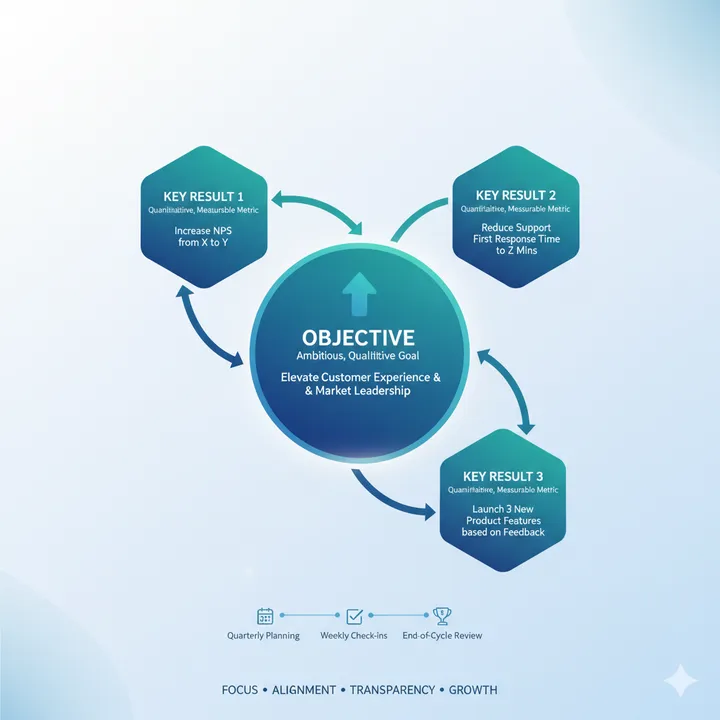
"OKR—Objectives and Key Results—is a framework where you raise an objective to be achieved and tie key results to it, in numbers, that measure it," I explained. "The crux is not stopping at raising the objective. Secure this many, progress this far by this date—you bind measurable results to it. Because there's a yardstick, you can judge both the person and the progress. The past hiring mismatch happened precisely because there was no standard for gauging skill. It's a tool for tying results to objectives."
"First, let's measure the current cost," Gemini said, opening ROI Polygraph. He entered the data Meguro had provided.
"The monthly cost is out," Gemini read off. "Delay labor from stalled AI-development tasks averages 160 hours a month; at ¥3,900 an hour, that's ¥624,000 a month. Wasted cost from past hiring mismatches averages ¥380,000 a month. New-project delays from the strain on internal engineers average ¥400,000 a month. Invisible stalls from the absence of result metrics average ¥340,000 a month. Opportunity loss from the inability to reallocate resources averages ¥320,000 a month. The total is ¥2,064,000 a month—about ¥24.76 million a year."
Meguro stared at the figures. "I'd been watching only the shortage of people. Once you add the cost of stalling with no yardstick for achievement, it comes to this much."
"Then let's design it with OKR," I continued.
[Objective—raise the success of the AI-development project]
"First, raise the objective," Claude said. "The success of the AI-development project. This is the direction. But raised alone, you can't tell whether it was achieved. Here we tie measurable results to it."
[Key Results—measure achievement with three numbers]
"Next, tie key results to it," Gemini continued. "One, secure three highly skilled engineers. Two, complete 50% of the AI-development project within four months. Three, reallocate internal engineers to resolve new-project delays. Because there are numbers, achievement is measurable."
[Gauging—set the standard for measuring skill first]
"After the results, the standard for gauging," I continued. "The past mismatch happened because there was no yardstick for skill. Set, in advance, the standard for measuring whether they can drive AI development autonomously. With a standard, you don't repeat the same mistake."
[Reallocation—recompose the internal resources]
"Last, reallocation," Claude continued. "As the highly skilled engineers come in, shift internal engineers to new projects. Along the objective and results, place people optimally. The delay across the whole clears."
[Estimating the payback]
"Let's run the numbers with the ROI Proposal Generator," Gemini proposed.
- Initial cost: OKR design, securing highly skilled engineers, team formation, resource reallocation, and progress-management design—¥5 million total
- Monthly cost: engineer utilization plus ongoing operation—¥220,000
- Monthly savings: project momentum from accelerated AI development = ¥480,000 (assuming a 70% reduction); resolution of new-project delays through reallocation = ¥360,000; improved hiring accuracy through skill-gauging = ¥280,000; elimination of stalls through result metrics = ¥300,000; ¥1,420,000 a month total
- Net monthly savings: ¥1,420,000 − ¥220,000 = ¥1,200,000 a month
- Payback period: ¥5 million ÷ ¥1,200,000 = about 4.2 months
"A little over four months to recover," Gemini summarized. "What works is not stopping at searching for people but tying measurable results to an objective. Without a yardstick, even once they join you can't tell if it was achieved, and mismatches repeat. Because OKR makes results into numbers, you can judge both the hire and the progress. The investment doesn't swing at empty air."
Meguro said as he checked the numbers. "I thought finding a good person would settle it. Unless you decide the results to measure achievement first, you can't even tell good from bad."
"OKR is a tool for tying measurable results to an objective," I replied.
Chapter 3: An implementation plan that ties objective to results
"Let me lay out the approach," I said, standing before the whiteboard.
"Month one—fix the objective and set the three key results and the skill-gauging standard. Month two—secure the highly skilled engineers and bring them onto the project. Months three and four—drive AI development and manage progress toward 50% completion in four months. Month five—reallocate internal resources and begin new projects. Month six—verify results and review the objective. Month seven onward—expand the scope of AI development and keep running OKR."
"If we find a good engineer, development moves forward—right?" Meguro confirmed.
"Finding isn't enough," Claude replied. "It moves forward because objective and results are bound together. When how many, by when, and how far are fixed in numbers, the joining person's work can be measured and drift in progress corrected early. The past mismatch was because there was no yardstick. Tying results with OKR comes before securing anyone."
Meguro said as he took notes. "Before searching for people, decide the yardstick for achievement. I can see the order now."
Chapter 4: The day the yardstick brought a person to life
Ten months later, a report arrived from Meguro.
AI development advanced greatly after the highly skilled engineers joined. "The stalled tasks began to move autonomously. Even the target of 50% in four months, we hit while chasing the numbers," Meguro wrote.
No hiring mismatch occurred either. The standard for measuring skill made the gauging certain. "We measured, in advance, whether they could drive AI development autonomously. The old pattern of discovering after they joined that they couldn't perform was gone," the report said.
The biggest change showed in the judgment of who to hire. From merely searching for people, they shifted to measuring on the yardstick of achievement. "I'd been stuck at 'find a good person.' Once I tied results to the objective, who, what, and how far became measurable, and I no longer hesitated in my judgments," Meguro wrote.
Internal resources were recomposed too. Reallocation untangled the new-project delays. "I could turn the strained internal engineers toward new work. The stall across the whole vanished," the report said.
As a side effect, the way initiatives were viewed changed. For people and for initiatives alike, the habit of measuring results in numbers took root. "I stopped ending at 'make progress.' I began to decide, in advance, what achieved and how far would count as success," Meguro wrote.
At the end of Meguro's report was written: "I thought the AI-development trouble was that we couldn't find a good person. But the real problem was that we were searching for people with no yardstick for achievement. The moment I tied results to the objective with OKR, both the person to choose and the progress came into view. Before searching for people, deciding the yardstick for achievement came first."
On the day a company that had searched for people without a yardstick for achievement became a company that could bring people to life by tying objective and results, talent acquisition had changed from an aimless people-hunt into a design that ties measurable key results to an objective and sets them in motion.
"A consultation about a talent shortage usually arrives in the form of 'we want to find good people.' But before searching for people, there's something to ask. Is there a yardstick for measuring achievement? What OKR asks is the objective and the key results that measure it. Tie results to the objective and you can judge both the hire and the progress. On the day a company that had searched for people without a yardstick could make achievement into numbers, what changed was not the quality of the talent but the very perspective of tying measurable results to an objective and setting them in motion."
Related Files
Tools Used
- ROI Polygraph — visualizing development-stall labor, hiring-mismatch cost, and resource strain
- ROI Proposal Generator — a payback simulation for securing AI-development talent, starting from the tying of objective and key results


