
ROI Case File No.581: They Tried to Strip Away Every Sheet of Paper, but Had Nothing to Tell Them Which One First

They Tried to Strip Away Every Sheet of Paper, but Had Nothing to Tell Them Which One First
Chapter 1: They Want the Paper Gone, but Can't Settle on Where to Begin
"We want to digitize the documents we currently manage on paper."
Jun Okita, head of the business reform office at TechNova, said this as he laid out the situation. "Invoices, materials for internal meetings, documents attached to approval requests. Almost all of it still circulates on paper. We want to read it with AI-OCR and eliminate the manual keying. The world talks about DX, and here we are with a mountain of paper."
"Is the keying effort what's troubling you?" Claude asked.
"Not only that," Okita answered. "Only the person in charge understands the knack of processing it. There are plenty of transcription mistakes, too. We once mistyped a digit on an invoice and had to reconcile everything afterward. So we want to digitize all of it in one sweep."
"Have you measured the impact and the volume for each document type?" I confirmed.
"...We haven't," Okita answered. "All I've thought about is making the paper disappear. Which document delivers how much, and how much of it there is. I've never laid them side by side and compared."
"If you try to strip everything away at once, nothing tells you which to touch first," I replied. "Let's break this down with PPM."
Chapter 2: PPM Asks—Let Impact and Volume Decide Placement
"This case calls for PPM."
Claude wrote "Impact / Volume" on the whiteboard.
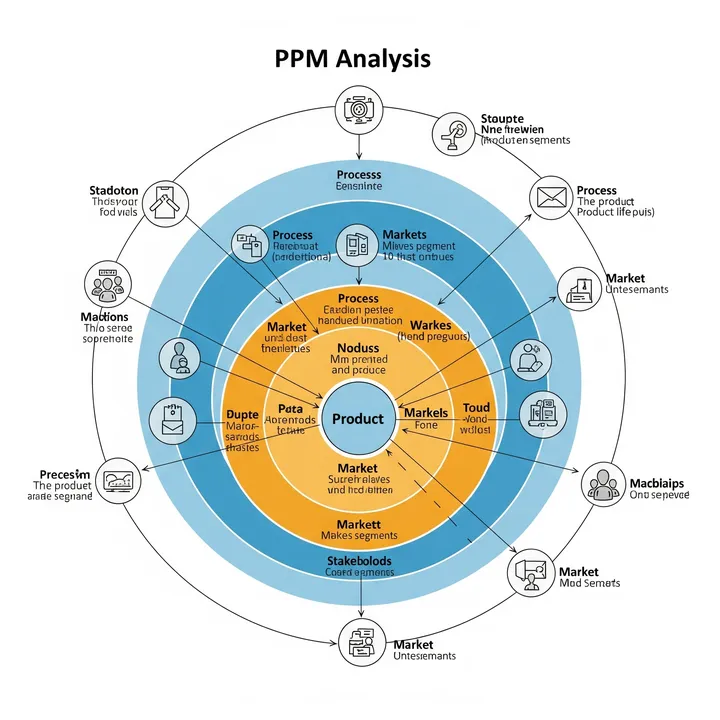
"PPM—Product Portfolio Management—is a framework for arranging your subjects along two axes and deciding where to pour resources and where to walk away," I explained. "The essence is not spreading the same force over everything. Pour into what has both large impact and large volume first, stack up what delivers reliably, prepare the conditions before touching the uncertain ones, and decide outright which ones you will not touch. It is a tool for assigning places."
"First, let's measure the current cost," Gemini said, opening ROI Polygraph. The data Okita provided went in.
"The monthly costs are out," Gemini read off. "Manual keying and transcription of paper documents averages 170 hours per month; at ¥3,700 per hour, that's ¥629,000 per month. Reconciliation and correction caused by mistyping averages ¥380,000 per month. Stagnation from processing being locked to one person averages ¥340,000 per month. Inefficiency in storing, searching for, and carrying paper averages ¥320,000 per month. Delayed investment decisions caused by an undefined digitization scope average ¥360,000 per month. The total is ¥2,029,000 per month. Annualized, roughly ¥24,350,000."
Okita stared at the figures. "I was only looking at the keying effort. Once you add the reconciliation from mistakes and the delay from not knowing where to start, it comes to this much."
"Then let's design with PPM," I continued.
[Star—Pour into the documents with both impact and volume first]
"First, the Star," Claude said. "Invoices. The format is fixed, the volume is high, and the damage from a mistyped figure is large. Both impact and volume are at their maximum. This is where AI-OCR goes first. Don't spread thinly across everything—pour into the single point that works hardest."
[Cash Cow—Stack the standardized documents that deliver reliably next]
"Next, the Cash Cow," Gemini continued. "Purchase orders, delivery notes, inspection certificates. Nothing flashy, but the formats are stable and recognition accuracy comes out easily. Reliable savings accumulate every month. You can extend the invoice template sideways as-is."
[Question Mark—Documents without a fixed format wait until conditions are ready]
"After the Cash Cow, the Question Mark," I continued. "Materials for internal meetings. The impact is promising, but the formats are all over the place, and reading them as-is won't produce accuracy. Touch them first and you fail. Standardize the format first, then invest once the conditions are in place."
[Dog—Decide what you will not touch]
"Last, the Dog," Claude continued. "Stamped documents that require the original to be retained, and forms that appear only a few times a year. Invest here and you never recover it. Decide not to digitize, and set it aside. Because you make the decision to discard, what you pour becomes concentrated."
[Calculating the payback]
"Let's run the numbers with ROI Proposal Generator," Gemini proposed.
- Initial cost: Document inventory and PPM classification, AI-OCR selection, form template design, core-system integration, and operational migration — ¥4,900,000 total
- Monthly cost: AI-OCR usage fees plus ongoing operation and maintenance — ¥210,000 per month
- Monthly savings: Reduced manual keying of invoices = ¥460,000 per month (assuming a 70% reduction), elimination of reconciliation and correction from mistyping = ¥320,000 per month, elimination of stagnation from single-person dependency = ¥280,000 per month, more efficient search and storage = ¥260,000 per month — ¥1,320,000 per month in total
- Net monthly savings: ¥1,320,000 − ¥210,000 = ¥1,110,000 per month
- Payback period: ¥4,900,000 ÷ ¥1,110,000 = approximately 4.4 months
"A payback of just over four months," Gemini summarized. "What makes it work is not stripping everything at once, but letting impact and volume decide placement. Touch everything evenly and you stumble on meeting materials that won't scan accurately, and the whole effort stalls. Concentrate on the Star, and the numbers move within the first three months. The investment doesn't swing at air."
Okita looked over the figures. "I thought eliminating the paper was the whole job. Without deciding the order, you burn your strength where it doesn't work."
"PPM is a tool for letting impact and volume decide placement," I replied.
Chapter 3: An Implementation Plan That Assigns Places
"Let me lay out how to proceed," I said, standing at the whiteboard.
"Month one—inventory the documents and measure impact and volume. Month two—classify into the four placements and select the AI-OCR product. Months three and four—apply AI-OCR to invoices and integrate with the core system. Month five—extend horizontally to purchase orders, delivery notes, and inspection certificates. Month six—standardize the format of meeting materials and run a trial application. Month seven onward—review the classification and continuously rotate what falls in scope."
"If we're going to digitize everything eventually, isn't it the same thing?" Okita asked.
"It isn't the same," Claude replied. "Start everything simultaneously and the documents that won't scan accurately consume your people, delaying even the invoices that should have paid off. Start with the Star, and the hours freed there become the resource for the next one, while the floor—having seen the result—cooperates. Assigning places, including deciding what you will not touch, comes before the digitization itself."
Okita took notes. "Before stripping the paper away, decide which to strip first. I can see the order now."
Chapter 4: The Day Places Were Assigned and the Paper Shrank
Ten months later, a report arrived from Okita.
Invoice processing changed dramatically after AI-OCR was applied. "The stack of paper that used to bury my desk at month-end now clears with scanning and a check. The hours we spent keying simply vanished," Okita wrote.
Mistyping dropped as well. Matching the scan results against core-system data caught digit errors and missed transcriptions. "The work of reconciling after the fact is gone. The overtime for corrections disappeared," the report said.
The largest change showed up in how they approached the work. From trying to strip everything at once, they moved to assigning places and pouring accordingly. "We were running on 'whatever's next in the pile.' Once we arranged everything by impact and volume, where to put people was obvious at a glance, and the hesitation stopped," Okita wrote.
The meeting materials, too, had their conditions prepared. Standardizing the format before sending them to scanning produced accuracy. "If we'd touched them first, we'd have failed, and digitization itself would have earned a bad name. Making them wait their turn was the decision that worked," the report said.
As a secondary effect, their view of investment changed. The idea of deciding what not to do took root. "We stopped saying 'do everything.' We now think in terms of where to pour and what to leave out," Okita wrote.
At the end of Okita's report, he had written: "I thought the paperless problem was that we had too much paper. But the real problem was that we tried to strip away every sheet without anything to tell us which one first. The moment PPM arranged them by impact and volume, both where to pour and what to leave out became visible. Before stripping the paper, assigning places came first."
The day a company that had tried to strip away every sheet without knowing which came first became a company that assigns places and pours accordingly, document digitization had changed from a simultaneous march to digital into a design that sets priorities by impact and volume, the report noted.
"Paperless consultations almost always arrive in the form of 'we want all the paper gone.' But before you start stripping, there is something to ask. Has it been decided which one comes first? What PPM asks about is impact, volume, and what you will not touch. Once placement is decided, resources gather at the single point where they work hardest. The day a company that had tried to strip everything at once managed to decide the order, what changed was not the quantity of paper but the very perspective of letting impact and volume assign the places."
Related Files
Tools Used
- ROI Polygraph — Visualizing manual keying hours, reconciliation costs from mistyping, and stagnation from single-person dependency
- ROI Proposal Generator — Investment-recovery simulation for AI-OCR deployment driven by prioritization through impact and volume


