
ROI Case File No.587: They Lumped It All Together as Paperwork and Never Split It into Branches

They Lumped It All Together as Paperwork and Never Split It into Branches
Chapter 1: They Want to Go Digital, but Don't Know How to Begin
"We want to move our internal operations toward paperless."
Toru Edagawa, general affairs manager at TechNova, said this as he laid out the situation. A construction and real estate company. "Our structure changed, and we're finally in a position to push DX. But given the industry, there's a lot of paper. Expense claims, leave requests, approval routings—all of it on paper. The reimbursement for parking fees alone is a monthly ordeal."
"Where does it hurt most?" Claude asked.
"Approval routings," Edagawa answered. "Paper circulates and needs stamps from several departments. We can't even tell whose desk it's stuck on. And with drawings and contracts, industry practice means some have to remain on paper. We looked at an electronic contract service before, but at our volume of units supplied the cost didn't justify it, so we passed. We also have a lot of older staff, so we want to avoid complicated systems. Change everything at once and the floor descends into chaos."
"Among the paper-based work, have you sorted which can go digital and which must keep an original?" I confirmed.
"...We haven't," Edagawa answered. "I've been thinking of it as one lump: there's a lot of paper. Application, approval, and retention are different things, but we treated them all together as paperwork. So nothing decides where to start."
"As one lump, there's no way to proceed in stages," I replied. "Let's break this down with a logic tree."
Chapter 2: The Logic Tree Asks—Split from Trunk to Branch
"This case calls for a logic tree."
Claude wrote "Trunk / Branch / Leaf" on the whiteboard.
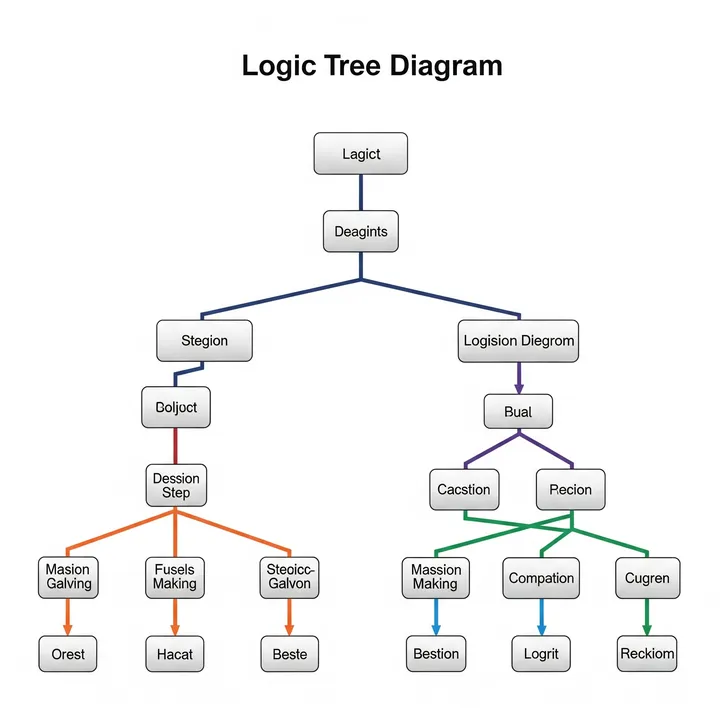
"A logic tree is a framework for branching a large mass without overlaps and without gaps, splitting it down to a size you can act on," I explained. "The essence is not handling the mass as a mass. 'There's a lot of paper' produces no move. Split it into application, approval, and retention; split application further into expenses, leave, and approval requests. Only once you're down to the leaves can you judge, item by item, whether it can go digital or needs an original. The order of staged rollout can only be assembled at the leaf level."
"First, let's measure the current cost," Gemini said, opening ROI Polygraph. The data Edagawa provided went in.
"The monthly costs are out," Gemini read off. "Paper applications, circulation, and stamping averages 180 hours per month; at ¥3,600 per hour, that's ¥648,000 per month. Delayed decision-making from stalled approval routings averages ¥440,000 per month. Reconciliation and rejection of reimbursement claims averages ¥320,000 per month. Deployments passed over because the digitization scope couldn't be separated average ¥360,000 per month. Storing, searching for, and carrying paper averages ¥300,000 per month. The total is ¥2,068,000 per month. Annualized, roughly ¥24,820,000."
Edagawa stared at the figures. "I was only looking at the effort of collecting stamps. Once you add the loss while approvals sit still, and everything we kept passing on, it comes to this much."
"Then let's design with the logic tree," I continued.
[Trunk—Split "a lot of paper" one level down]
"First, the trunk," Claude said. "Split paper-based work into three: application, approval, retention. These three differ in nature. Application is about input, approval is about circulation and sign-off, retention is about law and originals. You debated them mixed together, which is why no conclusion came out."
[Branch—Split application into expenses, leave, and approval requests]
"Next, the branches," Gemini continued. "Divide the application branch into expense claims, leave requests, approval requests, and reimbursements. Each differs in volume, departments involved, and number of approval steps. Count them per branch and you get, in numbers, where the time is going."
[Leaf—Judge each branch on whether it can go digital or needs an original]
"After the branches, the leaves," I continued. "Item by item, judge whether the law requires retaining an original, whether it's merely internal custom, and whether the stamp is genuinely necessary. Some drawings and contracts will stay on paper. But there is no basis anywhere requiring a stamp on a leave request. Get down to the leaves and you find the paper that exists only out of assumption."
[Order—Assemble the staged rollout at the leaf level]
"Last, the order," Claude continued. "Among the leaves that can go digital, put the high-volume, simple-to-operate ones first. Start with something unmistakable like leave requests. Older staff get used to it too if they touch the simple thing first. The order is what prevents chaos on the floor."
[Calculating the payback]
"Let's run the numbers with ROI Proposal Generator," Gemini proposed.
- Initial cost: Tree decomposition of operations, digitization feasibility assessment, workflow platform deployment, redesign of application forms, staged migration and internal training — ¥4,700,000 total
- Monthly cost: Workflow platform usage fees plus ongoing operation — ¥210,000 per month
- Monthly savings: Reduced application, circulation, and stamping hours = ¥440,000 per month (assuming a 70% reduction), elimination of stalled approvals = ¥340,000 per month, elimination of reimbursement reconciliation and rejections = ¥240,000 per month, more efficient storage and search = ¥240,000 per month — ¥1,260,000 per month in total
- Net monthly savings: ¥1,260,000 − ¥210,000 = ¥1,050,000 per month
- Payback period: ¥4,700,000 ÷ ¥1,050,000 = approximately 4.5 months
"A payback of about four and a half months," Gemini summarized. "What makes it work is not lumping paperwork together, but splitting down to the leaves. As a mass, the drawings that need originals drag the whole thing to a halt. Split into leaves, and only that one leaf stops while the rest moves ahead. The investment doesn't swing at air."
Edagawa looked over the figures. "I was thinking about whether digitization was possible for the business as a whole. Unless you look item by item, even what could move gets stopped."
"The logic tree is a tool for splitting a mass down to a size you can act on," I replied.
Chapter 3: An Implementation Plan That Splits into Branches
"Let me lay out how to proceed," I said, standing at the whiteboard.
"Month one—decompose paper-based work into a tree and measure volume and hours per branch. Month two—assess digitization feasibility per leaf and inventory the legal basis for each stamp. Months three and four—move leave requests and expense claims into workflow. Month five—digitize approval routings and review the number of approval steps. Month six—consolidate reimbursements and verify results. Month seven onward—take on the retention branch and keep reviewing the tree."
"Wouldn't digitizing everything at once also cost less overall?" Edagawa asked.
"You tried to do it in one go before, and passed," Claude replied. "An all-at-once deployment out of scale with your size stops because the economics don't work. Split into leaves and bring in the effective ones in order, and the savings from the first branch fund the next. Older staff can get used to it one simple sheet at a time. Splitting comes before consolidating."
Edagawa took notes. "Before deciding on digitization, split into branches. I can see the order now."
Chapter 4: The Day They Split into Branches and the Paper Receded
Ten months later, a report arrived from Edagawa.
Leave requests went paperless in the first month. "The operation is simple, so even our older staff learned it after touching it once. Losing the resistance right there was the big thing," Edagawa wrote.
Approval routings started moving too. Digitization plus a review of approval steps unstuck the backlog. "We can now see whose desk it's sitting on. The job of walking the building chasing stamps is gone," the report said.
The largest change showed up in how they saw the work. From lumping it together as paperwork, they moved to splitting into branches and judging. "I kept saying 'we have a lot of paper.' Once we split it into application, approval, and retention, the places we could act on and the places we should preserve became distinct," Edagawa wrote.
Drawings and contracts were deliberately left on paper. Splitting made the decision to keep them explicit too. "The conversation stopped being 'we can't digitize that, so let's give up on all of it.' The paper we keep and the paper we remove could be handled separately," the report said.
As a secondary effect, their view of custom changed. Checking the basis for a stamp took root. "We stopped saying 'because it's always been this way.' Now we ask which law this stamp rests on," Edagawa wrote.
At the end of Edagawa's report, he had written: "I thought the paperless problem was that our industry couldn't reduce paper. But the real problem was that we lumped it all together as paperwork and never split it into branches. The moment the logic tree split it down to the leaves, the paper we could remove parted from the paper we keep. Before deciding on digitization, splitting into branches came first."
The day a company that had lumped paperwork together became a company that judges at the leaf level, going paperless had changed from weighing an all-at-once deployment into a design that splits trunk into branches and assembles the order of advance, the report noted.
"Paperless consultations almost always arrive in the form of 'in our industry there's a lot of paper.' But before you debate feasibility, there is something to ask. Is that paper all one kind? What the logic tree asks about is the trunk, the branches, the leaves—and the order of advance. Split to the leaves and you can advance from the paper you can remove without being dragged down by the paper you keep. The day a company that had lumped paperwork together managed to split it into branches, what changed was not the industry's customs but the very perspective of splitting a mass down to a size you can act on."
Related Files
Tools Used
- ROI Polygraph — Visualizing application, circulation, and stamping hours, stalled approvals, and the cost of passed-over deployments
- ROI Proposal Generator — Investment-recovery simulation for paperless and DX promotion driven by tree decomposition and staged rollout


