📅 2025-10-06 23:00
🕒 Reading time: 17 min
🏷️ PEST
![]()
The week after resolving the VitalCare jobs theory deepening case, a consultation arrived from Africa regarding difficulties unique to emerging markets. The ninth case in Volume 18, "Reconstruction of Logic and Verification," concerned a company's challenge facing external environmental uncertainty and complexity.
"Detective, we're a rapidly growing logistics startup in Africa, but political, economic, social, and technological environmental changes are too intense, and we're struggling to formulate medium to long-term business strategies. There are too many external factors that cannot be resolved by internal efforts alone."
Amara Mutanga, co-founder of AfroLogistics Connect, visited 221B Baker Street unable to hide her sense of urgency. In her hands were business data showing rapid growth and, in stark contrast, reports of unpredictable external environment analysis.
"We're a startup deploying last-mile logistics solutions across all of East Africa. The business itself is going well, but external environmental changes are too intense, and we can't make strategic decisions with confidence."
AfroLogistics Connect's Growth Track Record: - Established: 2022 (rapidly growing logistics startup) - Service range: 5 East African countries, 25 cities - Monthly deliveries: 1.8 million cases (region's largest scale) - Sales growth rate: +320% year-over-year (explosive growth) - Funding raised: Cumulative ¥8.5 billion (high growth expectations)
The numbers certainly indicated a successful company. However, Amara's expression was etched with deep anxiety.
"The problem is that the impact of external factors we cannot control on our business is far too large and unpredictable. Political instability, economic fluctuations, social situation changes, technological infrastructure rapid changes. Everything affects our business."
Serious Impact of External Environment on Business: - Political instability: Delivery volume decreases 30% during election periods - Economic fluctuation: Profitability fluctuates ±25% monthly due to currency changes - Social situation: Forced to suspend business when regional conflicts occur - Technological change: Rapid competitive entry with communication infrastructure improvement - Regulatory changes: Business model review needed with government policy changes
"We're confident in 'internal improvements,' but completely cannot 'respond to external environment.' We continue to be tossed about by unpredictable changes."
"Ms. Amara, what analysis and countermeasures are you taking regarding external environmental changes?"
Holmes inquired quietly.
Amara began explaining the current situation with a perplexed expression.
"We're watching daily news and government announcements, but we only get fragmentary information and cannot conduct systematic external environment analysis. As a result, we're always reactive."
AfroLogistics' Current External Environment Response:
Information Gathering Current State (Sporadic and Reactive): - Political information: Daily checking of election and policy news - Economic information: Regular confirmation of exchange rates and inflation rates - Social information: Reports from local partners on security and social situation - Technological information: Industry journal confirmation of new technology and infrastructure development
Countermeasure Current State (Ad-hoc and Short-term): - Political risks: Business reduction or temporary suspension after problems occur - Economic fluctuation: No currency hedging, absorbing fluctuation with profits - Social problems: Local withdrawal or business interruption - Technological change: Reactive strategy following competitors
I noted the lack of systematic external environment analysis.
"With fragmentary information gathering, you cannot see the overall picture of external environment, interrelationships, or future impacts. Systematic analytical framework is needed."
Amara answered with a serious expression.
"Exactly. We notice individual problems but cannot read how they interact and give complex impacts on business."
Specific Cases of Business Disruption by External Environment:
First Half 2024: Complex Crisis - Political: Government change in certain country, policy for strengthening logistics regulations - Economic: 20% inflation rate increase, 30% local currency depreciation - Social: Transportation industry strike due to fuel price surge - Technological: 5G network development, local entry of international logistics giants
AfroLogistics' Response and Result: - Individual responses: Ad-hoc responses to each problem - Unclear priorities: Difficult to determine which problem to address first - Ignoring mutual influences: Not considering relationships between problems - Result: 2 months of business disruption, 35% revenue decrease
Second Half 2024: Missed Opportunity - Political: Pro-business government born in neighboring country, deregulation - Economic: Local economic turnaround with resource price increase - Social: Rapid e-commerce demand increase with middle class expansion - Technological: Rapid spread of payment systems
AfroLogistics' Response and Result: - Recognition delay: 3-month delay in noticing opportunity - Lack of preparation: Unable to prepare for market entry in time - Competitor lead: Others establish position first - Result: Lost opportunity worth ¥5 billion annually
"We continue to fail in both 'crisis management' and 'opportunity utilization,' unable to read external environment."
"Political, Economic, Social, Technological. Reading environment through four axes reveals the path"
"External environment is not a storm. It's a story with readable patterns"
"PEST analysis organizes environmental complexity and enables strategic judgment"
The three members began their analysis. Gemini deployed the "Emerging Market-Specialized PEST Analysis" framework on the whiteboard.
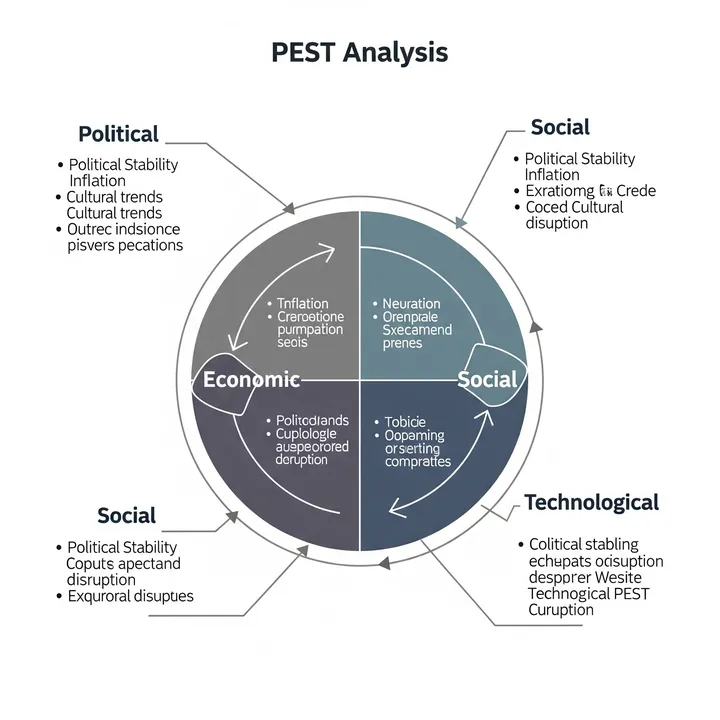
Emerging Market PEST Analysis Structure (Differentiation from Case 227): - P (Political): Political Factors - Government, policy, regulations, political stability - E (Economic): Economic Factors - Economic growth, currency, inflation, income levels - S (Social): Social Factors - Demographics, culture, values, lifestyle - T (Technological): Technological Factors - Infrastructure, digitalization, innovation
"Ms. Amara, let's systematically organize AfroLogistics' business environment through PEST analysis."
PEST Analysis of AfroLogistics Business Environment:
P (Political: Political Factors) Detailed Analysis
Current Political Environment (Mixed Risks and Opportunities): - Government stability: 3 of 5 countries have government change risks - Regulatory trends: Strengthening logistics industry regulations vs economic promotion policies - International relations: Trade agreements with neighboring countries, border control policies - Corruption/governance: Transparency issues in licensing processes
Specific Impacts of Political Influence on Business: - Regulatory changes: Licensing acquisition period 3 months → 12 months (during government changes) - Tax system fluctuation: Corporate tax rate 20% → 35% (policy shift) - Trade policy: Border crossing time 2 hours → 8 hours (political tension periods) - Public works: Budget cuts and suspension of road infrastructure development
E (Economic: Economic Factors) Detailed Analysis
Current Economic Environment (High Growth/High Volatility): - GDP growth rate: Annual 6-8% high growth (but large fluctuation) - Currency stability: 30-50% annual fluctuation range vs dollar - Inflation rate: Continuing 12-25% annual high inflation - Income level: Rapid middle class expansion (+15% annual growth)
Specific Impacts of Economic Influence on Business: - Currency fluctuation: Monthly ±25% revenue fluctuation (no hedging) - Inflation impact: +30% annual transportation costs, difficult to pass on prices - Purchasing power change: Rapid increase and decrease in delivery demand - Investment environment: Value fluctuation risk of local currency investments
S (Social: Social Factors) Detailed Analysis
Current Social Environment (Rapid Change): - Demographics: 70% youth, +5% annual urbanization rate - Digitalization: Smartphone penetration 60% → 85% (2 years) - Consumer behavior: +40% annual increase in e-commerce usage rate - Employment structure: Rapid increase in gig economy participants
Specific Impacts of Social Influence on Business: - Labor securing: Abundant supply of young workforce - Delivery demand: Demand explosion due to urbanization and digitalization - Customer expectations: Rising demands for delivery speed and quality - Competitive environment: Intensified competition for talent with local companies
T (Technological: Technological Factors) Detailed Analysis
Current Technological Environment (Rapid Infrastructure Development): - Communication infrastructure: Rapid 4G/5G coverage expansion - Payment systems: Over 80% mobile payment penetration - Logistics technology: GPS tracking and drone delivery introduction - Data analysis: Demand forecasting and route optimization by AI
Specific Impacts of Technological Influence on Business: - Operational efficiency: +40% delivery efficiency improvement through GPS and AI utilization - Competitive entry: Increased international company entry with lowered technology barriers - Customer experience: Demands for advanced services like real-time tracking - Investment necessity: Pressure for continuous investment in technological innovation
Claude reported an important integrated analysis.
"This is clear. AfroLogistics' business environment has a high-risk, high-return structure where PEST four factors interact complexly. Not individual responses but integrated strategy is needed."
Most Important Discovery: "PEST Factor Interaction"
In emerging markets, political, economic, social, and technological four factors are closely interrelated, with one change giving chain-reaction impacts to all other factors.
Specific Examples of PEST Interaction: - Political stability → Economic growth → Social change → Technology investment virtuous cycle - Political instability → Economic downturn → Social anxiety → Technology stagnation vicious cycle
After conducting detailed PEST analysis and environmental interaction research, AfroLogistics' strategic challenges became clear.
Necessity of Transformation from "Environment-Tossed Management" to "Environment-Utilizing Management":
Essence of Problem: Passive Response Treating External Environment as "Given"
AfroLogistics was passively responding while treating external environment as "unchangeable," but actually needed strategy to predict and actively utilize environmental changes.
Discovery of Strategic Opportunities Through PEST Integrated Analysis:
Strategic Utilization of Political Opportunities: - Regulatory preemptive response: Predict policy directions, convert regulatory compliance into competitive advantage - Government partnership: Public-private collaboration in public works and social issue resolution - Regional integration strategy: Regional development with politically stable countries as hubs - Risk distribution: Business distribution across multiple countries with different political risks
Strategic Utilization of Economic Opportunities: - Currency strategy: Utilization of currency basket and natural hedging - Inflation response: Price linkage system and cost structure flexibility - Income level-specific strategy: Service specialization for expanding middle class - Economic cycle response: Service level adjustment according to economic conditions
Strategic Utilization of Social Opportunities: - Young workforce utilization: Active utilization of gig workers and entrepreneurial spirit - Urbanization response: Optimization of urban dense delivery and suburban long-distance delivery - Cultural adaptation: Service design adapted to local culture and customs - Social contribution: Brand building through employment creation and regional development contribution
Strategic Utilization of Technological Opportunities: - Infrastructure utilization: Utilizing communication and payment infrastructure improvements for business expansion - Technological innovation: Differentiation through AI and IoT cutting-edge technologies - Digital divide resolution: Technology access improvement support business - Technology transfer: Local adaptation and dissemination of advanced technologies
Comparison Analysis with Competitors:
Environment-Utilizing Success Company (Kenya Company A): - PEST integrated strategy: Utilizing interaction of 4 factors in strategy - Prediction accuracy: Predicting and responding to 70% of environmental changes in advance - Opportunity utilization: Converting 80% of environmental changes into business opportunities - Result: 10x growth in 5 years, 35% regional market share
AfroLogistics' Current State: - PEST individual response: Responding to 4 factors separately - Prediction accuracy: Only 30% advance response to environmental changes - Opportunity utilization: Only 20% opportunity utilization of environmental changes - Challenge: Signs of entering growth stagnation period
Most Important Discovery: "Mindset Shift to Make Environment an Ally"
Emerging market uncertainty and volatility is not a threat; correctly understanding and predicting becomes the greatest source of competitive advantage.
Holmes compiled the comprehensive analysis.
"Ms. Amara, the essence of PEST analysis is 'acquiring strategic advantage through systematic environmental understanding.' Especially in emerging markets, the complex and volatile environment itself, by correctly reading it, can build competitive advantages that others cannot imitate. Environment is not a constraint but the greatest strategic resource."
PEST Integrated Strategy: Transformation from "Environment-Tossed Type" to "Environment-Utilizing Type"
Basic Policy of Strategy: Environmental Intelligence Platform
Phase 1: PEST Integrated Monitoring System Construction (4 months)
Political Intelligence System: - Policy trend prediction: Leading indicator monitoring of government policy and regulatory trends - Political risk evaluation: Continuous evaluation of elections, government changes, political stability - Regulatory adaptation preparation: Advance preparation for regulatory changes, competitive advantage conversion - Government relationship building: Active participation in public-private collaboration and policy dialogue
Economic Intelligence System: - Macroeconomic prediction: Integrated prediction model of GDP, inflation, exchange rates - Sector analysis: Detailed analysis of economic impacts on logistics industry - Customer purchasing power prediction: Demand forecasting and pricing strategy by income level - Currency risk management: Integrated strategy of natural hedging and financial hedging
Social Intelligence System: - Demographics analysis: Tracking urbanization, age composition, lifestyle changes - Consumer behavior prediction: Change prediction of e-commerce and delivery needs - Cultural adaptation strategy: Service development adapted to regional culture and customs - Social issue resolution: Employment creation and regional development contribution business
Technological Intelligence System: - Infrastructure development prediction: Tracking communication and transportation infrastructure development plans - Technological innovation monitoring: Trend monitoring of logistics-related technologies and competitor technologies - Digitalization support: Contribution to promoting local digitalization - Innovation investment: Strategic investment in cutting-edge technologies
Phase 2: Environment-Adaptive Business Strategy Implementation (6 months)
PEST Integrated Strategy Deployment:
Political Environment Utilization Strategy: - Establishing competitive advantage through regulatory preemptive response - Market access expansion through government partnership - Business stabilization through political risk distribution - Business environment improvement through policy proposals
Economic Environment Utilization Strategy: - Active business expansion during economic growth periods - Efficiency emphasis and foundation strengthening during economic downturn periods - Dynamic response system to currency and inflation - Service strategy by income level
Social Environment Utilization Strategy: - Active utilization of young workforce and entrepreneurial spirit - Preemptive response to urbanization and digitalization - Customer satisfaction improvement through cultural adaptation - Brand value improvement through social contribution
Technological Environment Utilization Strategy: - Converting infrastructure improvements into business expansion opportunities - Differentiation and efficiency through technological innovation - Contribution to digital divide resolution - New business creation through technology transfer
Phase 3: Continuous Environmental Adaptation System (Continuous)
Dynamic Strategy Adjustment System: - Quarterly PEST review: Continuous monitoring and strategy adjustment of environmental changes - Scenario planning: Response preparation for multiple environmental change scenarios - Early warning system: Detection and response within 72 hours of significant environmental changes - Learning accumulation system: Organizational accumulation of environmental prediction and response know-how
Expected Effects: - Environmental prediction accuracy: 30% → 75% (PEST integrated analysis effect) - Opportunity utilization rate: 20% → 70% (strategic environmental utilization) - Business stability: 50% reduction in performance fluctuation due to environmental change - Growth rate: Annual +320% → Annual +450% (environmental opportunity utilization)
Investment Plan: - PEST integrated system construction: ¥1.2 billion - Environment-adaptive strategy implementation: ¥1.8 billion per year - Expected revenue effect: ¥8 billion per year (opportunity utilization + risk reduction) - Investment recovery period: 5 months
"What's important is not accepting external environment as constraints but utilizing it as strategic resources. PEST analysis is the compass that converts environmental complexity into strategic advantage."
16 months later, a report arrived from AfroLogistics Connect.
Results of Business Transformation Through PEST Integrated Strategy:
Business Growth Acceleration and Stabilization: - Sales growth rate: +320% → +480% (environmental opportunity utilization effect) - Business stability: 60% reduction in performance fluctuation range (risk prediction and response) - Market share: 8% → 25% (grown to regional largest player) - Business scope: 5 countries 25 cities → 8 countries 45 cities (stable expansion)
Success of Strategic Response to Each PEST Factor:
Political Response Success: - Regulatory preemptive response: 90-day advance preparation for new regulations, 6 months ahead of competitors - Government partnership: Public-private collaboration business acquired in 3 countries - Political risk distribution: Overall performance impact 20% or less even during political instability - Policy proposals: Industry status improvement through logistics industry development policy proposals
Economic Response Success: - Currency risk management: 70% reduction in exchange fluctuation impact through natural hedging - Inflation response: Profit rate stabilization through dynamic price adjustment - Economic cycle utilization: Sustained growth through aggressive investment in boom and efficiency in recession - Income level-specific strategy: High-value-added service success with middle class expansion
Social Response Success: - Personnel utilization: Local youth 15,000 employed, gig economy activation - Urbanization response: Achieved industry highest efficiency in urban high-density delivery - Cultural adaptation: 95% customer satisfaction with services adapted to local customs - Social contribution: Recognition as "social value company" through regional employment creation
Technological Response Success: - Infrastructure utilization: +60% delivery efficiency improvement with 5G spread - AI introduction: 30% operating cost reduction through demand forecasting and route optimization - Digital support: Established new revenue source with local digitalization support business - Technology transfer: Technical superiority establishment through local adaptation of advanced technologies
Dramatic Improvement in Environmental Prediction and Response Capability:
Dramatic Prediction Accuracy Improvement: - Political trend prediction: 80% accuracy in election results and policy changes - Economic fluctuation prediction: 75% advance prediction of currency and inflation changes - Social change prediction: Advance grasp of consumption trends and demographics changes - Technological innovation prediction: 6-month advance prediction of infrastructure development and technology introduction
Strategic Opportunity Utilization: - Converting 85% of environmental changes into business opportunities (previously 20%) - Average 4 months faster environmental adaptation than competitors - 70% advance avoidance and mitigation of risks - 80% first-mover advantage secured in opportunities
Organizational Capability Evolution:
Environment-Adaptive Organizational Culture: - Environmental sensitivity: All employees sensitive to external environmental changes - Predictive thinking: Emphasis on "what will happen" not "what's happening now" - Opportunity discovery: Recognizing environmental changes as opportunities not constraints - Learning culture: Continuous improvement of environmental prediction and response
Sustainable Competitive Advantage: - Environmental understanding: Grasping environmental patterns competitors find difficult to understand - Adaptation speed: Industry fastest in environmental change response - Opportunity utilization capability: Ability to convert environmental changes into competitive advantage - Risk management: Converting uncertainty into manageable risks
Employee Voices:
Strategy Planning Manager (32 years old): "Every day used to be anxiety about 'what will happen today,' but now we can predict 'what will happen tomorrow' and prepare. Environmental changes have changed from scary things to strategic materials."
Local Business Manager (28 years old): "Even when political situation changes or economy fluctuates, we can respond calmly because we're prepared in advance. Rather, environmental changes are opportunities for us to move ahead of others."
Operations Manager (35 years old): "Technological changes and social changes all become business expansion opportunities. Since we acquired eyes to read environment with PEST analysis, work has become too enjoyable."
The letter from Amara contained deep gratitude and conviction:
"Through PEST integrated strategy, we were able to evolve from 'company tossed by environment' to 'company utilizing environment as strategic resource.' What was most important was correctly understanding and strategically utilizing emerging market uncertainty and complexity rather than fearing it as threats. Now all changes in political, economic, social, and technological aspects look like our growth opportunities. While feeling responsibility supporting 45 cities and 150,000 people's lives, we also realize infinite growth possibilities. PEST analysis was not just an environmental analysis method but a compass to certainly grow in an uncertain world."
That night, I deeply contemplated the essential relationship between external environment and corporate strategy.
The AfroLogistics case vividly demonstrated how important environmental understanding and utilization are, especially in emerging markets. Political, economic, social, and technological four factors don't exist independently but interact complexly forming business environment. Rather than fearing this complexity, systematically understanding it can turn it into the source of competitive advantage.
The true value of PEST analysis lies not just in the "organizing environmental factors" dealt with in Case 227, but in "strategic environmental utilization" as in this case. Recognizing external environment not as constraints but as strategic resources, and perceiving environmental changes as opportunity creation triggers becomes the foundation of sustainable growth.
In the context of Volume 18, "Reconstruction of Logic and Verification," AfroLogistics' transformation provided important implications. Logical internal improvement alone has limits, and strategic thinking to understand and adapt to/utilize external environmental logic creates true competitive advantage.
"A company's fate is not determined by external environment. It's determined by how to read and how to utilize external environment"
The next case will also explore value creation possibilities through strategic integration of external factors and internal capabilities.
"Environment is not a constraint surrounding companies. When correctly read, it becomes a strategic resource holding infinite possibilities."—From the detective's notes
Solve Your Business Challenges with Kindle Unlimited!
Access millions of books with unlimited reading.
Read the latest from ROI Detective Agency now!
*Free trial available for eligible customers only