
ROI Case File No.466 'The Orders That Never Arrived, The Inventory Nobody Could See'

The Orders That Never Arrived, The Inventory Nobody Could See
Chapter 1: The Morning the Fax Didn't Come
"Last month, there was an order in from a sales office that we didn't notice for three days."
Junko Takahashi, General Affairs Manager at Globex Corporation, placed a single fax sheet on the table as she spoke. The received date was at the beginning of the month. The "processed" stamp was dated three days later.
"The fax had arrived—why did it take three days?" I asked.
"Because it wasn't clear whose job it was to check the fax tray," Takahashi answered. "There are three people handling inventory management at our group company, and one of them was out sick that day. The other two were overwhelmed with routine work and didn't find a moment to check the fax tray."
"Walk me through how orders flow today," Claude confirmed.
"There are eight sales offices," Takahashi continued. "Each one sends orders differently. Some send faxes, some send emails, some call on the phone—all mixed together. When an order arrives, the group company staff manually enter it into Excel and allocate from inventory. Inventory levels are checked by opening the Excel file and looking visually."
"What about demand forecasting?" I asked.
"We don't have it," Takahashi said with a slight laugh. "Past order records are scattered and fragmented, so we can't detect patterns. If we're late ordering from the manufacturer, we run out of stock. If we order too early and there's a revision to the product manual, old stock sits unsold."
"One more thing," Gemini said. "You mentioned wanting to maintain the group company's role—the company where staff with disabilities work—while also improving efficiency. Are those two things in conflict right now?"
Takahashi paused. "They are. Efficiency means less work for the group company. But we want to protect those jobs. That dilemma is why we've never been able to act on this."
"Let's start by resolving that dilemma," I said.
Chapter 2: The Four Rotations PDCA Demands
"This case calls for PDCA."
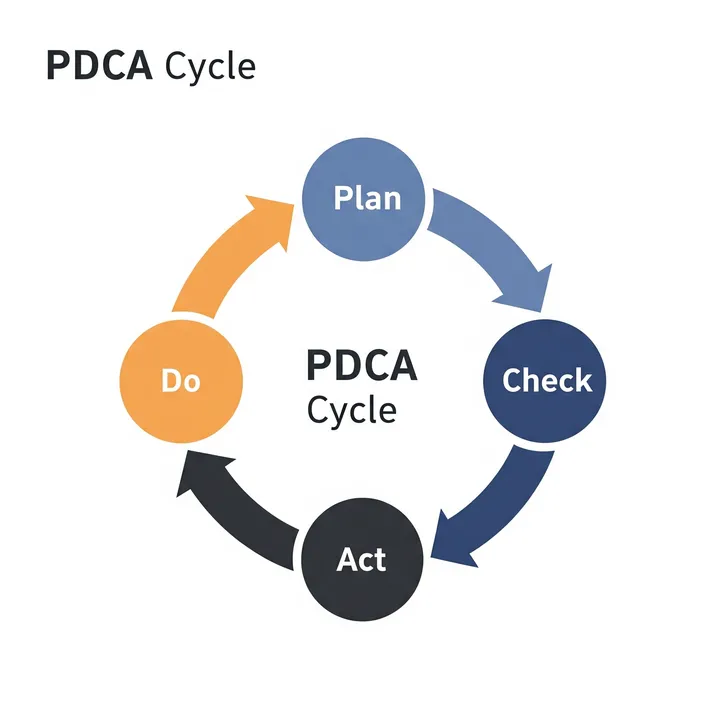
Claude drew a circle on the whiteboard and divided it into four sections: Plan, Do, Check, Act.
"PDCA—Plan, Do, Check, Act—is a framework for continuously improving operations by cycling through four stages," I explained. "It's especially effective for recurring, standardized work like inventory management. Rather than improving once and stopping, precision improves by continuing to turn the cycle and watching the numbers."
"Let's measure the current cost," Gemini said, opening ROI Polygraph and entering the operational logs and group company staff interviews Takahashi had provided.
The numbers returned.
"Monthly labor for the three group company inventory staff is in," Gemini read. "Inventory verification, reconciliation, and manual entry: 60 hours/month at ¥2,200/hour = ¥132,000/month. Eight sales offices' order handling and inquiries combined: 40 hours/month at ¥2,800/hour = ¥112,000/month. Total: ¥244,000/month in operating costs. Annualized: ¥2,928,000."
Takahashi stared at the numbers. "That doesn't include the opportunity cost of orders we missed due to the three-day lag."
"It doesn't," Claude answered. "Adding a projection for how many orders per month went unnoticed for three days would push the total higher. But today, let's focus on changing the structure."
"Then let's design with PDCA," I continued.
[P — Plan: Decide What to Change]
"The first decision in the Plan phase is how to redefine the group company's role," Claude said. "The group company staff currently receive faxes, manually enter data into Excel, and visually verify inventory counts. Of these three, which should be handed to the system?"
Takahashi thought. "Receiving faxes and entering data manually could both be replaced by a system. But—if those are replaced, the staff lose their work."
"Not lose—transform," Gemini said. "Monitoring inventory anomalies, managing updated versions of product manuals, judging timing of manufacturer orders—these are jobs that nobody is doing right now. When the system handles the routine work, staff can specialize in these jobs instead. Their role doesn't go down. It goes up."
Takahashi's expression softened slightly. "If I frame it that way, the group company might accept it."
"The second pillar of the Plan is unifying the order channel," I continued. "The current mix of fax, email, and phone gets consolidated into a single web form. When sales office staff fill out the form, it reflects in real time in the group company's system. No more checking a fax tray."
[D — Do: Execute in Stages]
"Execution moves through three stages," Claude said.
"Week 1: Deploy the order form. Roll out the unified web form to all eight sales offices. Operation should be explainable with a single one-page guide. Group company staff only need to receive the notification from the form."
"Week 2: Digitize inventory data. Migrate the Excel-managed inventory data to a cloud inventory system. Inventory counts update in real time—visual verification is no longer needed."
"Week 3 onward: Build demand forecasting," Gemini continued. "As order data accumulates, office-specific and product-specific ordering patterns become visible. Once three months of data has built up, add automatic suggestions for manufacturer order timing. This prevents both stockouts and excess old-version inventory."
[C — Check: Verify with Numbers]
"In the Check phase, record four indicators weekly," I continued.
"Order miss count, inventory reconciliation time, inquiries from sales offices, and group company staff overtime," Claude said. "If any indicator isn't changing, there's still an unsolved problem there. PDCA also runs to find the indicators that don't change."
[A — Act: Convert Improvement into the Next Plan]
"The Act phase converts what the Check uncovered into the next Plan," Gemini said. "If a particular sales office shows low adoption of the order form, that office's staff may need individual support. When the data is in, where to intervene becomes naturally visible."
Chapter 3: Resolving the Dilemma
"Let's project the investment plan through ROI Proposal Generator," I proposed.
Deployment costs and savings were placed side by side.
- Initial cost: Inventory management system deployment and configuration ¥900K
- Monthly cost: Cloud license ¥80K/month
- Monthly savings: Management side 55% reduction = ¥72,600; sales office side 70% reduction = ¥78,400; total monthly savings ¥151,000
- Net monthly improvement: ¥151,000 − ¥80,000 = ¥71,000
- Payback period: ¥900K ÷ ¥71,000 = approx. 12.7 months
"Payback just over a year," Gemini summarized. "Add in avoided opportunity loss from missed orders, reduced customer-handling costs from stockouts, and avoided disposal costs from old-version inventory, and the effective payback shortens further."
Takahashi folded her arms. "I'm still not sure how to communicate this to the group company."
"Let me ask one thing," Claude said. "Do the group company staff feel pride in their work right now?"
Takahashi thought. "If you ask whether receiving faxes and entering data gives them a sense of pride... I don't think so. They've said they're afraid of making mistakes."
"Then actually," Claude said quietly, "by having the system take over routine work, the staff are freed from work they're afraid of making mistakes in. Detecting anomalies, managing manual revisions—those require judgment. Those are jobs for people. Hand the routine to the system; keep the judgment with the people. That redefinition is the new form of protecting employment at the group company."
Takahashi exhaled slowly. "If I say it that way, it might get through."
Chapter 4: The Morning Orders Arrived
Five months later, a report arrived from Takahashi.
After the order form was deployed, the mixed fax, email, and phone order channels unified into one. From the week after deployment: order misses dropped to zero. The three group company staff members' monthly labor dropped from 60 hours to 27, and one staff member began devoting her freed-up time to inventory anomaly monitoring.
Three months of order data accumulated and sales office-specific ordering patterns became visible for the first time. Discovering that a particular office consistently ordered at month-end, they requested spreading orders through the month—and manufacturer order lead times stabilized. Old-version manual disposal costs fell 42% year-on-year.
Group company staff interview results were also in the report. One staff member said: "I no longer have to worry about entry errors. I can focus on watching the numbers now."
The final line of Takahashi's report read: "Running PDCA kept surfacing problems we hadn't initially seen. But that wasn't failure—it was becoming visible. When data accumulates, questions arise. When questions arise, the next Plan writes itself. PDCA was a map for improvement that never ends."
The morning a fax didn't come was gone. The morning orders arrived was here.
"The problem with inventory management was not inventory. It was the structure that prevented information from arriving. PDCA doesn't ask what to fix—it asks what to measure. Without measurement, change is invisible. Without visible change, improvement cannot begin. The invisible cost of analog ordering becomes a number the moment it's digitized. The moment it becomes a number, the next question is born. PDCA is a framework that keeps generating questions."
Related Files
Tools Used
- ROI Polygraph — Inventory management and order handling labor cost visualization
- ROI Proposal Generator — System deployment payback simulation


