
ROI Case File No.477 'The Inventory Was Lying'

The Inventory Was Lying
Chapter 1: System Inventory and Warehouse Inventory Don't Match
"Last month, we had a product the system showed as in stock that wasn't actually in the warehouse."
Shinichi Sano, Inventory Manager at GlobalBuild, opened an Excel sheet as he spoke. Imported building material SKUs and quantities lined up vertically. Several cells were highlighted in red.
"What are the red cells?" I asked.
"Discrepancies between system inventory and actual inventory," Sano answered. "This month's check found variances in seventeen SKUs. The largest had thirty more units in the system than in the warehouse. In other words, product that was supposed to be there wasn't."
"Do you know the cause?" Claude asked.
"Mostly, yes," Sano answered. "Sales staff reserve inventory when anticipating an order. When an order gets cancelled, they forget to release the reservation. The inventory stays reserved in the system while the actual stock has been shipped to the next customer. So the system shows inventory that doesn't exist."
"How often do reservation release failures occur?" Gemini asked.
"Eight to twelve times a month," Sano answered. "All eight sales staff are generating them—it's not concentrated in any one person."
"There's also a demand forecasting issue, I understand," I confirmed.
"Yes," Sano continued. "Imported building materials take two to three months from order to delivery. Despite that, our demand forecasting looks only at past shipment records. We're not tracking housing start data or material price trends. The result is simultaneous overstock and stockout."
"How much capital is the excess inventory locking up?" I asked.
Sano opened another sheet. "Total current inventory value: approximately ¥120,000,000. Of that, we estimate roughly ¥30,000,000 is stagnant—slow-moving inventory."
Chapter 2: The Three Eliminations of TPS
"This case calls for TPS."
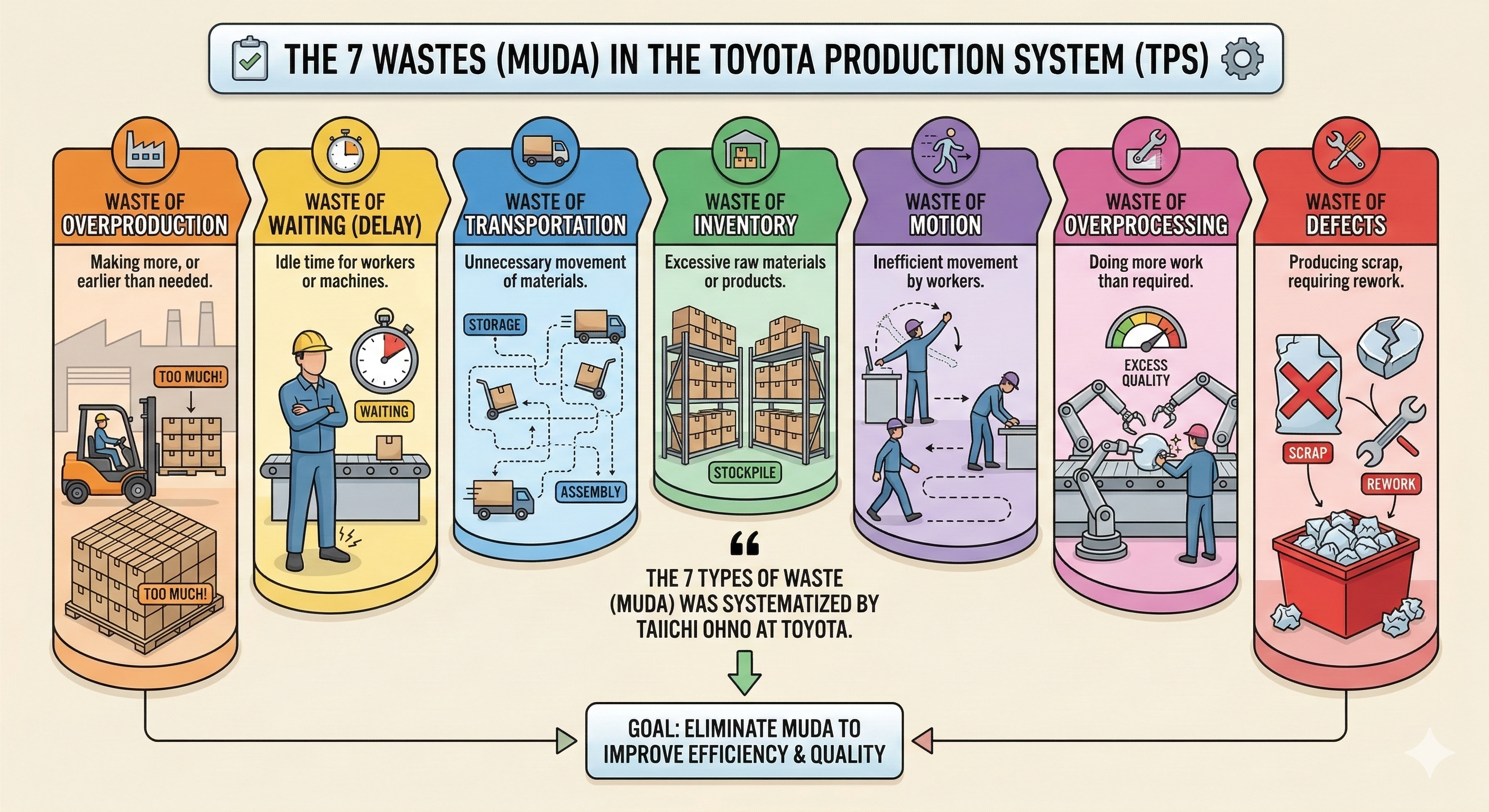
Claude wrote three terms on the whiteboard: Just-in-Time, Kanban, Elimination of Waste.
"TPS stands for the Toyota Production System—a framework that transformed inventory management in manufacturing," I explained. "Applying it to imported building materials with long lead times requires some adaptation, but the three core ideas hold for any industry: what's needed, when it's needed, in the quantity needed. GlobalBuild's challenges represent all three having collapsed simultaneously."
"Let's start by measuring the current cost," Gemini said, opening ROI Polygraph. Inventory data and reservation error logs from Sano were entered.
"Monthly inventory management costs are in," Gemini read aloud. "Inventory discrepancy verification and correction from reservation release failures: avg. 25 hrs/month at ¥2,700/hr = ¥67,500/month. Stockout response—emergency orders and customer coordination—avg. 15 incidents/month, 3 hrs each = 45 hrs, at ¥2,700/hr = ¥121,500/month. Capital cost of ¥30M stagnant inventory at 2% annual interest = ¥50,000/month. Total: ¥239,000/month. Annualized: ¥2,868,000. Opportunity cost from stagnant inventory not included."
Sano confirmed the numbers. "I'd never calculated stockout response cost before. Three hours per incident is realistic."
"Now let's work through TPS," I continued.
[Just-in-Time — Design Ordering Timing Around Demand]
"To achieve just-in-time with imported materials, you need ordering criteria that account for lead times," Claude said. "Currently, who makes order decisions and when?"
"Basically me," Sano answered. "There's a sense that when stock falls below a certain level, I order. But the threshold varies by SKU."
"The first task is defining reorder point and safety stock numerically by SKU," Gemini continued. "The formula: average demand during lead time + safety stock. Safety stock is estimated as the standard deviation of demand multiplied by the square root of lead time. When these numbers exist by SKU, decisions are driven by data, not instinct."
"Can we incorporate housing start data into forecasting?" Sano asked.
"Yes," Claude answered. "MLIT publishes monthly housing start statistics. We add those as an external variable in the order criteria. If starts are down from last month, reduce order quantity. If up, pull the reorder point forward. This monthly adjustment produces forecasting that goes beyond historical shipment data alone."
[Kanban — Make Reservation Status Visible to Everyone]
"The root cause of reservation release failures is that reservation status lives inside individual staff members' heads," Gemini said. "The Kanban philosophy is making status visible. If reservation status is visible to everyone in real time, failures drop structurally."
"Specifically," Claude continued, "we migrate from Excel to a cloud-based inventory management tool. When a reservation is entered, a cancellation deadline is automatically set. An alert goes to the responsible staff member the day before the deadline. If the deadline passes with no response, the reservation is automatically released. This design structurally eliminates release failures."
"Does the auto-release happen without confirming with the staff member?" Sano asked.
"Only if the alert is ignored," Gemini answered. "If the staff member confirms and needs to extend, they can. Auto-release only triggers when no action is taken. This design prevents both missed releases and over-reservation simultaneously."
[Elimination of Waste — Reduce Stagnant Inventory]
"Let's address the ¥30M in stagnant inventory," I continued. "First, rank stagnant SKUs by turnover rate. Items that haven't moved in six months become candidates for clearance sales or return negotiations. Next, reduce new order SKUs. The top 30% of SKUs by volume likely account for 80% of shipments."
"That's accurate," Sano nodded. "But we've been expanding our SKU range to meet customer requests."
"Reducing SKUs doesn't mean reducing value to customers," Claude said quietly. "Holding non-moving inventory means locking up capital that could fund moving inventory. If ¥30M is freed, you can order more of your best sellers, faster."
"Let's run the plan through ROI Proposal Generator," Gemini proposed.
A projection for cloud inventory system implementation and stagnant inventory clearance was produced.
- Initial cost: Cloud inventory system + order criteria design — ¥900,000
- Monthly cost: System subscription — ¥40,000/month
- Monthly savings: Zero reservation release failures = ¥67,500; 70% stockout response reduction = ¥85,050; stagnant inventory capital cost reduction = ¥25,000; total = ¥177,550/month
- Net monthly savings: ¥177,550 − ¥40,000 = ¥137,550/month
- Payback period: ¥900,000 ÷ ¥137,550 = approx. 6.5 months
"Payback within seven months," Gemini summarized. "Additionally, as ¥30M in stagnant inventory is cleared, there's a separate improvement in cash flow."
Chapter 3: Naming the Inventory
"Let me lay out the plan," I said, standing at the whiteboard.
"Month one—calculate reorder point and safety stock by SKU; rank stagnant inventory by tier. Month two—deploy cloud inventory management; configure reservation alert function. Month three—trial run of housing start-linked ordering criteria. Month four onward—monthly review of ordering criteria; continue clearing stagnant SKUs."
"Can I calculate the ordering criteria alone?" Sano asked.
"If your SKU count is high, I'll help with the initial pass," Gemini answered. "We'll embed the formula into an Excel template and hand it to you. After that, updating the numbers is all you need to do to regenerate the criteria."
Sano looked at the stagnant inventory list. "This ¥30M has been sitting in the corner of the warehouse for a long time. I knew it wasn't moving. But I couldn't get myself to let it go."
"Inventory becomes an asset only when it sells," I said quietly. "Non-moving inventory is money asleep. While it sleeps, warehouse space and capital costs accumulate. Clearing it is the most rational decision."
Chapter 4: The Day System and Warehouse Numbers Matched
Eight months later, a report arrived from Sano.
One month after cloud inventory went live, reservation release failures dropped from a monthly average of ten to zero. "The alert comes, so forgetting is impossible," one of the sales staff said, as Sano noted in his report.
Inventory discrepancy verification time fell from 25 hours to 3 hours per month. Stockout incidents fell from 15 to 4 per month.
Stagnant inventory clearance—through discounted sales and partial return negotiations—resolved approximately ¥9M over six months. The remaining ¥21M was still being cleared, but new-order stagnation had stopped, and Sano projected 70% resolution within six months.
From the month housing start statistics were integrated into order criteria, zero new stagnation from over-ordering had occurred.
Sano's final lines: "When system inventory and warehouse inventory match, you can trust the numbers. When you make ordering decisions from numbers you trust, the decisions come faster. When decisions come faster, both overstock and stockout decrease. From the day the inventory stopped lying, the feeling of the work changed."
The day the inventory started telling the truth.
"Inventory lies because the reservation status isn't visible. What you can't see, you can't manage. TPS's three eliminations—Just-in-Time, Kanban, Waste—are a design for having what's needed, when it's needed, in the quantity needed. Even with long lead times on imported materials, housing start data holds leading signals for demand. When those signals become numbers, intuition becomes criteria. On the day ¥30M in stagnant inventory began to move, the money asleep in the corner of the warehouse opened its eyes."
Related Files
Tools Used
- ROI Polygraph — Visualizing inventory discrepancy, stockout response, and stagnation costs
- ROI Proposal Generator — Simulating ROI on cloud inventory management implementation

