
ROI Case File No.480 'Two Hundred and Fifty Calls a Day'

Two Hundred and Fifty Calls a Day
Chapter 1: The Phones Never Stop Ringing
"Two of our five guidance lines are constantly overwhelmed. The phone rings nonstop, and missed calls are stacking up."
John Smith, CEO of Zenith Automations, spread materials on the table. The client was Arai Shoji Co., Ltd.—a nationwide used car auction chain. Their Koyama venue had told them phone operations were at a breaking point.
"How many calls come in per day?" I asked.
"An average of 250 to 300," John answered. "During peak periods, even more. The days immediately before and after auction events are especially concentrated."
"What types of calls are most common?" Claude asked.
"Four types," John answered. "General inquiries, data change requests, payment confirmations, and irregularity handling. About half—100 to 150 calls—are routine inquiries. Things like auction schedules, consignment fee confirmation, registration procedures. Inquiries where the answer is fixed are filling up the staffed lines."
"Fixed-answer inquiries are making non-fixed-answer inquiries wait," Gemini summarized.
"Exactly," John continued. "Irregularity handling and payment disputes require staff to verify while responding. But those lines are occupied by routine inquiries. Complex calls get deprioritized. Frustrated customers call again. The volume climbs."
"Is there a chatbot currently in place?" Claude asked.
"Yes. An old one, but it's running," John answered. "Most people don't use it. The information is outdated and it can't answer many questions. Customers try it, decide it's useless, and call anyway."
"Has AI adoption been attempted before?" I asked.
"This isn't the first time," John answered. "We evaluated another system a year ago, but the initial cost was too large to commit to. This time we want to start small. We don't want to repeat the failure of last time—where we couldn't move because we tried to solve everything at once."
"Starting small—that's today's topic," I said.
Chapter 2: The Minimum Viable Validation of MVP
"This case calls for MVP."
Claude wrote three letters on the whiteboard: M, V, P.
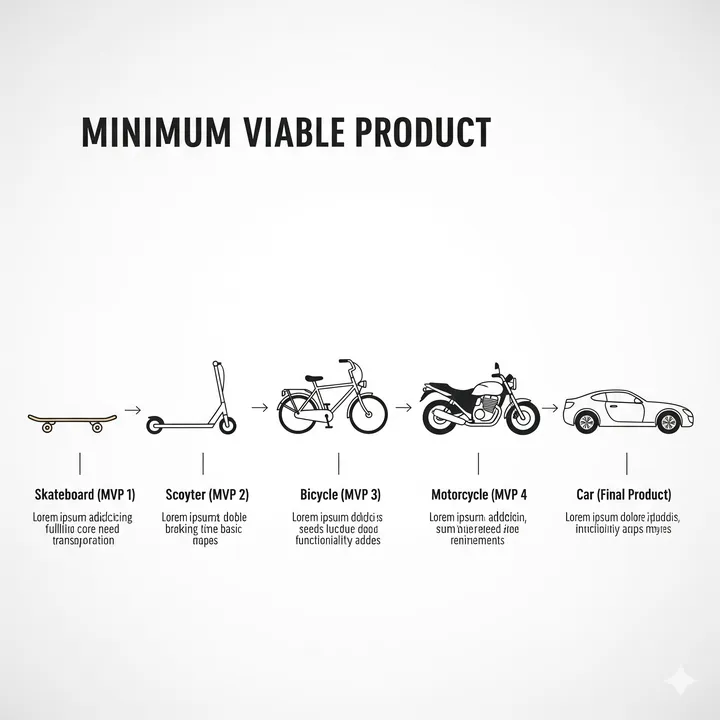
"MVP stands for Minimum Viable Product—a framework where a prototype with minimal functionality is used to run a verification," I explained. "The most common AI adoption failure is designing toward a complete solution—and becoming immobilized because everything needs to be in place before launch. MVP starts by defining the minimum unit that allows you to move. Deciding first what's minimum and what can come later—that judgment is what prevents repeating last year's failure."
"Let's start by measuring the current cost," Gemini said, opening ROI Polygraph. Call records and venue staff work logs from John were entered.
"Monthly phone operation costs are in," Gemini read aloud. "Six staff handling an average of 6,000 calls/month. Average handle time 3 minutes/call = 300 hours/month. At ¥2,200/hr: ¥660,000/month. If half are routine inquiries: ¥330,000/month spent on fixed answers. Opportunity cost from missed calls—assuming 50 lost customers/month who didn't get through, at ¥30,000 avg. transaction each: ¥1,500,000/month estimated. Total: ¥1,830,000/month. Annualized: ¥21,960,000."
John said quietly, "I'd never calculated the opportunity cost. Never counted the customers on the other end of the calls we couldn't take."
"Now let's design with MVP," I continued.
[MVP Layer One — The Maximum Problem Solvable with the Minimum]
"The first decision in MVP design isn't what's minimum—it's what's most painful," Claude said. "Arai Shoji's most painful problem is routine inquiries filling the lines and pushing complex calls to the back. Therefore, the MVP goal is automating routine inquiries. We limit it to exactly that."
"Chatbot or AI phone?" John asked.
"One—not both," I answered. "Since an existing chatbot is already running, adding AI capability to it is faster, cheaper, and lower risk than a full new deployment. We trial the existing chatbot MVP first."
[MVP Layer Two — Start with Minimal Data]
"We narrow the information the chatbot registers," Gemini continued. "Trying to answer every possible inquiry means spending too long on data preparation. First, create a state where only the top ten routine inquiry types can be answered. That's the MVP for information design."
"How do we identify the top ten?" I asked.
"We have staff log the content of every call for one week," Claude answered. "Compiling that log gives a clear top ten. This one week is the MVP's data collection phase."
"Last year, the information preparation took too long and the project stalled," John said.
"With only ten types, preparation finishes in one week," Gemini answered. "Instead of preparing everything before launching, we launch with ten and add what's missing after going live. MVP expansion only happens once it's running."
[MVP Layer Three — Where AI Phone Fits]
"Once the chatbot MVP is stable, we then consider AI phone," I summarized. "The AI phone MVP is routing. Incoming calls are routed by content—routine inquiries are directed to the chatbot; complex inquiries are connected to the staffed line. Routing is the only function AI phone gets. Answering calls is not in scope initially."
"AI doesn't answer?" John confirmed.
"Limiting to routing improves precision," Claude answered. "When AI tries to answer, errors occur. Wrong answers create customer dissatisfaction. With routing only, misroutes can be caught by humans. MVP is designed so failures are recoverable."
"Let's run the implementation plan through ROI Proposal Generator," Gemini proposed.
Costs for chatbot enhancement and AI phone routing deployment were produced.
- Initial cost: AI capability addition to existing chatbot + phone routing configuration — ¥600,000
- Monthly cost: Incremental subscription increase — ¥30,000/month
- Monthly savings: 50% routine inquiry automation = ¥165,000; 30% opportunity cost reduction = ¥450,000; total = ¥615,000/month
- Net monthly savings: ¥615,000 − ¥30,000 = ¥585,000/month
- Payback period: ¥600,000 ÷ ¥585,000 = approx. 1.0 months
"Payback in one month," Gemini summarized. "Opportunity cost reduction is the largest driver. When missed calls can be answered, payback accelerates."
John reviewed the numbers. "Last year the quote was for the complete solution. The initial cost was completely different under MVP thinking."
"Lower initial cost means faster decisions," I responded. "Faster decisions mean you can start moving."
Chapter 3: Why Start with the Minimum
"Let me lay out the plan," I said, standing at the whiteboard.
"Week one—staff log call content for all incoming calls. Week two—compile the log; prepare answers for the top ten types; register in the chatbot. Week three—chatbot MVP goes live. Staff review all interactions and evaluate response accuracy. Week four—configure AI phone routing. Record audio directing routine inquirers to the chatbot. Month two—run both in parallel; review routine inquiry self-resolution rate weekly."
"Could staff resist?" I asked John.
"Possibly," John answered. "They might worry their jobs are being taken."
"Let's think about how to communicate it," Claude said. "There's one thing to tell staff: AI handling routine inquiries means you can focus on the complex ones. Ask them first—what's the part of your job that stresses you most?"
"I think it's having to apologize to customers who couldn't get through," John answered.
"Tell them that's going to decrease," Claude said quietly. "Not 'your job is being taken'—'you're being freed from apologizing.' That framing changes how staff respond."
Chapter 4: The Day the Missed Calls Stopped
Five months later, a report arrived from John.
Two weeks after the chatbot MVP launched, the chatbot self-resolution rate for routine inquiries reached 47%. Monthly routine phone inquiries fell 31%. One of the overloaded guidance lines stabilized outside of peak periods.
A staff survey found five of six said "I find myself apologizing less." Four said "I can focus on complex inquiries now." Zero said "AI feels like it's taking my job."
AI phone routing launched in month three. After the audio redirecting routine inquirers to the chatbot was implemented, chatbot utilization climbed from 47% to 63%.
John's final lines: "Last year we calculated backwards from the complete solution and stopped at the initial cost. With MVP thinking, we had a live deployment within the first month. What we learned by running it made every subsequent design decision more precise. The day the missed calls decreased, the venue manager called to tell me it was the first time the staff had left on time."
The day two hundred and fifty calls a day could be handled by half the people.
"Designing toward a complete solution means you can't move. What MVP asks is: what's the minimum that lets you run a real verification? For Arai Shoji, the minimum was the top ten routine inquiry types. When ten types were automated, half the calls changed. When half the calls changed, the other half got attention. Starting with the minimum isn't compromise. It's the shortest path to movement. On the day the staff who had been apologizing to customers for unanswered calls could finally focus on the complex ones, two hundred and fifty calls started to mean something different."
Related Files
Tools Used
- ROI Polygraph — Visualizing phone operation hours and opportunity cost
- ROI Proposal Generator — Simulating ROI on phased MVP AI deployment


