
ROI Case File No.487 'HR Split into Three'

HR Split into Three
Chapter One: Mornings Opening Three Systems
"Every month from the 21st to the 25th, I bounce back and forth among three systems."
Keiko Sasaki, HR Director at GlobalTech, switched screens to demonstrate. Labor management SmartHR, a separate-vendor attendance system, another system for payroll—separate logins, separate screen designs.
"Heading into payroll close, we reconcile data among the three," Sasaki continued. "Export attendance data, import into payroll. Check social-insurance changes from labor data, reflect into payroll side. HR master data exists in all three, and we check which is latest every month."
"How many employees?" I asked.
"About 280," Sasaki answered. "Running three systems in parallel at this scale is clearly excessive. But each system was introduced from different context, and we've never had the occasion to integrate."
"What are the complaints about SmartHR?" Claude confirmed.
"Several," Sasaki answered. "Support is thin. Responses to inquiries take three days sometimes. Pricing has been continuously rising. Up 60% in annual cost compared to three years ago. And we want to run our own evaluation system, but custom-item flexibility falls short."
"How do you handle payroll calculation and various applications?" Gemini asked.
"We outsource to a labor and social security attorney (sharoushi)," Sasaki answered. "Monthly cost ¥350,000. But data preparation for the sharoushi consumes 40 hours monthly on our side. Effectively paying double cost."
"April 2027 SmartHR renewal is the switchover timing, you mentioned?" I confirmed.
"I want to move then," Sasaki answered. "But receiving proposals from multiple vendors with different angles makes comparison impossible. Without information organization first, we can't determine what axis to judge on."
"You can't decide from comparisons without information organization," I said quietly. "MECE is the tool for that organization."
Chapter Two: The Overlap and Omission MECE Demands
"This case needs MECE."
Claude wrote four letters on the whiteboard. M, E, C, E.
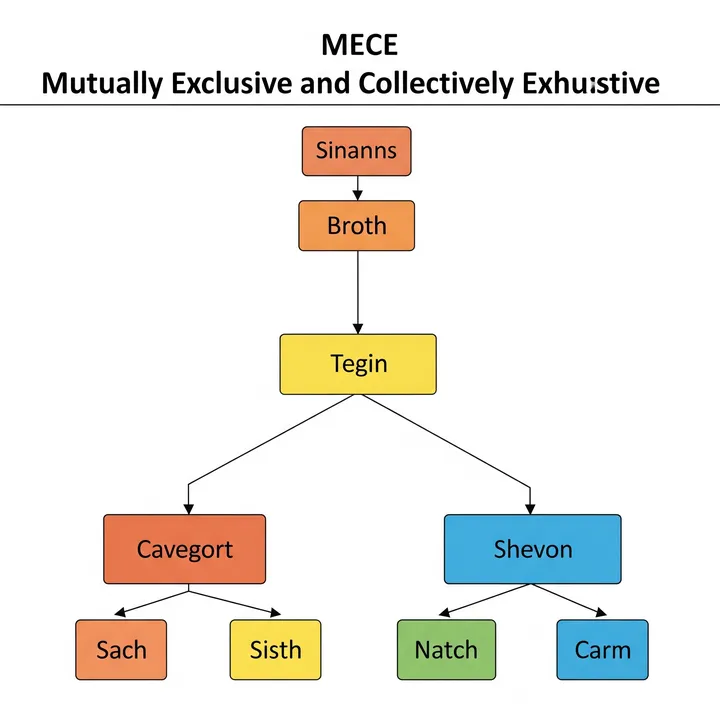
"MECE means Mutually Exclusive, Collectively Exhaustive," I explained. "When organizing complex problems, overlapping items cause circular discussion. Omissions cause unexpected problems later. MECE questions the quality of how you slice the problem. In domains where boundaries blur easily—like labor, attendance, and payroll—MECE decomposition is the starting point of selection."
"Let's measure current cost first," Gemini said, opening ROI Polygraph. Sasaki's operational logs went in.
"Monthly labor-related cost is out," Gemini read. "Four HR staff spend 150 hours on month-end close. At ¥3,200/hour, ¥480,000. Sharoushi outsourcing ¥350,000, data preparation for sharoushi 40 hours at ¥128,000. Three-system data integrity check 60 hours at ¥192,000. SmartHR tool fee ¥80,000. Attendance system ¥40,000, payroll system ¥60,000. Total: ¥1.33 million monthly. Annualized: ¥15.96 million."
Sasaki checked the numbers. "Both tool fees and labor are stacking up."
"So, let's design with MECE," I continued.
[MECE Axis One—Decompose the HR Function Landscape]
"Decompose HR and labor functions without overlap or omission," Claude said. "Into five. First, HR master management—employee information ledger. Second, attendance management—clock-in/out, leave, overtime records. Third, payroll and bonus calculation. Fourth, social insurance and labor procedures—onboarding, offboarding, insurance enrollment, applications. Fifth, evaluation management—HR evaluation records and operation. These five cover nearly all of HR."
"How are they currently split?" Sasaki asked.
"First and fourth in SmartHR, second in a separate-vendor attendance system, third in a payroll system, fifth effectively in Excel," Claude organized. "First—HR master exists as copies in the second and third systems. That's overlap. Fifth—evaluation isn't sufficiently handled in any system. That's omission."
[MECE Axis Two—Decompose Function Integration Options]
"Enumerate function-integration patterns without overlap or omission," Gemini continued. "First, integrated—one system covering all five functions. Second, hub—HR master as hub, connecting attendance, payroll, evaluation. Third, status quo—only strengthening connections among the three systems. These three nearly exhaust the options."
"Integrated seems ideal," Sasaki said.
"It seems so," I answered. "But integrated's weakness is that one weak function weakens all. Attendance management, for example, is richer in specialist vendors. Hub, conversely, unifies HR master while using specialist systems for attendance and payroll. For GlobalTech's scale and unique evaluation system, hub is the realistic candidate."
[MECE Axis Three—Decompose Selection Criteria]
"Decompose system selection criteria," Claude continued. "First, functional fit—to what extent each of five functions meets required specs. Second, connectivity—ease of API integration with other systems. Third, customizability—support for unique evaluation system. Fourth, support—inquiry response speed and quality. Fifth, total cost of ownership—5-year total including license, integration development, operations maintenance."
"Current SmartHR stumbled on the fourth," Sasaki confirmed.
"Correct," Gemini answered. "Even if functional fit rates high, weak support stops operations in practice. Having multiple criteria builds a structure that doesn't judge by specific strength alone."
[MECE Axis Four—Decompose the In-house Boundary]
"Decompose sharoushi outsourced work by in-house feasibility," I continued. "First, work requiring legal-change response—social insurance procedures, labor law response. Second, payroll calculation execution—with a system, execution itself is easy. Third, various application form creation and submission. Fourth, specialist judgment—payroll design, work rules amendment."
"How much can we bring in-house?" Sasaki asked.
"Second and third become feasible in-house via new system introduction," Claude answered. "First and fourth retain value for sharoushi consultation. Rather than bringing everything in-house, defining the domain to bring in-house balances outsourcing-cost reduction and retained expertise."
"Let's simulate with ROI Proposal Generator," Gemini suggested.
- Initial cost: HR master integration system, attendance/payroll integration development, data migration, training totaling ¥9.5 million
- Monthly cost: Integration system ¥150,000, continuing attendance and payroll systems ¥100,000, sharoushi fees limited to specialist work ¥150,000, totaling ¥400,000
- Monthly savings: Month-end labor reduction ¥320,000 (~70% reduction), integrity check reduction ¥192,000, sharoushi outsourcing reduction ¥200,000, sharoushi data prep reduction ¥100,000, totaling ¥812,000
- Net monthly savings: ¥812,000 − (¥400,000 − previous total ¥180,000) = ¥592,000
- Payback period: ¥9.5M ÷ ¥592,000 ≈ 16.0 months
"Just under a year and a half for payback," Gemini summarized. "Year two and beyond continues at ¥7.1 million annually in net savings. Considering SmartHR's rising trend, the five-year cost scenario without switching likely exceeds current cost. Moving now also stops future cost inflation."
Sasaki reviewed the figures. "When we introduced SmartHR three years ago, I thought this would integrate. Now I'm considering the next integration. Today's organization is needed so I don't repeat the same mistake."
Chapter Three: Toward Overlap-Free, Omission-Free Selection
"Let me organize the approach," I said at the whiteboard.
"Month one—document current business flow for each of the five HR functions. Month two—information collection from three vendors for each of integrated type and hub type, six companies total. Month three—primary screening on the five selection criteria, RFP issued to three companies. Month four—proposal reception and comparison evaluation, one company decision. Month five onward—development and migration prep toward April 2027 switchover."
"Do we proceed assuming hub type?" Sasaki confirmed.
"We look at both hub and integrated," Claude answered. "Narrowing to one early makes invisible options multiply. Once proposals are received, the optimal form for GlobalTech becomes visible."
Sasaki closed her materials. "I was thinking between continuing three systems or integrating into one. Hub type—a third option—became an option for the first time today."
Chapter Four: The Day Month-End Closed in Two Days
Thirteen months later, a report from Sasaki arrived.
After examination, a hub configuration was adopted. HR master was unified on an integration platform, attendance management continued with the existing specialist vendor, payroll migrated to a new system. Two months after April 2027 launch, month-end shortened from five days to two days. "The time spent bouncing among three systems disappeared," Sasaki wrote.
The sharoushi relationship converted: monthly payroll outsourcing was terminated, and only legal-change response and work-rules consultation remained on retainer. Monthly fee dropped from ¥350,000 to ¥150,000. The sharoushi also responded positively, "Can now concentrate on actual specialist work."
The unique evaluation system's operation completed within the new system's custom-items feature. Evaluation sheet distribution through aggregation, previously manual in HR, became automated, and overtime during evaluation periods dropped to near zero.
The biggest change was in HR staff voices. "No longer dreading month-end" and "With data in one place, can immediately answer executive questions"—the report excerpted from an attached survey.
In the cost comparison against a SmartHR-continuation scenario, the 5-year total estimated approximately ¥43 million in savings. "The gap between a system that keeps rising and an integration platform hard to raise prices on widens with time," Sasaki wrote.
A day when HR split into three began running on one ledger.
"HR split into three systems produced three month-end works. What MECE asks is overlap-free, omission-free decomposition. Labor, attendance, payroll, procedures, evaluation—decompose into five, and where overlap exists and where omission exists becomes visible. Integrated, hub, or status quo—decompose into three, and GlobalTech's optimum becomes visible. Once overlap-free, omission-free decomposition is done, selection proceeds naturally. On the day HR split into three became one ledger, month-end mornings became a different time."
Related Files
Tools Used
- ROI Polygraph — Visualizing labor, attendance, payroll fragmentation costs and outsourcing costs
- ROI Proposal Generator — HR system integration payback simulation


