
ROI Case File No.491 'The Night AI Interviews Brought Applicants Back'

The Night AI Interviews Brought Applicants Back
Chapter One: One Week After Application, Candidates Disappear
"It takes an average of six days from application to scheduling an interview."
Atsushi Fujikawa, CEO of TechNova, opened his recruitment management spreadsheet as he spoke. Application channels were split three ways: phone, email, and a recruitment app. Different staff handled each, and their available hours didn't align.
"Last summer at a trade show, we received a proposal for an AI interview system," Fujikawa continued. "It looked useful, but we judged the price didn't justify it and passed. Six months later, the situation has worsened. We're seeing more cases where applicants commit to other companies before we even schedule an interview."
"Do you track monthly applicant numbers and the interview reach rate?" Claude asked.
"We average 45 applications per month," Fujikawa answered. "Of those, 28 reach the interview stage. The remaining 17 either decline during scheduling or stop responding."
"You mentioned earlier that interview time slots are difficult to coordinate," Gemini said. "What specifically?"
"Working hour management has tightened," Fujikawa replied. "We can't add overtime for interviewers. Daytime is filled with regular work, and we can only secure two hours for interviews, from 4 PM to 6 PM. That often doesn't match candidates' preferred times. Most candidates want slots after their current job's end of day."
"Candidate intent cools during the six days between application and interview," I said quietly. "Recruitment should be viewed through the same structure as advertising."
Chapter Two: ROAS Asks About the Profitability of Recruitment Spend
"This case requires ROAS."
Claude wrote four letters on the whiteboard: R, O, A, S.
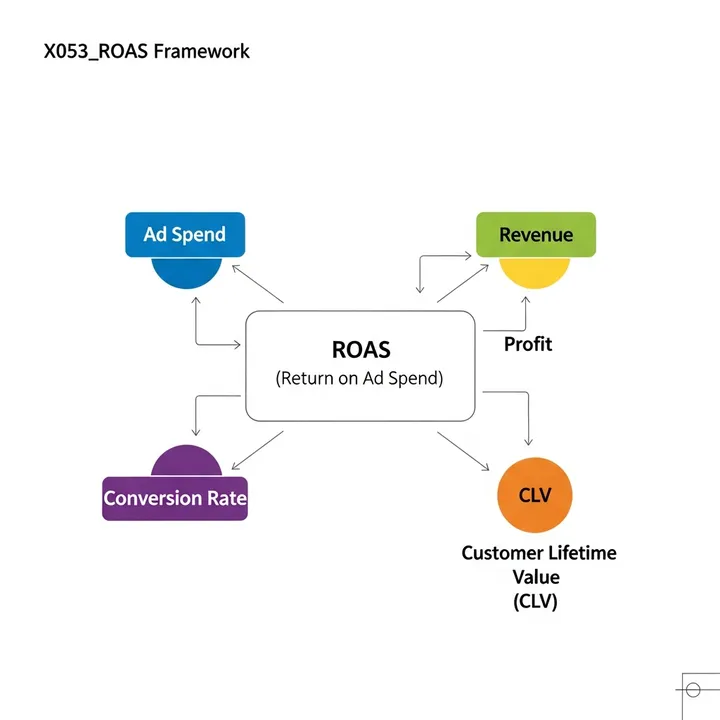
"ROAS stands for Return On Advertising Spend, a metric that measures revenue against advertising expenditure," I explained. "Recruitment operations share a remarkably similar structure with advertising. Fees paid to job platforms are advertising costs. Applications are responses. Interview reach and offers are conversions. A single hire is equivalent to a closed deal. Through a recruitment ROAS lens, attrition between application and interview is structurally identical to 'paying advertising costs to acquire leads, then losing them through delayed response.'"
"Let's first measure current costs and losses," Gemini said, opening ROI Polygraph. She entered the recruitment data Fujikawa had provided.
"Monthly recruitment ROAS losses are out," Gemini read. "Job platform advertising spend averages 650,000 yen per month. With 45 applications acquired through this, the cost per application is approximately 14,000 yen. Since 17 candidates drop out during scheduling, roughly 240,000 yen per month in acquisition costs is being neutralized."
Gemini continued. "Additionally, three interviewers spend an average of 90 hours per month on application response and scheduling. At 3,500 yen per hour, that's 315,000 yen monthly. The high per-hire workload keeps the cost per hire elevated. On top of that, the opportunity cost from delayed hiring fulfillment due to lower interview reach rates averages 400,000 yen monthly—the operational burden increase from unfilled positions. In total, 955,000 yen per month is generated from structural inefficiencies in the recruitment flow. That converts to approximately 11.5 million yen annually."
Fujikawa stared at the figures. "We're throwing away advertising spend after the applications come in."
"Now let's design with ROAS," I continued.
[ROAS Layer One—Decomposing the Cost per Acquisition]
"There are two ways to raise recruitment ROAS," Claude said. "Lower advertising costs, or raise conversion. Lowering ad costs has limits in platform selection. The bigger room for improvement lies on the conversion side—raising the rate from application to interview reach."
"Specifically?" Fujikawa asked.
"We aim for same-day interview booking on application day," I answered. "If the current six days shrinks to same-day, we can recover most of those 17 dropouts. The AI interview becomes a window that operates on candidate-friendly hours. The 4-to-6 PM constraint disappears."
[ROAS Layer Two—Making the Interview Window 24/7]
"The role of AI interviewing isn't just first-stage automation," Gemini continued. "A 24-hour window means candidates can interview after work or on weekends. Application to interview completion can be done same-day at the fastest."
"Human-led second interviews remain, correct?" Fujikawa confirmed.
"They remain," Claude agreed. "AI handles the first round. AI determines basic suitability and matches with desired conditions, and only those who pass advance to a human-led second interview. Since second-round candidates are pre-filtered, interviewer workload drops, and that freed time can be invested in higher-quality interviews. Both sides improve in quality."
[ROAS Layer Three—Redesigning the Conversion Path]
"We integrate the application channels," I continued. "The three channels of phone, email, and recruitment app are consolidated around the recruitment app as the starting point. Phone and email inquiries are still received, but ultimately funneled to the app for end-to-end progression to AI interview booking. The more channels diverge, the more response gaps and delays occur."
[ROAS Layer Four—Calculating Investment Recovery]
"Let's run the numbers with ROI Proposal Generator," Gemini suggested.
The costs and recruitment ROAS improvement effects of AI interview implementation lined up.
- Initial cost: AI interview system implementation, recruitment flow redesign, application channel integration setup, interviewer training. Total: 2.8 million yen
- Monthly cost: AI interview system usage fee 150,000 yen
- Monthly improvement: Reduction in dropouts validating ad spend = 200,000 yen (recovering roughly 14 of 17), application response workload reduction = 210,000 yen (recovering 60 of 90 hours), opportunity cost improvement from faster fulfillment = 300,000 yen. Total: 710,000 yen monthly
- Net monthly improvement: 710,000 − 150,000 = 560,000 yen
- Payback period: 2,800,000 ÷ 560,000 = 5 months
"Payback within five months," Gemini summarized. "From year two onward, net improvement of 6.7 million yen per year continues. Furthermore, reduced overtime for interviewers aligns with tightened working hour management. That's a secondary effect that doesn't appear in the numbers."
Fujikawa reviewed the figures and said, "Six months ago at the trade show, I passed because I was only looking at price. When you put advertising loss and workload alongside the cost, the basis for judgment changes."
"Recruitment is the same as advertising," I responded. "Through cost per acquisition, paused investments start moving."
Chapter Three: Interviews Begin on Application Day
"Let me organize the rollout," I said, standing at the whiteboard.
"Week 1—Submit requirements to three AI interview vendors and receive proposals. Weeks 2–3—Select one vendor, sign contracts, and design integrated application channels. Week 4—Design AI interview question items, agree on evaluation criteria, train interviewers. Week 5—Trial run with mock interviews from five employees to verify accuracy. Week 6—Reflect the new flow on job platforms and go live. Week 7 onward—Weekly monitoring of average time and pass rates from application to second interview."
"Who designs the AI interview questions?" Fujikawa asked.
"We reference your top current interviewers and historical hire data," Claude answered. "We articulate what your best interviewers look for in first-round interviews and translate that into question items the AI can evaluate. From the data, we extract trends among past successful hires and early-departing hires, then incorporate those into the evaluation criteria. What we delegate to AI is the automation of judgment; the design of the judgment axis is done by humans."
Fujikawa closed his materials and said, "In the six months I passed for price, we lost 11 million yen worth."
Chapter Four: The Day the Interview Window Operated Through the Night
Seven months later, a report arrived from Fujikawa.
The average time from application to second interview had shortened from six days to 1.4 days, three months after launch. AI interviews taken on the same day as application accounted for 40 percent of all applications, with particularly heavy AI interview activity in the post-work hours of 8 to 10 PM. "While our company sleeps, the interview window is processing applications," Fujikawa wrote.
Dropouts decreased from a monthly average of 17 to 4. Among the recovered applicants, three additional hires per month materialized. "When applicants we paid advertising to acquire actually reach interviews instead of dropping out—just that alone gives recruitment ROAS a different picture," the report noted.
Application response workload for the three interviewers fell from 90 hours per month to 25. The freed hours were redirected to improving the quality of second interviews for AI-screened candidates. Second interview duration extended from 30 minutes to 50 minutes, and signs of declining early turnover began to appear. "Volume processed in round one, quality elevated in round two"—the division of labor was working.
The most unexpected change was in the channel mix. After AI interview launch, recruitment app applications exceeded 70 percent of the total, while phone and email applications declined naturally. Candidates began choosing the path "where you can interview right after applying." Channel integration completed faster than expected, driven by candidates' own behavioral shifts.
The end of Fujikawa's report read: "Six months ago, I passed for price. This time, I judged by ROAS. The same product, viewed through a different metric, produces an inverted conclusion."
He noted that checking interview completion notifications that arrived overnight had become a daily morning ritual.
"Recruitment shares the same structure as advertising. How much you pay per application and how many close as hires—through cost per acquisition, paused investments start moving. Six days between application and interview cools the candidate's intent. Open the window before it cools, and dropouts decrease. What AI interviewing solved was not the manpower problem. It was the structural problem of response delays after advertising costs are paid. On the night the interview window operating through the dark hours brought applicants back, the ROAS numbers quietly inverted."
Related Files
Tools Used
- ROI Polygraph — Visualizing ad spend loss and response workload in recruitment flow
- ROI Proposal Generator — Investment recovery simulation for AI interview implementation

