
ROI Case File No.478 'The Whiteboard Was the Production Plan'

The Whiteboard Was the Production Plan
Chapter 1: When It Gets Erased, Nobody Knows Anymore
"The production plan is written by hand on a whiteboard in the factory. When it gets rewritten at the morning briefing, the previous plan is gone. No record of what changed."
Takashi Onishi, Head of Manufacturing at TechNova, placed a photo on the table. A large whiteboard along the factory wall. SKUs, quantities, and staff names written in marker. A red notation in the corner read "CHANGE."
"How often do changes occur?" I asked.
"Every day," Onishi answered. "Orders shift, materials don't arrive, equipment goes down—the reason is different every time, but there isn't a day when the plan doesn't change. Every change means someone updates the whiteboard and announces it verbally. Anyone who didn't hear the announcement keeps working from the old plan."
"Have there been errors caused by the verbal communication gap?" Claude asked.
"Yes," Onishi answered immediately. "Last month a staff member who hadn't heard about the change prepared materials from the old plan. We didn't notice until the afternoon. Staying late to meet the shipment deadline. That overtime came from a communication failure in the plan change."
"You also mentioned issues with inventory management and monthly reporting," Gemini confirmed.
"Both are visual inspection and manual work," Onishi continued. "Staff walk the shelves and count inventory. Monthly reports require pulling data from the core system, pasting it into Excel, building charts—three people spend two full days on it. During those two days, those three people can't do anything else."
"You mentioned the parent company is asking for AI adoption," I confirmed.
"The word 'AI' is just floating around, it feels like," Onishi said with a slight smile. "No concrete image of what to use it for. I came today because I wanted to make that concrete."
Chapter 2: ROAS and the Investment-to-Return Ratio
"This case calls for ROAS."
Claude wrote four letters on the whiteboard: R, O, A, S.
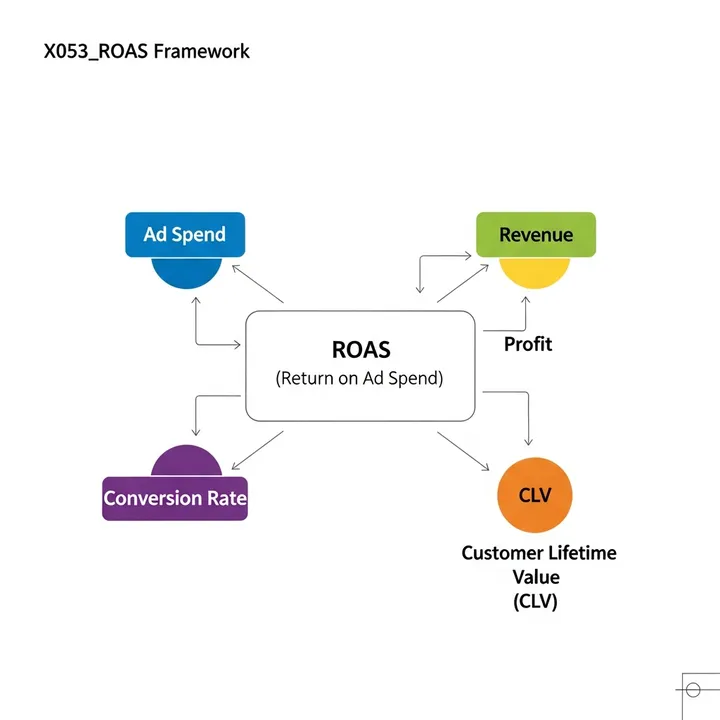
"ROAS stands for Return On Advertising Spend—an index for measuring how much revenue is generated per advertising dollar," I explained. "But the core logic—how much return do you generate per unit invested—applies directly to prioritizing AI implementation. Which AI tools should receive how much investment, and how much cost will that eliminate? Applying ROAS thinking to the three challenges reveals the sequence by return on investment."
"Let's start by measuring the current cost," Gemini said, opening ROI Polygraph. Work logs and incident records from Onishi were entered.
"Monthly costs across the three challenges are in," Gemini read aloud. "Overtime from production plan communication errors: avg. 4 incidents/month × 2 hrs × 5 staff avg. × ¥3,000/hr = ¥120,000/month. Manual inventory checks: 4 times/month × 2 staff × 3 hrs × ¥3,000/hr = ¥72,000/month. Monthly report manual work: 3 staff × 2 days × 8 hrs × ¥2,800/hr = ¥134,400/month. Total: ¥326,400/month. Annualized: ¥3,916,800."
Onishi confirmed the numbers. "I'd never calculated the whiteboard cost. Communication errors costing over ¥1.4M annually—"
"Now let's design the priority through ROAS," I continued.
[ROAS Priority — Which Has the Highest Return per Investment?]
"We rank the three challenges by ROAS," Claude said. "First: automated monthly report generation. Investment is small, savings are largest. Pulling data from the core system and auto-generating a report is covered by off-the-shelf tools. Second: digital production planning. Deploy a cloud production management tool so all changes are notified to everyone in real time. Third: inventory sensor automation. IoT sensors or camera-based auto-counting has high initial cost and a longer payback period."
"I had been about to start with the third option," Onishi said. "Sensor visibility on equipment looks impressive to the parent company."
"Starting with what looks impressive lowers the ROAS," I said quietly. "Start with what has the largest effect and the fastest payback. That sequencing is what makes AI adoption succeed."
[Move One — Automated Monthly Report Generation]
"Three reasons this comes first," Gemini continued. "First, the core system already exists. The data source is defined, so tool configuration is simplest. Second, savings are the largest at ¥134,400/month. Third, when those three people have their two days back, they can participate in the production plan digitization project. The first move enables the second."
[Move Two — Digital Production Planning]
"The goal is a state where everyone receives a simultaneous notification the moment a plan changes," Claude said. "A cloud production management tool sends a push notification to all relevant staff whenever a plan update is entered. The whiteboard can stay. But establish the habit of entering changes into the system before writing on the board. Once the system is the authoritative record, the board becomes supplementary."
"We don't have to eliminate the whiteboard?" Onishi asked.
"Eliminating it isn't the goal," I answered. "Eliminating communication gaps is. If the whiteboard stays but everyone already knows about changes in real time, gaps don't happen."
"Let's run the investment plan through ROI Proposal Generator," Gemini proposed.
Costs and savings for moves one and two were laid out.
- Initial cost: Report auto-generation tool + cloud production management deployment — ¥1,000,000
- Monthly cost: Combined tool subscriptions — ¥80,000/month
- Monthly savings: Report work reduction = ¥134,000; 80% communication error reduction = ¥96,000; total = ¥230,000/month
- Net monthly savings: ¥230,000 − ¥80,000 = ¥150,000/month
- Payback period: ¥1,000,000 ÷ ¥150,000 = approx. 6.7 months
"Payback within seven months," Gemini summarized. "Inventory sensor automation is planned as Phase Three once these two stabilize. If the initial cost there is ¥3M, the monthly savings runway from this phase can fund it."
Onishi reviewed the numbers. "ROAS sequencing was the most clarifying thing today. I'd been trying to do everything at once."
Chapter 3: When the Order Is Decided, You Can Move
"Let me lay out the plan," I said, standing at the whiteboard.
"Month one—select and configure the report auto-generation tool. Confirm the data extraction format from the core system and design the output template. Target: compress a two-person, two-day task to under half a day. Month two—deploy cloud production management tool to the floor. Set up change notifications; allow one month of parallel operation with the whiteboard. Month three—evaluate parallel operation and transition. Once communication errors reach zero, designate the system as the authoritative record."
"Will there be floor resistance?" Onishi asked.
"Yes," Claude answered. "Staff used to the whiteboard may be unfamiliar with checking smartphone notifications. The countermeasure: for the first month, at every morning briefing, display the system on a screen as part of the routine. The experience is not 'one more thing to look at'—it's 'where you look has changed.'"
Onishi looked at the whiteboard photo. "This has been going on for ten years. It was harder to imagine what would come after the change than it was to resist the change."
"The numbers today show you what comes after," I responded.
Chapter 4: The Day They Entered It Before Writing It on the Board
Six months later, a report arrived from Onishi.
The report auto-generation tool stabilized within two weeks of deployment. Monthly report work fell from two full days to four hours for three staff. The freed time was channeled into the production management tool rollout.
One month after the cloud production management tool went fully live, overtime from communication errors hit zero. "When a change happens, everyone's phone gets a notification. We don't have to wait for the morning briefing," the floor staff said, as Onishi noted in his report.
The whiteboard remained. But the content on it was now always in sync with the system. "It feels like it's become supplementary," a staff member said.
Phase Three—inventory sensor automation—was confirmed for launch in month seven. Monthly savings had accumulated into a fund for the initial investment.
Onishi's final lines: "Deciding the sequence with ROAS took away the hesitation. Start with what has the largest effect and the fastest payback. That logic became the explanation to the floor. When you can explain with numbers why you're starting here, the floor moves more easily."
The day they entered the change into the system before writing it on the board.
"The most common AI adoption failure is starting with what looks impressive. ROAS asks: how much return per unit invested? When that question is applied to three challenges, the sequence becomes clear. Clear sequence means you can move. Moving means the first success funds the next investment. In the factory where someone used to work overtime every time the whiteboard changed, a change notification now arrives on a smartphone. The AI adoption the parent company asked for began in the least glamorous place."
Related Files
Tools Used
- ROI Polygraph — Visualizing monthly costs across three challenges
- ROI Proposal Generator — Simulating ROI by AI adoption sequence


