
ROI Case File No.492 'A Design That Withstands Tenfold with Five People'

A Design That Withstands Tenfold with Five People
Chapter One: Over a Thousand Customers Running on Excel
"Parent company cases and our own customers are mixed together, and Excel sheets are fragmented across departments."
Yusuke Shimada, IT department manager at GlobalTech Solutions, opened the shared folder as he spoke. Customer master, case management, billing management, work tracking—the file names were aligned, but the formats differed subtly. There were also cases where the same customer was registered under different IDs.
"We're contracted by our parent company to handle coffee machine repairs, covering the eastern Japan region," Shimada continued. "Parent company cases are managed in their system. The problem is on our own customer side. Recently, our own customer cases have increased, and Excel management is exceeding its limits."
"Tell me about your current structure and volume," Claude asked.
"Five people handle our own customer side," Shimada replied. "Currently around 800 customers, averaging 120 cases per month. We have plans to add new services for our own customers next fiscal year, which is expected to grow case volume to five to ten times the current level."
"You want to absorb that fivefold to tenfold growth with the current structure," I confirmed.
"Yes," Shimada said. "Rather than adding people, we want to absorb it through systems. It's clear continuing with Excel will break down. But there are too many CRM and ERP options—we don't know where to start. Before product comparisons, it's unclear how to organize our own operations."
"You're missing the stage of recording the current state before product selection," Claude pointed out quietly.
Chapter Two: RCD Asks About Three Layers of Buildup
"This case requires RCD."
Claude wrote three letters on the whiteboard: R, C, D.
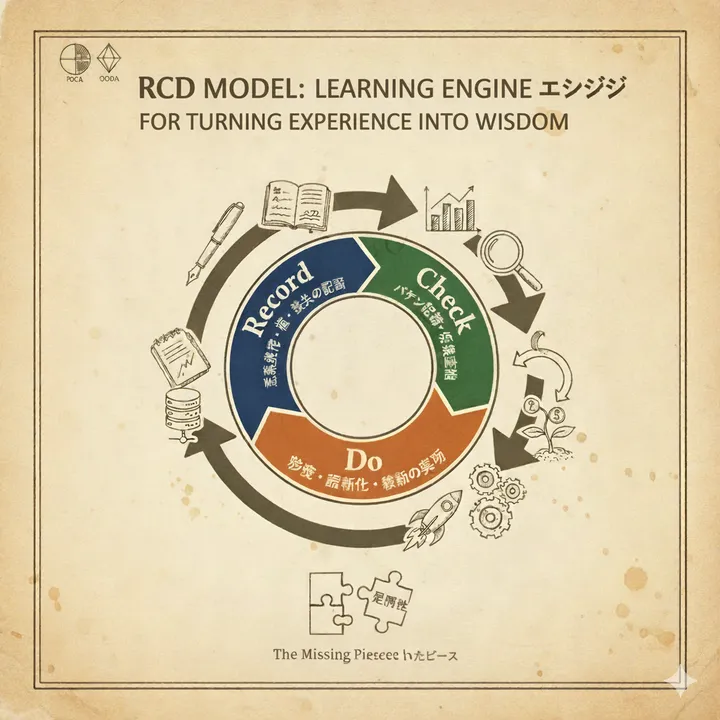
"RCD is a framework that progresses operational improvement through three stages: Record, Check, and Do," I explained. "Whereas PDCA starts from planning, RCD starts from recording. It begins by visualizing the current state. At the stage of core system implementation, where 'current operations aren't even organized yet,' jumping straight to planning misses the focus. Record, check, then execute. This sequence determines the precision of product selection."
"Let's first measure current costs," Gemini said, opening ROI Polygraph. She entered the operational data Shimada had provided.
"Monthly Excel management costs are out," Gemini read. "Five people spend an average of 320 hours per month on manual entry of customer and case information. At 3,200 yen per hour, that's 1.024 million yen monthly. Information duplication and reconciliation work takes 80 hours, or 256,000 yen. Human error correction from copy-paste between Excel files takes 40 hours, or 128,000 yen. Monthly and weekly report creation takes 60 hours, or 192,000 yen. Total: 1.6 million yen per month. Annualized: approximately 19.2 million yen."
Shimada stared at the numbers. "If volume becomes five times the current, this number also becomes five times."
"Linearly extended, that's 96 million yen annually," Claude responded. "Even if you add people, manual labor compounds exponentially under Excel operations. The only way to suppress it is on the system side."
"Now let's design with RCD," I continued.
[R—Record: Write Out the Current State Completely]
"The first stage is thorough recording," Claude said. "Interview the five team members, and have each one write out their daily work in chronological order. From which source they obtain what information, where they enter it, to whom they pass it—record each step."
"Before product selection?" Shimada asked.
"Before," I answered. "If you start by comparing CRMs and ERPs, you end up reshaping your own operations to fit each product's features. If you place recording first, the contour of your own operations is fixed first. Products are then selected to fit that contour. Reverse the order, and incompatibility emerges later."
[C—Check: Inspect the Records to Find Waste and Duplication]
"Next, we inspect the recorded operations," Gemini continued. "How many times the same information is entered. In how many places the same information is stored. Where information is sourced and where it's used. What inspection reveals is the contour of operations and the scope to be systematized."
"How do you design the inspection lens?" Shimada asked.
"We inspect through four lenses," Claude answered. "First, input duplication—operations entering the same data in multiple places. Second, confirmation roundtrips—operations passing information back and forth between people. Third, report reconstruction—operations recreating existing data in another format. Fourth, search difficulty—operations consuming time to find information. Operations falling into these four categories are the priority targets for systematization."
[D—Do: Decide the CRM and ERP Division and Execute]
"In the execution stage, we decide the division between CRM and ERP," I continued. "CRM handles customer information and case management. ERP handles billing, costs, inventory, and work tracking. There's an option to implement both as an integrated package, but at five people, operational load becomes too heavy. This time, we'll implement two compatible products in combination, with a staged expansion design."
"What's the order of staged implementation?" Shimada asked.
"CRM first," Gemini answered. "The biggest duplication revealed by inspection is customer information management. Unifying this significantly reduces input load on the five team members. After CRM stabilizes, we connect ERP in the second phase. Simultaneous implementation has high failure probability."
[Calculating Investment Recovery]
"Let's run the numbers with ROI Proposal Generator," Gemini suggested.
- Initial cost: CRM implementation, ERP implementation, data migration, integration setup, training for five team members. Total: 6.2 million yen
- Monthly cost: CRM and ERP combined: 220,000 yen
- Monthly reduction: Manual entry workload reduction = 720,000 yen (assuming 70% reduction), duplication and reconciliation reduction = 210,000 yen, human error correction reduction = 100,000 yen, report automation reduction = 160,000 yen. Total: 1.19 million yen monthly
- Net monthly reduction: 1,190,000 − 220,000 = 970,000 yen
- Payback period: 6,200,000 ÷ 970,000 = approximately 6.4 months
"Payback in just over six months," Gemini summarized. "What matters is from year two onward. Even if volume becomes five times, system processing time doesn't scale proportionally. Where the current Excel-centric state would require five times the workload, after systematization it can be absorbed at roughly 1.5 times. The structure allows growing revenue while maintaining a five-person team."
Shimada confirmed the figures and said, "Compared to the cost of adding people, the meaning of the investment looks different."
"A design that withstands tenfold with five people can only be created at system implementation," I responded.
Chapter Three: An Implementation Plan That Starts from Records
"Let me organize the approach," I said, standing at the whiteboard.
"Weeks 1–2—Interview five team members to record operations, chronologize each person's daily work. Week 3—Inspect records and extract waste and duplication through four lenses. Weeks 4–5—Submit requirements to three CRM products and receive proposals. Week 6—Select CRM, sign contract. Weeks 7–10—CRM implementation, data migration, parallel operation. Week 11—CRM standalone operation begins, two months of monitoring. From week 19—Begin ERP selection, with CRM-ERP integration requirements clarified before proceeding."
"That's over six months," Shimada confirmed.
"It is," Claude agreed. "However, at the point of CRM launch, monthly reductions on the scale of 700,000 yen begin. Rather than rushing ERP implementation, producing results with CRM first raises field acceptance. Implementation that begins from records becomes implementation the field can understand as their own operations."
Shimada took notes and said, "I was planning to start with product comparison. Starting from records seems to change the precision of selection."
Chapter Four: The Day Manual Entry Disappeared from Operations
Nine months later, a report arrived from Shimada.
Three months after CRM implementation, manual entry of customer information decreased by approximately 75 percent. The customer master, previously scattered across Excel, was unified, and duplicate registration of the same customer became structurally zero. "The mistake of mistyping the same customer name disappeared," the report noted.
ERP implementation started on schedule from week 19. Because CRM had been verified as stable, ERP requirements definition proceeded smoothly. "We could write ERP requirements based on the operational flow visible after CRM launch, so conversations with the vendor moved quickly," Shimada wrote.
The biggest change came in the eighth month, when new services launched. When case volume increased 4.2 times year-over-year due to new services for own customers, the number of staff handling them remained at five, with overtime contained within an average of 10 hours per month. "Even at five times the volume, we don't work five times harder—the design works," the report noted.
As a secondary effect, report creation time was significantly shortened. Weekly and monthly reports were auto-generated through standard CRM and ERP functions, eliminating the need for staff to format them in Excel. The timing of management meeting materials shifted from 10 business days into the month to 3 business days into the month. "Management decisions can move a week earlier," Shimada's superior commented in an attached note.
While the volume hadn't yet reached tenfold, the sense within the company that the current structure could absorb it had grown. "We didn't have to make the wrong choice between adding people and changing systems," Shimada wrote at the end.
The day they started from operational records had transformed into a foundation that withstands tenfold with five people.
"Start from product selection, and you implement by fitting operations to the product. Start from records, and you implement by fitting the product to operations. RCD asks the order of recording, checking, and executing. A plan without records is out of focus, and execution without inspection only moves the same waste to another location. The day five people who had been handling 120 cases on Excel started handling 600 through systems, what increased was the case count, and what stayed the same was the number of people. A design that withstands tenfold can only be made before you see the fivefold number."
Related Files
Tools Used
- ROI Polygraph — Visualizing Excel management workload, duplicate work, and report workload
- ROI Proposal Generator — Investment recovery simulation for staged CRM/ERP implementation


