
ROI Case File No.506 'The Night the Booking Site Phones Kept Ringing'

The Night the Booking Site Phones Kept Ringing
Chapter One: Marketing Was Answering the Phones
"Our marketing staff are on the phones all morning."
Mao Onishi, Booking Division Director at NextWave Solutions, showed us the inquiry log. Thirty to fifty calls per person per day. The inquiries—condition verification on items posted on the booking site, pricing, cancellation policy—were mostly things "written on the site if you read it."
"Who are the customers?" Claude asked.
"Mainly people in their 40s and 50s," Onishi answered. "Because the trips are high-priced, there's a strong psychological need to confirm by phone before purchase. Telling them 'it's on the site' often gets 'I won't feel safe unless I confirm by phone.' Push back and they leave."
"How many people are responding?" I asked.
"Five," Onishi answered. "Every one of them is a marketing hire. Ad operations, content creation, newsletter design—that's supposed to be their core work. But morning is phones, afternoon is email replies. Marketing work is mostly handled by evening overtime."
"There's visible attrition risk," Gemini said.
"A few have already indicated intent to leave," Onishi answered. "We hired marketing professionals and in reality they're doing call-center work. If we don't fix this, the team collapses."
"This isn't a 'replace everything with AI' story," I replied. "We split the response by what's actually being asked. With PPM."
Chapter Two: PPM Asks—Four-Quadrant Inquiry Classification
"This case calls for PPM."
Claude wrote "PPM" on the whiteboard.
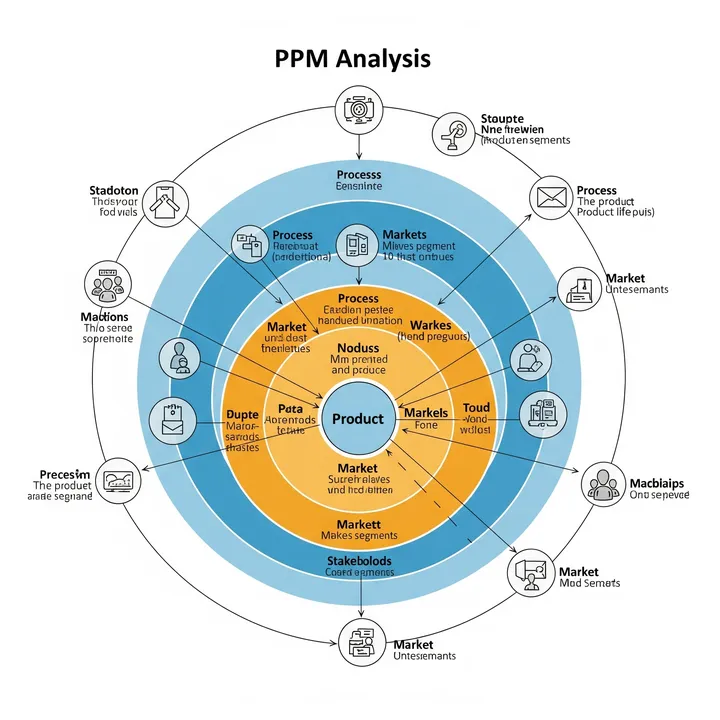
"PPM stands for Product Portfolio Management—a method classifying businesses into four quadrants on market growth and market share," I explained. "It originated at Boston Consulting Group as a strategy framework. We adapt it to inquiry handling. Classify inquiries on two axes—'frequency, high or low' and 'AI feasibility, high or low'—and the response design becomes clear."
"First, let's measure the current cost," Gemini said, opening ROI Polygraph. He input the inquiry data Onishi provided.
"The monthly inquiry-handling cost has come out," Gemini read. "Phone and email handling by five marketing staff averages 600 hours per month at 4,000 yen per hour, or 2.4 million yen monthly. Opportunity cost from stalled marketing work—delayed ad optimization, unsent newsletters—averages 1.8 million yen monthly. Estimated opportunity cost from leads dropping off during inquiry response averages 900,000 yen monthly. Overtime for staff averages 300,000 yen monthly. Attrition risk expected value averages 400,000 yen monthly. Total: 5.8 million yen monthly. Annualized: approximately 69.6 million yen."
Onishi looked at the figures. "Sixty million yen including attrition risk. This belongs on the executive agenda."
"Now let's design with PPM," I continued.
[Quadrant 1—High Frequency, AI-Feasible: Stars]
"The first quadrant is 'high-frequency and AI-feasible' inquiries," Claude said. "Price confirmation, cancellation policy, booking conditions, room availability—items already on the site that can be answered with templates. About 60% of total inquiries. We fully automate this with an AI chatbot. Customers ask via the on-site chat window and get immediate answers. The matter resolves before a phone is picked up."
[Quadrant 2—High Frequency, AI-Difficult: Cash Cows]
"Next, 'high-frequency but hard for AI'—inquiries entangled with individual circumstances," Gemini continued. "Schedule coordination, multi-plan comparison, possibility of special arrangements—human judgment is required, but the volume is high. Here we keep human response, but AI drafts the response. Staff confirm and edit before sending. Response time drops by about 40%."
[Quadrant 3—Low Frequency, AI-Feasible: Question Marks]
"The third quadrant is 'low-frequency, AI-feasible,'" I continued. "Special pricing structures, limited-time plan explanations, and so on. AI can handle these, but the volume is small, so the priority is low. We include them in the first-quadrant chatbot and improve them later."
[Quadrant 4—Low Frequency, AI-Difficult: Dogs]
"The final quadrant is 'low-frequency, AI-difficult,'" Claude continued. "Complaints, special consultations, emotionally sensitive cases. Volume is small, but response quality directly affects customer satisfaction. One experienced senior responder handles this exclusively. We don't spread it across all five marketers."
[Integrating Quadrant-Specific Response Design]
"Combining the four quadrants," Gemini continued. "Q1 is full AI automation, Q2 is AI drafting plus human judgment, Q3 is wrapped into Q1 automation, Q4 is handled by a senior specialist. The proportions of total inquiries are 60%, 20%, 10%, and 10%. The structure of response labor changes dramatically."
[Estimating the Payback]
"Let's run it through ROI Proposal Generator," Gemini proposed.
- Initial cost: 6.8 million yen (AI chatbot, FAQ preparation, training on past inquiries, Q2 drafting support system, operations design, training)
- Monthly cost: 220,000 yen (AI chatbot and drafting support combined)
- Monthly savings: marketing handling labor reduction = 1.44 million yen (60% reduction assumed); recovery of marketing work opportunity cost = 1.2 million yen; reduced lead drop-off = 450,000 yen; overtime reduction = 200,000 yen; attrition risk reduction = 250,000 yen. Total: 3.54 million yen monthly
- Net monthly savings: 3.54 million − 220,000 = 3.32 million yen
- Payback period: 6.8 million yen ÷ 3.32 million yen ≈ 2.1 months
"Just over two months for payback," Gemini summarized. "Particularly large is the revenue improvement from marketers returning to their core work. Ad operations and newsletter campaigns recover their previously-lost effects directly. The effect of returning to core work is larger than the reduction of inquiry-handling cost itself."
Onishi looked at the numbers. "With PPM, what to automate and what to keep is decided beyond discussion."
"The point of the four quadrants is to make priorities explicit," I replied.
Chapter Three: Operational Design by Inquiry Quadrant
"Here's the implementation plan," I said, standing at the whiteboard.
"Weeks 1–2: classify the last six months of inquiry logs into the four quadrants. Weeks 3–4: select an AI chatbot, prepare FAQs. Weeks 5–6: train the chatbot, build the Q2 drafting system. Week 7: design site navigation, place the chat window. Week 8: pilot operation, transition the senior specialist into the Q4 role. Week 9: production rollout, automation in Q1 goes live. Week 10 onward: monitor accuracy, add FAQs monthly."
"What's the site-navigation tweak?" Onishi confirmed.
"Show the chat window before the phone number," Claude replied. "Currently the phone number sits large at the top of the site. We move it down and put the chat window up top. We change what the customer chooses first. The phone won't disappear entirely, but the ratio will surely shift."
Onishi made a note. "It isn't a 'replace it all with AI' story but a 'split by quadrant' framing. The acceptance from the floor is different."
Chapter Four: The Day Marketing Returned to Marketing
Eight months later, a report arrived from Onishi.
Three months after the chatbot went live, inbound phone calls fell 61% versus baseline. Q1 inquiries were resolved in chat, and phones converged on complaints and special consultations. "Each person now handles five or fewer calls per day," Onishi wrote.
The five marketers' time allocation shifted dramatically. Hours that had been swallowed by inquiry handling returned to ad operations, content creation, and newsletter design. Ad ROAS began improving two months after the ops restart. Newsletter open rates rose. "The moment we returned to core work, the core metrics started moving," the report said.
The most surprising change appeared in customer satisfaction. Beyond improvements to phone reachability, the immediacy of chat earned high marks. "The customer segment that said 'phone is more reassuring' came to appreciate chat as more convenient once they got used to it," Onishi wrote.
Q2 semi-automation also delivered. The AI drafting workflow took hold, and response time shortened by about 40%. "Eighty percent of the draft is correct, so review and minor edits are all that's needed," the report said.
Attrition risk dropped significantly. Of the two marketers who had indicated intent to leave, both chose to stay. "They said they'd stay because they were back in a workplace where they could do core work," Onishi wrote.
As a side effect, lead acquisition increased. After marketing returned to its core function, ad and content quality improved, and site traffic and booking conversion rose. "Improving inquiry handling cascaded all the way into lead acquisition," the report said.
The final line of the report read: "There was a period when I considered replacing everything with AI. The moment we split inquiries into four quadrants with PPM, what to keep and what to change became clear. Raising response quality and advancing automation are not in conflict."
The night the booking site phones kept ringing quietly regained the sound of its core business, the report said.
"Inquiry handling isn't a matter of 'put everything on AI.' Split inquiries on two axes—frequency high or low, AI feasibility high or low—and a priority order for response design appears. PPM asks how to compose a portfolio. Stars, cash cows, question marks, dogs—mix items with different roles and resources scatter. In a booking organization where marketing answered the phone, the day quadrant classification was built, what disappeared wasn't the phone ringing but the time spent outside core work."
Related Files
Tools Used
- ROI Polygraph — Visualizing inquiry-handling labor, stalled marketing work, and attrition risk
- ROI Proposal Generator — Payback simulation for quadrant-specific response design


