
ROI Case File No.513: Support Expiry, the Surface Problem

Support expiry, the surface problem
Chapter 1: Support Expires at the End of Next Year
"Our data integration system's support expires in December 2027. To secure budget for next fiscal year, we need to decide on the migration target this fiscal year."
Kaito Seto, IT Director at DataSync Solutions, said this as he opened the system architecture diagram. A data integration platform deployed ten years earlier in a core systems overhaul. A hub connecting thirty internal systems and data from two hundred external trading partners. "I'd like your help with vendor selection. Introduce me to firms strong in data integration."
"Has the migration scope been defined?" Claude asked.
"Internal consensus is to port the current functions as-is," Seto replied. "But I have my doubts. Operations and integration partners have changed in ten years. Will rebuilding the same thing really justify the investment?"
"What's the source of the doubt?" I asked.
"I can't articulate it well," Seto answered. "Support is expiring, so we have to move. If we don't, operations stop. But should I really be locking in another ten-year system in this rush, in the same form as before?"
"It may just look like a support-expiry problem on the surface," I responded. "Let's dig with 5WHYS."
Chapter 2: 5WHYS Asks Why Five Times
"This case calls for 5WHYS."
Claude wrote "Why?" five times on the whiteboard.
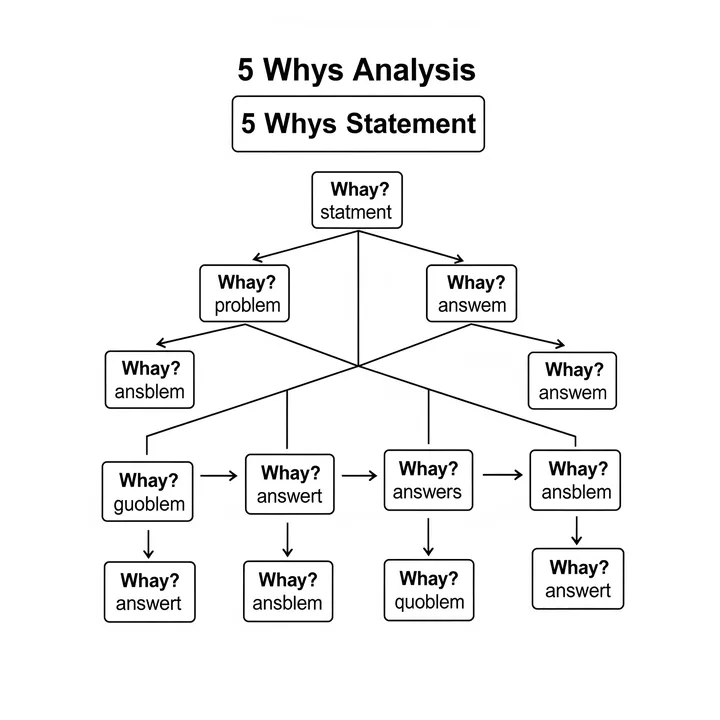
"5WHYS is an analytical technique that repeats 'why' five times against a surface problem to reach the root cause," I explained. "A classic framework from the Toyota Production System, but it's especially valuable before large investments like system migrations. Acting on the surface problem means designing a ten-year system on faulty premises."
"Let's measure current costs first," Gemini said, opening ROI Polygraph. Seto's data went in.
"Monthly related costs are out," Gemini read. "Current data integration system maintenance: 700,000 yen/month. Recovery labor during integration outages averages 40 hours monthly, or 180,000 yen/month. Labor for adding or changing integration partners averages 60 hours monthly, or 280,000 yen/month. Opportunity cost for new-business integration response delays averages 900,000 yen/month—the loss from slow construction of new integrations on old design. Lost opportunity from being unable to fulfill customers' integration requests averages 600,000 yen/month. Expected-value risk after support expiry: 500,000 yen/month. Total: 3.16 million yen/month. Annualized: roughly 37.9 million yen."
Seto looked at the figures. "I'd accounted for maintenance fees. I didn't realize indirect costs had stacked up this much."
"Now let's dig with 5WHYS," I continued.
[Why 1 — Why is support expiry a problem?]
"The first 'why,'" Claude said. "When support expires, vendor support is no longer available. When failures occur, the response can't be handled in-house, and the risk of prolonged outages emerges. This is the surface layer."
[Why 2 — Why is loss of support a business risk?]
"The second 'why,'" Gemini continued. "If a failure occurs without support, data integration stops for extended periods. An integration outage simultaneously halts operations across thirty internal systems and two hundred external companies. The reach of the risk exceeds the system alone."
[Why 3 — Why do integration outages translate into customer impact?]
"The third 'why,'" I continued. "Your data integration platform is embedded in your customers' operations. Their workflows are designed around your integration, so outages propagate to their operations too. A structural characteristic of B2B business."
[Why 4 — Why does customer impact directly become a trust issue?]
"The fourth 'why,'" Claude continued. "In your industry, integration stability is at the core of vendor selection criteria. A single major outage directly influences renewal decisions. Trust takes time to build and is lost in an instant."
[Why 5 — Why is trust the essence of the revenue base?]
"The final 'why,'" Gemini continued. "Seventy percent of your annual revenue comes from customers with five-plus years of continuous contract. The revenue base weighted toward existing customer retention is overwhelmingly larger than new acquisition. The support-expiry problem isn't a system problem—it's a problem of revenue base continuity."
[The moment the root cause appears, the design direction shifts]
"Reaching Why 5 reveals that the essence of this migration isn't 're-implementing current functions,'" I continued. "We need a design that satisfies both continuity of integration—supporting the revenue base—and extensibility for new business. Rebuilding the same thing means having this same discussion again in ten years."
[Estimating investment recovery]
"Let's run ROI Proposal Generator," Gemini proposed.
- Initial cost: Requirements redefinition, new platform development with extensibility, phased migration of existing integrations, customer-side coordination, and operational design: 32 million yen total
- Monthly cost: New platform operation and ongoing maintenance: 420,000 yen/month combined
- Monthly savings: Maintenance fee reduction = 280,000 yen/month, integration outage recovery labor reduction = 120,000 yen/month, integration addition labor reduction = 220,000 yen/month, faster new-business integration response = 700,000 yen/month, customer integration request response = 480,000 yen/month, support-expiry risk reduction = 500,000 yen/month. Total: 2.3 million yen/month
- Net monthly savings: 2.3 million yen − 420,000 yen = 1.88 million yen/month
- Payback period: 32 million yen ÷ 1.88 million yen = approximately 17 months
"Just under a year and a half," Gemini summarized. "Pure replacement of existing functions doesn't justify a 32-million-yen investment. The faster speed of new-integration construction and the ability to respond to customer requests are the essential returns on this investment."
Seto checked the numbers. "I was only looking at migration cost. With the assumption of rebuilding the same thing, I couldn't see this."
"5WHYS is a tool that questions the premise of judgment," I responded.
Chapter 3: A Migration Plan Reasoning Back from the Root Cause
"Let's lay out the path," I said at the whiteboard.
"Months 1–2: Analyze usage patterns of the existing two hundred integrations; rank by revenue contribution. Months 3–4: Define requirements for the new platform with extensibility built in; issue vendor RFP. Month 5: Select vendor and contract. Months 6–12: Build the new platform; begin phased migration starting with high-priority integrations. Months 13–20: Migrate remaining integrations; coordinate with customers. Month 21: Decommission the old platform, making the December 2027 support deadline."
"How do we approach the budget request?" Seto asked.
"The case to leadership shouldn't lead with support expiry—lead with revenue base," Claude responded. "Frame the 32-million-yen investment as supporting continuity of existing customers, who account for 70% of annual revenue. When the meaning of the investment changes, the approval pathway changes."
Seto took notes. "I was going to explain it to leadership as 'support is expiring.' The meaning of the investment is changing at the root."
Chapter 4: A Different View Beyond Support Expiry
Twenty-four months later, Seto's report arrived.
The new data integration platform went fully live as planned in November 2027, ahead of the old system's support expiry. "We met the surface mission of making the deadline. But the real outcome was elsewhere," Seto wrote.
The launch speed for new business improved dramatically. New customer integration construction, which had taken three months, now went live in an average of two weeks—and the priority bargaining between sales and development over integration requests disappeared. "Sales used to lose opportunities citing 'development resource shortage.' That constraint is gone," the report noted.
Expansion requests from existing customers could now be fulfilled too. Requests previously given up on as "your system is too old for new integrations" began getting answered one after another. The renewal rate on continuous contracts rose two points from before the migration. "The number looks small, but two points in a region that accounts for 70% of revenue is large over a year," Seto wrote.
The most unexpected change appeared in the quality of internal IT discussions. The passive framing of "we respond because support is expiring" shifted to active framing of "how do we design the system to support revenue base continuity?" "IT discussions in executive meetings shifted from cost to investment," the report said.
A side effect changed the vendor selection process. Evaluation criteria at the RFP stage now include "extensibility," "customer-side coordination support," and "understanding of revenue base impact"—price-only vendor comparisons disappeared. "Vendors also told us the quality of our briefs had changed," Seto wrote.
Integration outage incidents also dropped. Monitoring was built into the new platform's design from the outset, enabling early detection of incident precursors. "It's a fundamentally different operation from when we responded after the failure," the report noted.
At the end of the report, Seto wrote: "If we had moved on the surface problem of support expiry, we'd have spent ten years rebuilding the same system. After digging with 5WHYS, what surfaced was the conversation about the revenue base. When the layer of the problem changes, the design changes at the root."
In December 2027, the person who pressed the shutdown switch on the old system wasn't a field engineer—it was an executive, he wrote.
"Acting because a deadline is approaching is the entrance to thoughtlessness. Stack five whys, and beyond the surface problem, the real problem becomes visible. 'Support is expiring' looks like a system problem. Dig in, and it's a customer-trust problem and a revenue base continuity problem. Whether to rebuild the same thing or build an extensible platform—the very premise of judgment changes. 5WHYS asks for the resolve not to stop asking why. In an organization moving on the external pressure of a deadline, on the day they stacked five whys, what changed wasn't the migration plan—it was the meaning of the investment itself."
Related Files
Tools Used
- ROI Polygraph — Visualizing maintenance fees, integration outage costs, and new-business opportunity loss
- ROI Proposal Generator — Investment recovery simulation for an extensibility-embedded data integration platform


