
ROI Case File No.514: Two Hundred Surveys, Where Handwriting and Print Mix

Two hundred surveys, where handwriting and print mix
Chapter 1: The Day After an Event, Half a Day Disappears
"The day after an event, half a day vanishes into survey data entry."
Reina Mizuho, Exhibition Planning Manager at Globex Corporation, said this as she showed a bound stack of survey forms. The operator of a comprehensive housing showroom. On top of the standing visitor surveys, large events like housing fairs gather two to three hundred per day. "Lots of questions. Checkboxes, free text, and hand-drawn sketches all mixed together. Scanning alone won't aggregate them."
"What's on the survey?" Claude asked.
"Close to fifty items," Mizuho replied. "Family composition, visit purpose, housing type of interest, budget band, decision timing, must-have features, free comments, even a floor-plan sketch field. Sales, design, and marketing each add what they want to know, so items keep multiplying."
"And the current processing flow?" I asked.
"Two general-affairs staff manually enter into Excel the next day," Mizuho answered. "About 100 standing forms a month; 200–300 per day at events. Monthly average is around 500. Sketches and handwriting take time to interpret, and entry errors happen. We've been talking about digitization for three years, but it's too complex—no off-the-shelf tool fits."
"This isn't a simple digitization conversation," I responded. "Let's break it down with VRIO."
Chapter 2: VRIO Asks Four Criteria for Asset Value
"This case calls for VRIO."
Claude wrote four letters on the whiteboard. V·R·I·O.
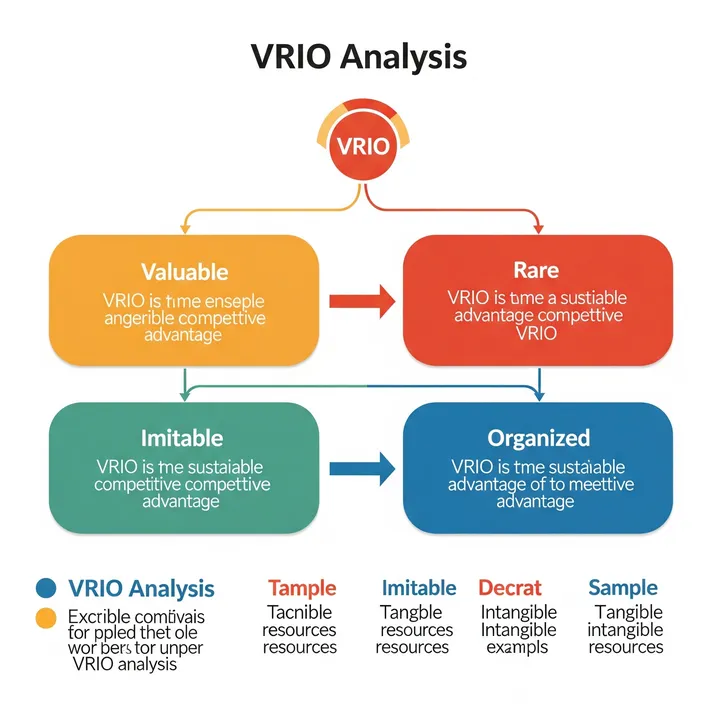
"VRIO is a framework that evaluates a resource's competitive advantage on four criteria: Value, Rarity, Imitability, and Organization," I explained. "A classic from corporate strategy theory, but it applies to operational system investment decisions too. Instead of just digitizing survey data, design it as a unique asset versus competitors, and the meaning of the investment changes."
"Let's measure current costs first," Gemini said, opening ROI Polygraph. Mizuho's data went in.
"Monthly survey processing costs are out," Gemini read. "Two general-affairs staff's entry labor averages 120 hours monthly at 2,800 yen/hour, or 336,000 yen/month. Error correction labor averages 30 hours monthly, or 84,000 yen/month. Report creation labor averages 40 hours monthly, or 152,000 yen/month. Opportunity loss in sales follow-up from inability to analyze in real time averages 900,000 yen/month—the loss before visitor interest cools. Lag costs in information sharing among sales, design, and marketing average 400,000 yen/month. Opportunity loss from sketches not being incorporated into analysis is 300,000 yen/month. Total: 2.172 million yen/month. Annualized: roughly 26.1 million yen."
Mizuho looked at the numbers. "I thought it was about entry labor. The sales opportunity loss figure is larger."
"Now let's design with VRIO," I continued.
[V — Value: The business value of digitization]
"First, value," Claude said. "If survey data can be analyzed in real time, sales can follow up while visitor interest is still hot. Housing decisions have long consideration periods, but follow-up in the first three days significantly affects close rates. Immediate digitization carries clear business value on its own."
[R — Rarity: Information assets others don't have]
"Next, rarity," Gemini continued. "When housing prospects' interest patterns, budget bands, and sketched floor-plan preferences accumulate as structured data, they become a proprietary dataset competitors can't possess. Customer profiles unique to your showroom emerge—things market research can't capture."
[I — Imitability: Capturing handwritten sketches]
"The imitability point," I continued. "This is critical. Digitizing checkboxes alone is something competitors can replicate. The differentiator is the mechanism that converts handwritten sketches into structured data via AI image recognition. Extracting features like 'L-shaped kitchen preferred' or 'south-facing living room preferred' from floor-plan sketches makes the design hard for competitors to follow."
[O — Organization: A cross-departmental utilization system]
"The organization point," Claude continued. "Gathering data is pointless without an organization that uses it. Operational design is needed for how sales, design, and marketing each integrate real-time data into their work. Shared dashboards, Slack integration, regular analysis meetings—we build the organizational receiving structure in parallel."
[All four criteria together turn the investment into a unique asset]
"Designing to satisfy all four VRIO criteria turns this from operational efficiency into a competitive-advantage asset," I continued. "Valuable, rare, hard to imitate, and usable in the organization—only when these four align does the investment generate long-term returns."
[Estimating investment recovery]
"Let's run ROI Proposal Generator," Gemini proposed.
- Initial cost: Tablet input system, sketch-AI analysis, cross-departmental dashboard, automated sales follow-up integration, and field training: 7.2 million yen total
- Monthly cost: System operation and AI analysis usage: 280,000 yen/month combined
- Monthly savings: Entry labor reduction = 300,000 yen/month, error correction reduction = 80,000 yen/month, report automation = 130,000 yen/month, close-rate lift from immediate follow-up = 700,000 yen/month, faster cross-department information sharing = 320,000 yen/month, sketch data utilization = 250,000 yen/month. Total: 1.78 million yen/month
- Net monthly savings: 1.78 million yen − 280,000 yen = 1.5 million yen/month
- Payback period: 7.2 million yen ÷ 1.5 million yen = approximately 4.8 months
"Under five months to recover," Gemini summarized. "The largest saving line is the close-rate lift from immediate follow-up. Housing has high unit prices, so even one additional closed deal has a large effect."
Mizuho checked the numbers. "I didn't expect to discuss survey digitization in terms of competitive advantage. The meaning of the investment looks different."
"VRIO is a tool that raises operational improvement to the level of asset creation," I responded.
Chapter 3: A Rollout Plan Satisfying All Four Criteria
"Let's lay out the path," I said at the whiteboard.
"Month 1: Revise survey items; design tablet input flow; plan paper-tablet coexistence. Month 2: Build tablet app; develop sketch capture screen. Months 3–4: Build AI image recognition model; create training data from 300 past sketches. Month 5: Build sales follow-up integration; design the three-department dashboard. Month 6: Pilot at the standing showroom. Month 7: Full-scale operation at a major event; start improvement loops. Month 8 onward: Analyze accumulated data; build utilization patterns as a unique asset."
"Is sketch AI recognition technically feasible?" Mizuho asked.
"With three years of past sketches as training data, feature extraction is fully achievable," Claude responded. "Complete structuring is hard, but 90%+ accuracy is realistic for 'kitchen location,' 'living room orientation,' and 'room count.' The remaining 10% gets human correction by design."
Mizuho took notes. "The conversation that had stalled for three years on paper started moving the moment VRIO reframed the investment's meaning."
Chapter 4: The Day Handwriting Became Data
Nine months later, Mizuho's report arrived.
Survey processing time fell 86% versus prior three months after tablet introduction. The standing showroom achieved immediate digitization, and even large events completed aggregation the same day. "The half-day that disappeared the next day, disappeared," Mizuho wrote.
The biggest change showed up in sales follow-up speed. The operation of automatically distributing a list of high-interest visitors to sales reps by the evening of the visit took hold. "Cases we could only contact at noon the next day, we can now contact the same evening," the report noted. With early-stage follow-up while interest ran high, close rates from first visits rose five points compared to before the migration.
The sketch AI delivered beyond expectations. After training on three years of accumulated sketches, feature extraction accuracy reached 92%. "Structured data like 'south-facing living room preferred,' 'LDK 20+ tatami preferred,' and 'study needed' now comes out automatically. The initial speed of design proposals improved dramatically," Mizuho wrote.
The cross-department dashboard also went live. Sales, design, and marketing now run weekly meetings while looking at the same data, and decision-making speed for initiatives improved. "Each department used to look at separate Excel files. Just looking at the same screen changed the quality of discussion," the report noted.
Value as a unique asset also surfaced. The accumulated customer profile data began being used in decisions about new showroom locations and in planning new product lineups. "Customer profiles unique to our showroom—things market research can't reveal—are now visible. The basis for management decisions has expanded," Mizuho wrote.
A side effect: field staff's awareness of survey design changed. The mindset shifted from "more items is better" to "select items with analytical value." "Staff started revising next term's items while looking at analysis results. They've stepped onto the using-data side," the report said.
At the end of the report, Mizuho wrote: "I'd thought survey digitization was an operational efficiency conversation. The moment we decomposed it with VRIO, it became a conversation about unique-asset creation. The reason discussion had stalled three years was that the meaning of the investment wasn't visible."
The mornings of going to work carrying two hundred survey forms had ended; on that day, the accumulated data had become the foundation for business decisions, she wrote.
"Operational efficiency conversations often stop at cost reduction. VRIO asks beyond that. Is the resource valuable, rare, hard to imitate, and usable in the organization? Measured on four criteria, operational improvement is raised to the level of asset creation. The meaning of the investment shifts. The design that turns a survey of mixed handwriting and print into a dataset competitors cannot possess isn't a digitization conversation—it's a competitive advantage conversation. On the day the mornings of carrying two hundred sheets of paper to the next day disappeared, what changed wasn't processing speed—it was the very positioning of the data."
Related Files
Tools Used
- ROI Polygraph — Visualizing entry labor, sales opportunity loss, and inter-department sharing delay
- ROI Proposal Generator — Investment recovery simulation for a unique-asset survey platform


