
ROI Case File No.517: Right After Migration, Quotes Got Slower

Right after migration, quotes got slower
Chapter 1: New System, So Why Is It Slower?
"We migrated from Excel to kintone, and somehow quotes got slower."
Sota Kurihara, Sales Department Manager at TechVerse, said this as he laid out the old and new quoting flows. A new kintone-based system built in-house over a year. In the three months after migration, sales' quote-creation time had instead increased. "Screen transitions multiplied; entry fields got more granular. Amounts that came out in one shot through Excel formulas now take several screen transitions in kintone."
"What's the field's reaction?" Claude asked.
"Stress is building," Kurihara replied. "'The old Excel was faster' is a recurring comment. The CEO calls it 'a matter of getting used to it,' but the field is starting to lose trust in the migration. On top of that, there's no feature to reference similar past deals, so every quote starts from scratch. Veterans price from memory; juniors are flying blind."
"And the CEO's directive?" I asked.
"'Use AI to further streamline quoting,'" Kurihara answered. "An atmosphere of 'another new system?' is floating through sales. There's psychological resistance to AI introduction itself. The problem is how to handle the field's emotions, more than how to build the technology."
"Not a feature discussion, an emotion discussion," I responded. "Let's design with EMPATHY."
Chapter 2: EMPATHY Asks for Design Anchored in Empathy
"This case calls for EMPATHY."
Claude wrote seven letters on the whiteboard. E·M·P·A·T·H·Y.
"EMPATHY is a framework that deeply understands users' emotions, context, and experience, and anchors design in empathy," I explained. "A core concept of design thinking, but fundamentally important in internal system rollouts too. Because systems are ultimately used by people, advancing on feature discussions leaves users' emotions behind. To layer AI on a field with psychological resistance right after migration, the design must start from empathy."
"Let's measure current costs first," Gemini said, opening ROI Polygraph. Kurihara's data went in.
"Monthly quoting-related costs are out," Gemini read. "Twelve sales reps' quote creation labor averages 360 hours monthly at 4,200 yen/hour, or 1.512 million yen/month—up after migration. Rework labor from inability to reference past deals averages 120 hours monthly, or 504,000 yen/month. Lost deals from pricing variance: 800,000 yen/month—juniors' deals underperform in competitive comparisons. Low-margin deals from pricing variance: 900,000 yen/month—even veterans deviate from appropriate values, relying on memory. Cost of migration goals unmet due to sales' psychological burden: 600,000 yen/month—system distrust propagates across operations. Total: 4.316 million yen/month. Annualized: roughly 51.8 million yen."
Kurihara looked at the figures. "You include sales' psychological burden as a cost?"
"People's emotions are also variables tied directly to operational outcomes," I responded. "Now let's design with EMPATHY."
[E — Explore: Probe the sales experience]
"First, explore the field's experience," Claude said. "Interview the twelve sales reps and identify which moments of quote creation produce stress. Screen transitions? Item entry? Past reference? Pricing judgment? Put the emotional hot spots into words."
[M — Map: Map the experience on a time axis]
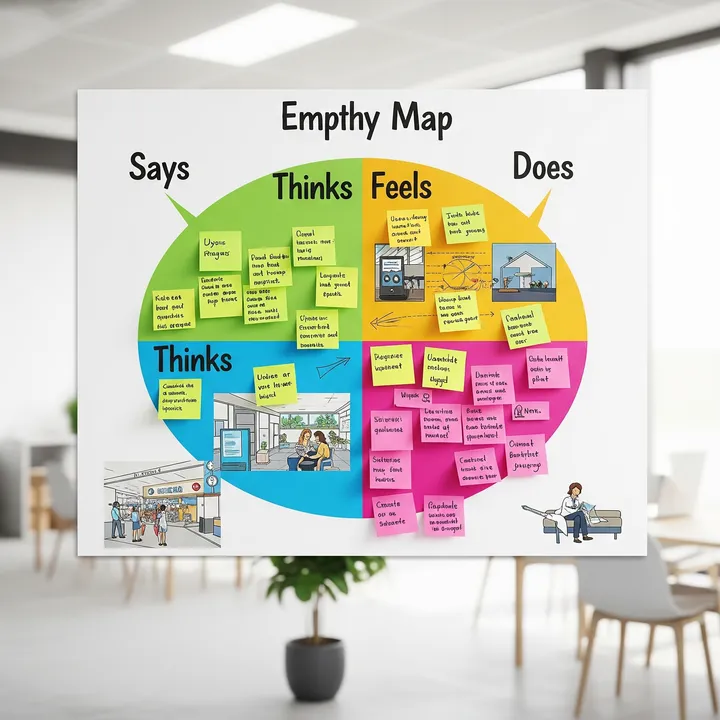
"Next, line up the entire quote-creation process on a time axis," Gemini continued. "From customer hearing through submission, decompose into twelve sub-steps. Make one screen showing time, psychological load, and current issues at each step. Which kintone screen transitions are loading which steps surface."
[P — Personalize: Support designed per persona]
"Design support per persona," I continued. "For veteran sales, 'automatic surfacing of similar past deals' works. For junior sales, 'automatic price-range suggestions' works. Not uniform features—support designed for each user segment."
[A — Augment: Extend, don't replace the existing system]
"The extension policy," Claude continued. "Don't replace kintone—layer an AI support layer on top. Sales stay on the current kintone screens; an AI assistant supports them from the side. Design the psychological resistance of 'another new system?' to zero."
[T — Test: Try small and measure emotion]
"Build in a test phase," Gemini continued. "Two weeks of pilot operation with three veterans and three juniors. Measure not just functional evaluation but the change in psychological load. Quantify 'is it easier than before,' 'is it trustworthy,' 'do you want to keep using it.'"
[H — Harvest: Convert success cases into organizational knowledge]
"Harvest success cases," I continued. "Share the effective uses from the pilot as use cases for all sales. Not how to use AI, but the story of how AI changed sales activity. To unlock psychological barriers, experience stories work better than feature explanations."
[Y — Yield: Continuous improvement that pays off]
"Finally, continuous improvement," Claude continued. "Feed sales usage data back into the AI to keep raising proposal accuracy. An experience design where the more sales use it, the more it becomes their hand. That's the key to long-term retention."
[Estimating investment recovery]
"Let's run ROI Proposal Generator," Gemini proposed.
- Initial cost: Sales interviews, AI support layer development, kintone integration, past deal data preparation, pilot operation, and company-wide training: 7.2 million yen total
- Monthly cost: AI operation and ongoing model learning: 260,000 yen/month combined
- Monthly savings: Quote creation labor reduction = 760,000 yen/month, past deal reference efficiency = 420,000 yen/month, lost-deal reduction from pricing accuracy = 600,000 yen/month, low-margin deal reduction = 700,000 yen/month, recovery of migration outcomes = 420,000 yen/month. Total: 2.9 million yen/month
- Net monthly savings: 2.9 million yen − 260,000 yen = 2.64 million yen/month
- Payback period: 7.2 million yen ÷ 2.64 million yen = approximately 2.7 months
"Under three months," Gemini summarized. "What matters is the design that doesn't negate the kintone migration but layers empathy-based support on top. The migration investment is preserved while the field's psychological barriers are unlocked."
Kurihara checked the numbers. "I'd assumed an 'introduce AI' feature conversation. I hadn't considered designing anchored on sales' emotions."
"EMPATHY is the starting point of designs that don't leave the field behind," I responded.
Chapter 3: Phased Introduction Beginning with Empathy
"Let's lay out the path," I said at the whiteboard.
"Weeks 1–2: Interview the twelve sales reps; create the experience map. Weeks 3–4: Define AI support layer requirements; design persona-specific support. Weeks 5–8: Develop; build the kintone integration. Weeks 9–10: Pilot operation with three veterans and three juniors; measure emotional indicators. Week 11: Productize the pilot outcomes as use cases; share as internal stories. Week 12 onward: Production rollout to all twelve sales. Week 16 onward: Embed continuous feedback."
"You're not leading with 'AI for efficiency'?" Kurihara asked.
"We lead with 'easier' and 'helpful,'" Claude responded. "AI is mentioned, but not as a feature—as an experience. The experience of past deals from a veteran appearing in one second. The experience of juniors gaining confidence in pricing. What the field wanted wasn't efficiency; it was reassurance."
Kurihara took notes. "The CEO's directive was 'AI for efficiency.' Sales' real wish was 'make it easier.' They sound the same, but the design starting point differs."
Chapter 4: The Day Sales Trusted the System Again
Nine months later, Kurihara's report arrived.
Quote creation time, three months after the AI support layer went live, was down 56% versus prior. Recovery exceeded the post-migration deterioration and reached a speed below the Excel era. "'Faster than the old Excel' was said for the first time. That was a major turning point," Kurihara wrote.
Particularly strong results came from juniors' pricing accuracy. With the AI presenting similar past deals and price ranges, even juniors could issue quotes near veteran accuracy. "Veterans accompanying juniors to customer meetings dropped in frequency. Juniors started standing on their own feet," the report noted.
Veteran sales' burden also eased. The labor of recalling past deals from memory disappeared, and they could concentrate on the customer-proposal activities that are their actual job. "Veterans were freed from 'memory contests.' Regardless of age, performance can come out," Kurihara wrote.
The most unexpected change appeared in evaluation of kintone itself. With the AI support layer making kintone easier to use, the impression flipped to 'kintone is usable.' "Instead of denying kintone and layering a different system on top, the form of helping kintone landed well. The sense that the migration investment wasn't wasted returned to the field," the report noted.
Close rates also improved. With pricing accuracy improved, the probability of winning competitive comparisons rose, and quarterly close rates climbed four points from before migration. "Deals previously won 'somehow with a discount' became deals won 'at appropriate value, head-to-head,'" Kurihara wrote.
Use-case stories shared internally totaled over 80. "Sales started voluntarily posting 'I used it this way and it worked.' The lead role of in-house study sessions shifted from the tool to experience stories," the report said.
A side effect: discussions of rollout to other departments began. "Watching the change in sales' experience, procurement and design started asking 'can we have a similar system?' Success cases built with EMPATHY have wave power to other departments," Kurihara wrote.
At the end of the report, Kurihara wrote: "Had we advanced 'AI for efficiency' as a feature conversation, the field would have pushed back again. We designed anchored on sales' emotions, and trust came back. Empathy is a design concept that sits above features."
The mornings when sales who had resisted the new system began voluntarily broadcasting AI support tips marked the true completion of the migration project, he wrote.
"Push by features and the field builds walls. EMPATHY asks for design that begins with empathy. Deeply understand users' emotions, context, and experience, then decide what to build. Explaining 'we're layering AI' to sales carrying dissatisfaction right after kintone migration won't resonate. Map sales' emotions on a time axis and design separate support for veterans and juniors. Empathy sits above features as a design concept and as a starting point. On the day a field that had resisted a new system began voluntarily broadcasting how to use it, what changed wasn't the tool's performance—it was the designer's perspective."
Related Files
Tools Used
- ROI Polygraph — Visualizing quote labor, pricing opportunity loss, and psychological-burden cost
- ROI Proposal Generator — Investment recovery simulation for an empathy-anchored AI support layer


