
ROI Case File No.515: Quotes Always Came Out by Gut Feel

Quotes always came out by gut feel
Chapter 1: No One Can Explain the Basis of the Sale Price
"Quotes go out. But no one can explain the basis of the sale price."
Koji Totsuka, Corporate Planning Director at GlobalTech, said this as he laid out past quote documents. An OEM contract manufacturer. Components are machined at a Chinese factory; domestic Japanese assembly and sales follow. "We receive USD quotes from the Chinese factory, convert to yen, and add overhead and tariffs. The work is manual and varies by who does it."
"What's the current state of cost calculation?" Claude asked.
"We're piloting it with Gemini," Totsuka replied. "Dollar-to-yen conversion, tariff application, overhead allocation—we're trying to automate with AI, but accuracy is unstable. Plus, the allocation logic for overhead (labor, equipment depreciation, quality control) isn't standardized. As a result, quote accuracy is uneven, and some deals may be loss-making."
"Is the issue only cost-calculation accuracy?" I asked.
"There's another," Totsuka answered. "No one can verify whether current sale prices are appropriate. Pricing is anchored on settings from ten years ago, and we quote at numbers that feel like they yield a margin. Whether manufacturing cost is high or sale price is low—the structure is invisible."
"What's the job you want to advance?" I asked.
"A system where we can present appropriate sale prices with clear reasoning," Totsuka said. "Sales can explain to the customer, executives can decide, the field can improve—I want cost information usable at all three layers."
"Then let's break it down with JTBD," I responded.
Chapter 2: JTBD Asks What Job You Really Want to Advance
"This case calls for JTBD."
Claude wrote "J·T·B·D" on the whiteboard.
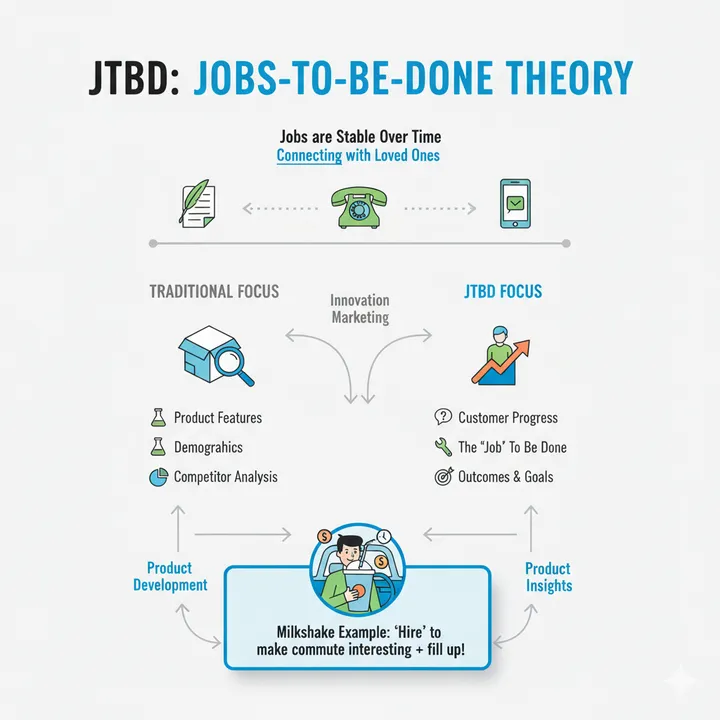
"JTBD—Jobs To Be Done—is a framework that decomposes the 'progress' customers or users want to make, then identifies the obstacles to that progress," I explained. "Christensen's theory, but fundamentally effective for internal operations design too. Instead of building a cost calculation feature, design from the Job of 'giving the quote a basis and advancing the decision,' and the necessary features fall out naturally."
"Let's measure current costs first," Gemini said, opening ROI Polygraph. Totsuka's quote data went in.
"Monthly related costs are out," Gemini read. "Quote creation labor averages 160 hours monthly at 3,800 yen/hour, or 608,000 yen/month. Manual overhead allocation labor averages 80 hours monthly, or 304,000 yen/month. Expected-value risk of loss-making deals due to inadequate cost accuracy averages 1.4 million yen/month—high probability because deal-level P&L isn't verified. Lost margin from inability to set appropriate sale prices averages 1.8 million yen/month. Labor preparing management decision material averages 60 hours monthly, or 360,000 yen/month. Lost deals from delayed quote presentation average 600,000 yen/month. Total: 5.072 million yen/month. Annualized: roughly 60.9 million yen."
Totsuka looked at the figures. "The loss-making deal risk and lost margin are the largest. Until now I'd only been looking at quote labor."
"Now let's design with JTBD," I continued.
[Defining the Job — What work do you really want to advance?]
"First, define the Job to be done," Claude said. "'Automate cost calculation' isn't a Job—it's a feature. The real Job is 'give the quote a basis and advance appropriate sale-price decisions at the deal level.' The higher-order Job is 'as a manufacturer, sustainably secure profits.' Awareness of Job hierarchy changes feature priorities."
[Job obstacles — Decompose what's blocking progress]
"Next, identify obstacles to the Job," Gemini continued. "Obstacle 1: Errors from manual dollar-to-yen conversion and tariff application. Obstacle 2: Non-standardized overhead allocation logic. Obstacle 3: Inability to verify deal-level P&L after the fact. Obstacle 4: Past data isn't analyzed, so there's no basis for judging appropriate sale prices. Obstacle 5: Slow quote presentation, losing business opportunities. The design must clear all five at once."
[Positioning the current AI (Gemini)]
"The position of the Gemini pilot," I continued. "Gemini is effective for conversion and calculation support, but isn't designed to carry the whole Job. We reposition it not as a standalone AI, but as a 'foundation that advances the cost Job' integrated with the cost database, deal management, and the executive dashboard."
[Job-centered design — Closing the five obstacles]
"We organize the design starting from the Job to close all five obstacles," Claude continued. "USD quotes are automatically converted and tariff-applied on receipt. Overhead allocation is system-built with standard rules and auto-computed by deal characteristics. On deal completion, actual costs auto-aggregate, and the variance against the quote appears on the executive dashboard. Margin analysis on past deals derives appropriate sale-price ranges. Gemini generates initial quote drafts from similar past deals, and the responsible person only verifies."
[Estimating investment recovery]
"Let's run ROI Proposal Generator," Gemini proposed.
- Initial cost: Cost calculation foundation, overhead allocation engine, deal P&L dashboard, Gemini integration, executive reporting features, and field training: 9.6 million yen total
- Monthly cost: System operation and AI usage: 320,000 yen/month combined
- Monthly savings: Quote creation labor reduction = 420,000 yen/month, overhead allocation labor reduction = 210,000 yen/month, loss-making deal risk reduction = 1.1 million yen/month, margin lift from appropriate sale prices = 1.2 million yen/month, management decision material reduction = 250,000 yen/month, lost-deal reduction from faster quoting = 420,000 yen/month. Total: 3.6 million yen/month
- Net monthly savings: 3.6 million yen − 320,000 yen = 3.28 million yen/month
- Payback period: 9.6 million yen ÷ 3.28 million yen = approximately 2.9 months
"Under three months," Gemini summarized. "The largest line is margin lift from appropriate sale prices. Once costs are visible, decisions like price negotiation on low-margin deals or focusing sales on high-margin deals become possible."
Totsuka checked the numbers. "I was debating cost calculation as a feature. Through the Job hierarchy, the higher-order purpose of profit security becomes visible."
"JTBD is a tool that brings feature discussions back to purpose discussions," I responded.
Chapter 3: A Design Plan Anchored on the Job
"Let's lay out the path," I said at the whiteboard.
"Months 1–2: Organize three years of past quotes and actual costs; standardize overhead allocation rules. Month 3: Define cost calculation foundation requirements; design Gemini integration. Months 4–5: Build the system; build the deal P&L dashboard. Month 6: Pilot, validate accuracy with past deals. Month 7: Production launch; embed into the quoting process. Month 8 onward: Use accumulated data to refine appropriate sale-price ranges; expand use in management decisions."
"Are you replacing Gemini?" Totsuka asked.
"Gemini stays at the core," Claude responded. "Natural-language generation of initial quote drafts, similarity search on past deals, summary reports for executives—these are areas where Gemini's strengths apply. We reposition it as the integration foundation."
Totsuka took notes. "A project whose purpose was 'introduce AI' has shifted to a design of 'advance the Job.'"
Chapter 4: The Day Reasoned Quotes Became Routine
Ten months later, Totsuka's report arrived.
Quote creation time, three months after the new foundation went live, was down 65% versus prior. Gemini generated initial drafts from similar past deals, and the responsible person only verified and adjusted. "Quotes that took half a day per deal now come out in an hour," Totsuka wrote.
The biggest change showed up in the new ability to verify deal-level P&L after the fact. Actual costs auto-aggregated, and the variance against quotes became visible, enabling early discovery and response to loss-making deals. "We used to realize 'this deal was a loss' only at quarterly close. Now we see it at deal completion," the report noted. Over six months, loss avoidance of roughly 21 million yen annually was realized through identifying loss-making deals.
Discussion of appropriate sale-price ranges also began. With margin distributions on past deals visualized, concrete conversations emerged between sales and executives: "this product line has room for a price increase" and "this customer is being underpriced compared to other vendors." "The basis for price negotiations shifted from feeling to data," Totsuka wrote.
Gemini's utilization scope also expanded. Monthly cost reports for executives, deal-by-deal P&L commentary for sales, cost improvement proposals for manufacturing—three types of summaries auto-generated from the same cost data became routine. "The same data, but different summaries depending on the reader. AI bridged that gap," the report noted.
A side effect: the field's mindset changed. The manufacturing floor began to view cost movements as tied to their own work, and improvement proposals increased. "It used to be 'cost is accounting's job.' Now it's 'how does my work affect cost?'" Totsuka wrote.
Negotiating power with the Chinese factory also changed. With detailed cost breakdowns visible, price-hike requests from the factory could be countered with specific reasoning. "Hikes we used to accept passively can now be negotiated with numbers," the report noted.
At the end of the report, Totsuka wrote: "A project that began with 'we want to automate cost calculation with AI' became, after JTBD decomposition, a management challenge of securing profit. Raise the Job hierarchy a level, and feature discussions return to purpose discussions."
The mornings of issuing gut-feel quotes had ended; on that day, the cost data had become the foundation for management decisions, he wrote.
"Many automation-with-AI requests stop at the feature discussion. JTBD asks what work you really want to advance. Raise the Job hierarchy one level and cost calculation becomes a profit conversation; quote automation becomes a decision-speed conversation. Define the Job before you build features. Identify the obstacles to progress and redesign to clear them. At a factory where quotes went out by gut feel, on the day the Job was put into words, what changed wasn't calculation speed—it was the way the organization faced its margins."
Related Files
Tools Used
- ROI Polygraph — Visualizing quote labor, loss-making deal risk, and lost-margin opportunity
- ROI Proposal Generator — Investment recovery simulation for a Job-anchored cost foundation


