
ROI Case File No.522: Hundreds of Failures Lay Sleeping at the Bottom of a Spreadsheet

Hundreds of Failures Lay Sleeping at the Bottom of a Spreadsheet
Chapter 1: The Failure Records Exist, but They Go Unused
"We've accumulated hundreds of past defect cases. But no one can use them."
Kentaro Uryu, quality management department manager at TechConstruct, said this while opening an Excel file. Defect records from construction projects. The process where it occurred, the cause, the countermeasure—an enormous run of rows, each entered by hand. "At the start of a project, we create a quality management plan. At that point, the person in charge searches this spreadsheet by hand for whether a similar defect occurred in the past. But if they're bad at searching, they miss things. These hard-won failure records aren't being put to use."
"How much effort does searching past cases take?" Claude asked.
"On average, four hours per plan document," Uryu answered. "You narrow down by keyword, then read the matching cases one by one. The quality of the search varies by person—a veteran picks out exactly the right ones, but a junior misses the important cases. It's become personnel-dependent work."
"What's the difficulty specific to the construction industry?" I confirmed.
"It's that what we build is different every time," Uryu answered. "No two buildings are the same. So past cases don't apply directly. From cases that are 'similar but different,' you have to draw out the essential lesson. We want to predict defects with AI, but I have no idea how to handle data whose conditions change every time."
"You need to grasp the data not as points but as a chain of processes," I responded. "Let's break it down with VALUECHAIN."
Chapter 2: VALUECHAIN Asks Where in the Value Chain Defects Are Born
"This case needs VALUECHAIN."
Claude drew an arrow flowing from left to right on the whiteboard.
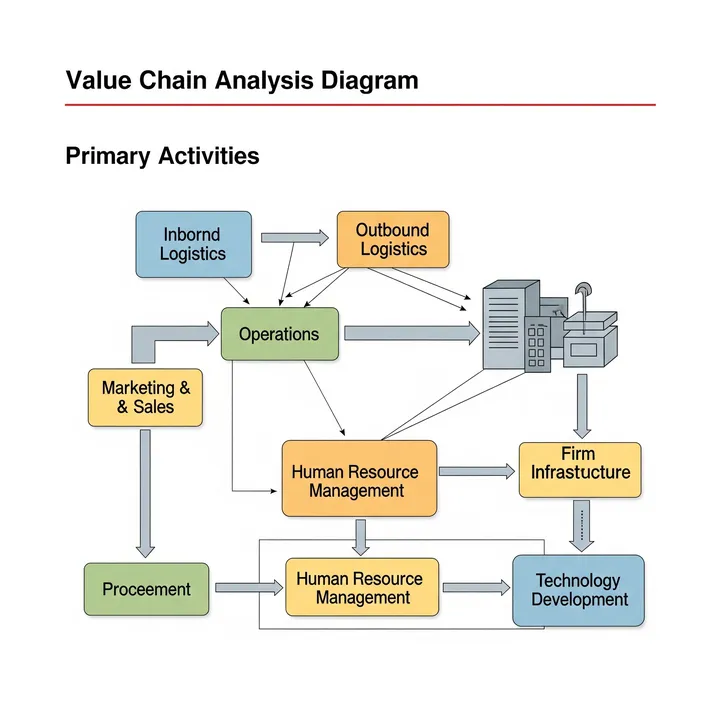
"VALUECHAIN—value chain analysis—is a framework that breaks business activity into a sequence of value-creating processes and visualizes where value is created and where it is lost," I explained. "It's a technique Porter proposed, but applied to quality management, it's powerful. Instead of managing defects collectively as 'results,' you classify them by which link in the chain—design, procurement, construction, inspection—the seed was born in. Because even when what you build differs every time, the structure of the processes does not change."
"First, let's measure the current cost," Gemini said, opening ROI Polygraph. He entered the data Uryu had provided.
"The monthly quality-management cost came out," Gemini read aloud. "The labor of searching past cases when creating quality management plans averages 240 hours a month; at an hourly rate of 4,500 yen, that's 1,080,000 yen a month. The rework cost from missing important cases due to inconsistent search precision averages 800,000 yen a month. The countermeasure cost when a missed defect recurs on site averages 1,200,000 yen a month. The opportunity loss from accumulated data going unused averages 600,000 yen a month. The expected value of the personnel-dependency risk in veterans' search know-how averages 500,000 yen a month. The total is 4,180,000 yen a month. Annualized, that's about 50.16 million yen."
Uryu stared at the figures. "I thought it was only the effort of searching. When you add in the recurrence cost of missed defects, I had no idea it was this much."
"Then let's design with VALUECHAIN," I continued.
[Breaking Down Primary Activities—Grasping Defects' Origin Process as a Chain]
"First, we break down the construction project's value chain," Claude said. "Five processes: design → procurement → construction → inspection → handover. We reclassify the hundreds of accumulated defects not by result but by 'which process the cause was seeded in.' Seventy percent of defects that surfaced at the construction stage actually had their cause at the design stage—chain structures like this come into view."
[Breaking Down Support Activities—Common Factors That Cross Processes]
"Next, the support-activity perspective," Gemini continued. "Supplier quality, engineer skill, inspection structure—we organize the elements that support the primary activities as cross-cutting axes. Defects involving a particular supplier are frequent, recurrences are frequent in a particular engineer category—cross-process patterns like these surface when you look at the value chain's support activities."
[AI Prediction Model—Learning Defect Signals Process by Process]
"We have the AI model learn the chain structure we've decomposed," I continued. "We train a prediction model on data structured by process and by factor from past cases. When a new project's plan is being created, you input the design conditions, and the AI traces back up the chain to warn, 'with this design, this defect tends to appear at the construction process.' Even when what you build differs every time, the chain patterns of the processes are transferable."
[Automated Plan-Creation Support—From Searching to Proposing]
"Last is operational design," Claude continued. "When creating a quality management plan, the AI automatically searches for similar past cases and presents them as process-by-process risks. Instead of the person in charge searching by hand, the AI pulls up related cases from the chain structure. The personnel dependency of searching disappears, and a structure forms in which even juniors can extract risks at a veteran's level."
[Estimating the Investment Recovery]
"Let's estimate with ROI Proposal Generator," Gemini proposed.
- Initial cost: Defect database construction, process-by-process structuring, AI prediction model development, plan-creation support system integration, and on-site training—8,600,000 yen total
- Monthly cost: Model operation plus data-update platform ongoing cost—260,000 yen a month combined
- Monthly reduction effect: Past-case search labor reduction = 760,000 yen a month (assuming 70% reduction), missed-case rework reduction = 560,000 yen a month, defect-recurrence countermeasure reduction = 840,000 yen a month, quality improvement through use of accumulated data = 400,000 yen a month—2,560,000 yen a month total
- Monthly net reduction: 2,560,000 yen − 260,000 yen = 2,300,000 yen a month
- Payback period: 8,600,000 yen ÷ 2,300,000 yen = about 3.7 months
"Recovery within four months," Gemini summarized. "What's especially large is the reduction in defect-recurrence countermeasures. By reflecting past failures in prediction, the very structure of repeating the same failures on site shrinks. The recurrence-prevention impact works even harder than the search efficiency."
Uryu confirmed the figures and said, "I was managing defects as a list of results. I'd never had the idea of grasping them as a chain of processes. I thought AI was impossible because we build something different every time, but the structure of the processes doesn't change."
"VALUECHAIN is a tool for replacing results with a chain of causes," I responded.
Chapter 3: A Deployment Plan Built on Process Chains
"Let me organize how we'll proceed," I said, standing before the whiteboard.
"Months one and two—cleansing the hundreds of defect cases and structuring them by process and by factor. Month three—defining the value chain model and designing the cross-cutting axes of support activities. Months four and five—developing the AI prediction model and training it on past cases. Month six—building the quality management plan support system and trial-running it. Month seven—starting production operation and verifying it in parallel with the person in charge's search work. Month eight onward—feeding the results of new projects back to continuously improve prediction accuracy."
"You build something different every time—will the predictions hit the mark?" Uryu confirmed.
"They will," Claude responded. "What we're predicting isn't 'this building' but the pattern that 'this defect is seeded in this chain of processes.' Even when the building differs, the chain in which a design-stage judgment produces a construction-stage defect is common. So it's transferable. This is the strength of grasping things with the value chain."
Taking notes, Uryu said, "The hundreds of cases sleeping at the bottom of the spreadsheet have begun to look like assets for the first time."
Chapter 4: The Day Failures Protect the Future
Nine months later, a report arrived from Uryu.
Searching past cases when creating quality management plans was cut 70% versus before, three months after the AI support system went live. "A search that took four hours finishes in just over an hour. And regardless of the person's experience, they can extract risks at the same quality," Uryu wrote.
Defect recurrence also fell sharply. With the AI issuing warnings from the process chain, construction risks could now be crushed at the design stage. "Before, defects appeared after construction had started. Now we know at the planning stage that 'this design is dangerous.' On-site rework has visibly decreased," the report said.
The most unexpected change appeared in the way past failures were viewed. Failure cases shifted from "records to hide" to "assets that protect the future." "There was an atmosphere where reporting a defect lowered your evaluation. Now the recognition has shifted to 'if you record it, the AI learns and protects the next project.' Reports have increased," Uryu wrote.
The personnel dependency of search know-how was also resolved. Veterans' search intuition was absorbed into the AI model, and even juniors could now extract cases at the same level. "Even when a veteran leaves at retirement, the structure now keeps the search quality from dropping," the report said.
As a secondary effect, quality evaluation of suppliers began. As a result of analyzing the value chain's support activities, it became numerically visible that defects were concentrated in particular suppliers. "Suppliers that had been called 'unstable in quality' by gut feeling were backed up by data. It became material for procurement negotiations," Uryu wrote.
The prediction model's accuracy continued to improve, too. The results of new projects were added to the training data, and prediction hit-rate improved over nine months. "The more we use it, the smarter it gets. We proved that even in construction—an industry that builds something different every time—the chain of processes can be learned," the report said.
At the end of Uryu's report, he had written: "The true nature of the worry that 'we have data but can't use it' was not the volume of data but its lack of structure. The moment we broke it into a process chain with VALUECHAIN, the hundreds of sleeping cases started to move. A record of failure becomes a weapon that protects the future only once it's structured."
It was recorded that the day hundreds of failures sleeping at the bottom of a spreadsheet turned into a shield protecting the next project, quality management changed from the work of recording into the work of predicting.
"Sites where data utilization doesn't advance share a common misunderstanding: the belief that data is lacking. But in most cases the data is plentiful—it just lacks structure. What VALUECHAIN asks is the chain of processes where value is created and lost. Rather than listing defects as results, you re-grasp them by the chain of which process they were seeded in. Even in construction, where what you build differs every time, the structure of the processes is invariant. The day a company that had been letting hundreds of failures sleep at the bottom of a spreadsheet turned those failures into assets that protect the future, what changed was not the volume of data but the very way of seeing it."
Related Files
Tools Used
- ROI Polygraph — Visualizing past-case search labor, missed-case rework, and defect-recurrence cost
- ROI Proposal Generator — Investment-recovery simulation for a process-chain quality-prediction platform


