
ROI Case File No.526: They Retyped Handwritten Reports Into Excel Every Day

They Retyped Handwritten Reports Into Excel Every Day
Chapter 1: They Were Deciphering Illegible Handwriting
"Field workers write reports by hand. The management department retypes them into Excel. Every day."
Kenji Usami, manufacturing management department manager at GlobalTech, said this while showing a single report. A parts-manufacturing factory. About twenty workers record hourly production counts and defect counts by hand. "We later input this handwriting into Excel and aggregate it. Altogether it takes about a hundred minutes a day. And sometimes the writing is hard to read and we can't decipher it. Input errors occur too."
"Who bears the load of manual input?" Claude asked.
"Several people in the management department," Usami answered. "They collect the paper the field wrote and transcribe it into Excel one sheet at a time. When the writing is messy, they go to the field to confirm. Until aggregation is done, that day's production status isn't visible. There's no real-time quality at all."
"Is the direction of digitization settled internally?" I confirmed.
"The direction is decided," Usami answered. "We want to stop using paper and switch to digital input. But the field is used to handwriting. Whether they'll use a tablet if we hand them one, how the management department's aggregation will change, how far competitors have progressed—various parties' circumstances tangle up, and we can't organize how to proceed."
"The field, the management department, the competitors—you need to organize by each party's standpoint," I responded. "Let's break it down with 3C."
Chapter 2: 3C Asks About Customer, Competitor, and Company
"This case needs 3C."
Claude wrote "Customer, Competitor, Company" on the whiteboard.
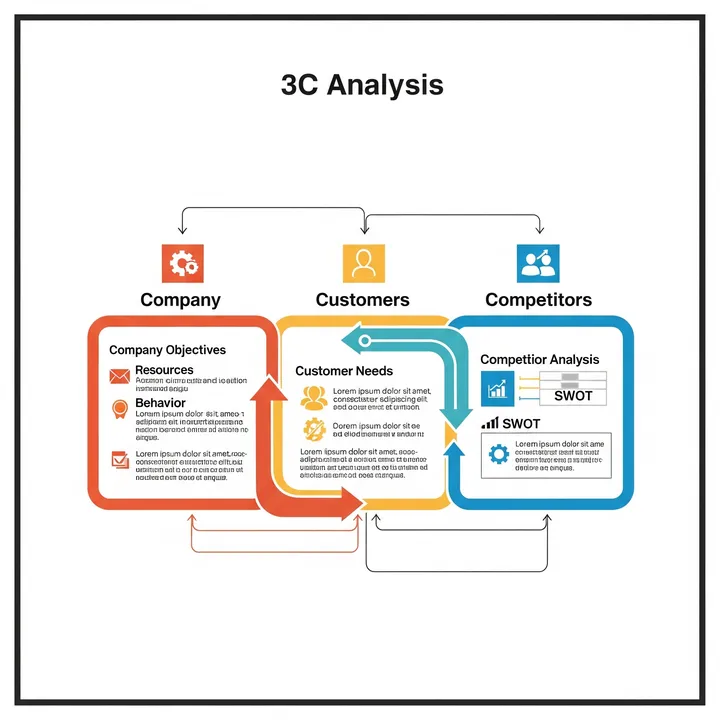
"3C is a framework proposed by Kenichi Ohmae that assembles strategy from three perspectives—customer, competitor, and company," I explained. "It's a market-analysis technique, but it's effective for internal digitization too. Because unless these three perspectives line up—whom is the improvement for (the customer = the field and the management department), how far have competitors progressed, what does the company aim for—you end up just deploying a tool that goes unused. We organize digitization as a problem of standpoints."
"First, let's measure the current cost," Gemini said, opening ROI Polygraph. He entered the data Usami had provided.
"The monthly reporting cost came out," Gemini read aloud. "Manual input and aggregation labor is a hundred minutes a day; converted over 22 days a month, that's about 37 hours; at the management department's hourly rate of 3,400 yen, 126,000 yen a month. The labor of field confirmation and inquiries when reading is difficult averages 20 hours a month, or 68,000 yen. The cost of correcting aggregated data due to input errors averages 150,000 yen a month. The opportunity loss from delayed production judgment because data isn't visible in real time averages 300,000 yen a month. The expected value of the personnel-dependent deciphering risk of handwritten reports averages 100,000 yen a month. The cost of storing and managing paper averages 80,000 yen a month. The total is 824,000 yen a month. Annualized, that's about 9.89 million yen."
Usami stared at the figures. "I thought it was only the manual input labor. When you add the judgment delay from data not being visible in real time, the scale is different."
"Then let's design with 3C," I continued.
[Customer—Field Workers and the Management Department, Two Layers of Needs]
"First, Customer," Claude said. "The customer in this case is two internal layers. Field workers want 'a mechanism to input faster and more simply than by hand.' The management department wants 'a mechanism to aggregate and analyze accurate data instantly.' The two have different needs. Easy for the field to use, and usable by management—an input design that satisfies both is needed."
[Competitor—The Digitization Level of the Same Industry]
"Next, Competitor," Gemini continued. "Peers in the same industry have already advanced digitization of work reports. An operation that relies on paper and Excel transcription produces a lag in the speed of using production data. While competitors manage production in real time, a structure that takes half a day to aggregate falls behind in the speed of improvement. We set the destination using the competitor level as the baseline."
[Company—Eyeing Load Reduction and Future Automation]
"The Company perspective," I continued. "GlobalTech is in parts manufacturing, and the management department bears the mission of lowering the field's load while turning a profit. They're currently considering systematization premised on manual input, but automation and robotization are in view for the future. We position this digitization as the first step of a data platform that connects to future automation."
[The Move Integrating the Three Perspectives]
"When you integrate the three perspectives, the move settles," I continued. "We provide the field with simple input on a tablet, lowering the load of handwriting. The input data is saved instantly to the cloud, and the management department can aggregate and analyze it in real time. The accumulated data becomes the foundation for future automation. A design that satisfies all three directions—customer, competitor, company—at once."
[Estimating the Investment Recovery]
"Let's estimate with ROI Proposal Generator," Gemini proposed.
- Initial cost: Tablet device provisioning, digital-input app construction, cloud-aggregation platform, real-time analysis screen, and field training—3,200,000 yen total
- Monthly cost: Cloud usage fee plus ongoing operating cost—120,000 yen a month combined
- Monthly reduction effect: Manual-input/aggregation labor reduction = 110,000 yen a month (assuming 90% reduction), field-confirmation labor reduction = 60,000 yen a month, input-error correction reduction = 130,000 yen a month, elimination of production-judgment delay = 210,000 yen a month, paper-management cost reduction = 70,000 yen a month—580,000 yen a month total
- Monthly net reduction: 580,000 yen − 120,000 yen = 460,000 yen a month
- Payback period: 3,200,000 yen ÷ 460,000 yen = about 7.0 months
"Recovery in seven months," Gemini summarized. "In scale it's not a large project, but the impact of changing the daily work of twenty field workers is significant. Especially, the effect of data being visible in real time changes the speed of production judgment."
Usami confirmed the figures and said, "I thought it was the simple matter of bringing in tablets. When you organize across three perspectives—the field and management having different needs, the gap with competitors, future automation—the resolution of the design rises."
"3C is a tool for lining up parties of different standpoints on the same diagram," I responded.
Chapter 3: A Digitization Plan That Proceeds From the Field's View
"Let me organize how we'll proceed," I said, standing before the whiteboard.
"Weeks one and two—interviewing field workers, organizing the input items, and confirming the management department's aggregation needs. Weeks three and four—designing the digital-input app and examining tablet operation. Weeks five and six—a pilot on a small number of lines, verifying the field's input load. Weeks seven and eight—improving the input UI and building the cloud aggregation and analysis screen. Weeks nine and ten—rollout to all workers and training. Week eleven onward—analytic use of the accumulated data and arranging the data platform toward future automation."
"I'm worried about whether the field will use a tablet," Usami confirmed.
"That's exactly why we design from the field's needs," Claude responded. "In 3C's Customer, we placed the field's ease of use as the top priority. We'll make a UI that inputs faster than handwriting, with no hesitation. If the field actually feels it's convenient, it takes root. If you increase input items only for management's convenience, the field will hate it and revert to paper. Defending the field's view is the key to success."
Taking notes, Usami said, "The perspective of seeing both the field and management as customers had been missing until now."
Chapter 4: The Day That Day's Production Is Visible That Day
Nine months later, a report arrived from Usami.
Manual-input and aggregation labor was cut 90% versus before, three months after the digital-input system went live. "Data the field inputs on a tablet is aggregated straight into the cloud. The work of management retyping one sheet at a time disappeared," Usami wrote.
Input errors and reading difficulties were also resolved. With no more deciphering of handwriting or transcription mistakes, data accuracy rose. "Going to the field because we can't read the writing—that became zero. Data reliability rose dramatically," the report said.
The biggest change appeared in the speed of production judgment. That day's production counts and defect counts became visible in real time. "Before, we didn't know that day's production status until the evening when aggregation finished. Now we can respond on the spot to a morning rise in defects. Judgment is half a day faster," Usami wrote.
The field's acceptance was also smooth. Because input is faster than handwriting and there's no rewriting, the field welcomed it. "I thought we'd be told 'paper is easier.' In reality it was well received as 'faster than writing.' Designing from the field's view paid off," the report said.
As a secondary effect, a culture of data analysis sprouted. From the accumulated data, defect rates by time of day and production trends by line became visible. "Data that had been buried in a mountain of paper became visible in graphs. Improvement discussions shifted to a data starting point," Usami wrote.
A foothold for future automation was also laid. The digitized data began to serve as material for examining automation and robotization. "This digitization was not an endpoint but a starting point. With data accumulated, the next discussion about automation became concrete," the report said.
At the end of Usami's report, he had written: "I'd thought bringing in tablets was the end of it. Because we lined up the three perspectives—field, management, competitor—with 3C, we got a design the field uses, management utilizes, and that connects to the future. Lose sight of whom the improvement is for, and the tool goes unused."
It was recorded that the day a factory that had retyped handwritten reports every day became a factory where that day's production is visible that day, work reporting changed from the work of transcribing into data put to use in real time.
"A common failure in digitization consultations is designing only for the convenience of the side bringing in the tool. Even if you deploy a convenient tool, if it doesn't mesh with the needs of the field that uses it, it reverts to paper. What 3C asks is the three perspectives—customer, competitor, company. Two layers of customer in the field and management, the competitor's digitization level, the company's future vision—only when the three are lined up on the same diagram does it become a design that is used. The day a factory that had retyped handwritten reports every day could see that day's production that day, what changed was not the input tool but the very perspective of whom the improvement is for."
Related Files
Tools Used
- ROI Polygraph — Visualizing manual-input labor, input-error correction cost, and production-judgment delay
- ROI Proposal Generator — Investment-recovery simulation for work-report digitization built on three perspectives


