
ROI Case File No.527: The Day a Twenty-Year-Old System Stops Under Windows 11

The Day a Twenty-Year-Old System Stops Under Windows 11
Chapter 1: We Can Already See the Limit
"The sales management system we use now was built twenty years ago. It's already at its limit."
Mamoru Enazaki, sales management department manager at TechNova, said this while showing the old system's screen. "It only supports OSes older than Windows 10. Upgrading to Windows 11 will cost extra. The company that handled the development is small, and we have anxieties about its maintenance structure too. Because it runs on our own server, maintenance and management are all on our shoulders."
"Where do the operational obstacles appear?" Claude asked.
"In many places," Enazaki answered. "By specification, history isn't retained, so we can't go back to past transactions. There are screens where you have to enter the same information twice. We have sales data, but we can't use it for customer analysis. The data lies dormant."
"What do you hope for from a new system?" I confirmed.
"We want to go to the cloud," Enazaki answered. "We want to be freed from maintaining our own server. We want a rental-type system that also utilizes AI to keep costs down. But replacing a system that's run for twenty years is frightening. If we're renewing it anyway, I don't want it to be a mere rebuild—I want to turn the sales data we've never been able to use into value. But I don't know how."
"You need to re-grasp the dormant sales data as customer value," I responded. "Let's break it down with RFM."
Chapter 2: RFM Asks About Recency, Frequency, and Monetary Value
"This case needs RFM."
Claude wrote "Recency, Frequency, Monetary" on the whiteboard.
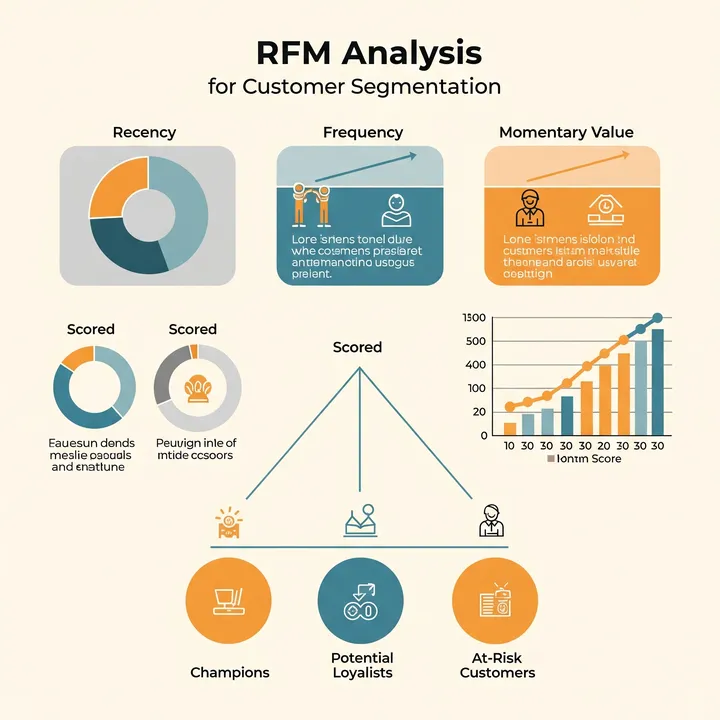
"RFM is a customer-analysis framework that classifies customers along three axes—the most recent purchase date (Recency), purchase frequency (Frequency), and purchase amount (Monetary)," I explained. "What matters in renewing a sales management system isn't merely making it new. Twenty years of sales data hold information on which customers are excellent and which are drifting away. Only by making it a design that can classify customers with RFM does the system renewal become a starting point for data utilization."
"First, let's measure the current cost," Gemini said, opening ROI Polygraph. He entered the data Enazaki had provided.
"The monthly cost of the aging system came out," Gemini read aloud. "The labor of duplicate work like double entry averages 220 hours a month; at an hourly rate of 3,600 yen, that's 792,000 yen a month. The labor of inquiries and confirmation because history isn't retained averages 120 hours a month, or 432,000 yen. The burden of maintaining and managing the in-house server averages 600,000 yen a month. The opportunity loss from sales data not being utilized for customer analysis averages 900,000 yen a month. The expected value of the business-continuity risk from OS incompatibility and maintenance-structure anxiety averages 500,000 yen a month. The expected value of the recovery risk during system failures averages 300,000 yen a month. The total is 3,524,000 yen a month. Annualized, that's about 42.29 million yen."
Enazaki stared at the figures. "I thought it was only the effort of double entry. I had no idea the opportunity loss of not using data for customer analysis, and the business-continuity risk, would become numbers too."
"Then let's design with RFM," I continued.
[Recency—Catching the Signs of Defection]
"First, Recency," Claude said. "We make each customer's most recent purchase date an analysis axis. We make it a structure that can extract, from twenty years of sales data, customers who haven't purchased for a while. It becomes a starting point for re-approaching excellent customers who are drifting away. Data that had lain dormant turns into a weapon against defection."
[Frequency—Distinguishing Regulars From One-Timers]
"Next, Frequency," Gemini continued. "We classify customers by purchase frequency. We distinguish regulars who transact often from customers who buy only occasionally. Relationship maintenance for high-frequency customers, upselling measures for low-frequency ones—by making the new system a design that can aggregate frequency data, the sales team's moves change."
[Monetary—Setting Priorities by Revenue Contribution]
"The Monetary perspective," I continued. "We measure customers' revenue contribution by purchase amount. It becomes clear who brings profit and where resources should be concentrated. When you multiply Recency and Frequency, the top customers—recent purchase, high frequency, large amount—surface. The allocation of sales resources changes from gut to numbers."
[Integrating Cloud Renewal and RFM]
"Last is the renewal design," I continued. "We migrate to a cloud-based sales management system and keep costs down with AI-utilizing development methods. We eliminate duplicate entry and fully preserve history. On top of that, we build in RFM-based customer classification as a standard feature. Not a mere system renewal, but a platform that turns twenty years of data into customer strategy."
[Estimating the Investment Recovery]
"Let's estimate with ROI Proposal Generator," Gemini proposed.
- Initial cost: Cloud sales management system development, data migration, RFM analysis function construction, history-preservation design, AI-utilizing development, and field training—11,800,000 yen total
- Monthly cost: Cloud usage fee plus maintenance ongoing cost—340,000 yen a month combined
- Monthly reduction effect: Duplicate-work labor reduction = 630,000 yen a month (assuming 80% reduction), history-inquiry labor reduction = 340,000 yen a month, in-house server maintenance reduction = 550,000 yen a month, customer retention/upsell contribution through RFM use = 700,000 yen a month—2,220,000 yen a month total
- Monthly net reduction: 2,220,000 yen − 340,000 yen = 1,880,000 yen a month
- Payback period: 11,800,000 yen ÷ 1,880,000 yen = about 6.3 months
"Recovery in a little over half a year," Gemini summarized. "What matters is not ending the renewal cost as a mere rebuild. By building in RFM analysis, twenty years of data turn into sales contribution from customer retention and upselling. A defensive renewal becomes an offensive platform."
Enazaki confirmed the figures and said, "I'd thought of it as a defensive matter—making an old system new. If we classify customers with RFM, the renewal becomes an offensive investment."
"RFM is a tool for turning dormant data into customer strategy," I responded.
Chapter 3: A Renewal Plan That Puts Data to Use
"Let me organize how we'll proceed," I said, standing before the whiteboard.
"Months one and two—organizing the current system's operational requirements and designing the inventory and migration of twenty years of sales data. Months three and four—developing the cloud system, eliminating duplicate entry, and building the history-preservation function. Month five—implementing the RFM analysis function and designing the customer-classification logic. Month six—data migration and verification through parallel operation. Month seven—production cutover and full migration from the old system. Month eight onward—operating sales measures based on RFM analysis and establishing approaches by customer segment."
"Switching over a system that's run for twenty years—isn't there a risk?" Enazaki confirmed.
"We proceed carefully with parallel operation," Claude responded. "If you switch over abruptly, there's a danger of bringing operations to a halt. We run old and new in parallel for a set period, confirm data consistency, and then switch over. To rush the new value of RFM analysis and cause an accident during migration would be putting the cart before the horse. The order is: firm up the defense, then put the offensive features to use."
Taking notes, Enazaki said, "With the renewal as the trigger, dormant data turns into value. Because I didn't have this idea, it would have ended as a mere rebuild."
Chapter 4: The Day Dormant Data Speaks of Customers
Ten months later, a report arrived from Enazaki.
Duplicate work and history-inquiry labor were cut 80% versus before, three months after the cloud system went live. "The screens that required double entry were unified, and past transactions can be traced back instantly. The friction of daily work decreased dramatically," Enazaki wrote.
They were also freed from in-house server maintenance. With the cloud migration, the burden of maintenance and management and the anxiety over OS compatibility vanished. "The very discussion of paying extra for Windows 11 compatibility disappeared. The nights of dreading a server failure are over," the report said.
The biggest change appeared in how customers were seen. Through RFM analysis, twenty years of sales data turned into material for customer strategy. "'This excellent customer hasn't bought recently,' 'this customer's frequency can be raised'—the data began to speak of customers' states. The sales team moved by numbers, not by gut," Enazaki wrote.
Results in defection prevention also appeared. Re-approaching excellent customers whose last purchase had grown distant could now be picked up by the system. "We could reach out first, looking at the data, to a client we'd been about to lose. Without RFM, it was a defection we wouldn't have noticed," the report said.
As a secondary effect, the quality of sales meetings changed. Customers could now be discussed by RFM segment, and abstract talk decreased. "Instead of 'let's raise sales,' we can speak concretely: 'this measure for this segment.' Meetings got shorter and the moves got clearer," Enazaki wrote.
The cost containment from AI-utilizing development also worked. Through AI-utilizing development methods, a high-functionality system was realized at a contained cost. "Features that would have been out of reach with full scratch went in at a realistic investment," the report said.
At the end of Enazaki's report, he had written: "I'd had only the defensive idea of making an old system new. When I classified customers along RFM's three axes, the renewal turned into an offensive investment. Twenty years of data, given structure, become customer strategy itself."
It was recorded that the day a company that had been dreading the prospect of a twenty-year-old system stopping under Windows 11 gained a day to let dormant data speak of customers, system renewal changed from a defensive rebuild into an offensive data platform.
"System-renewal consultations tend to lean toward defense. Old, anxious maintenance, no OS support—resolving the anxiety becomes the goal, and the renewal ends as a mere rebuild. What RFM asks is how to turn dormant data into customer strategy. Classify customers by the three axes—recency, frequency, monetary—and twenty years of sales data become a weapon for defection prevention and customer upselling. When a company that had dreaded a twenty-year-old system gained a day to let data speak of customers, what changed was not whether the system was old or new but the very perspective of turning data into value."
Related Files
Tools Used
- ROI Polygraph — Visualizing duplicate-work labor, the opportunity loss of dormant data, and business-continuity risk
- ROI Proposal Generator — Investment-recovery simulation for a sales-management renewal with RFM analysis built in


