
ROI Case File No.532: What Was Decided Out Loud Was Recorded Nowhere
What Was Decided Out Loud Was Recorded Nowhere
Chapter 1: The More Important the Meeting, the Less the Record Survives
"We want to make our internal meeting minutes more efficient somehow. The senior meetings in particular survive only as verbal accounts."
Toru Urushibara, administration manager at Globex Corporation, spread out his materials as he spoke. "The more important the meeting—president-level, division-head-level—the less it's recorded. What was decided can't be confirmed afterward."
"How much effort does writing the minutes take?" Claude asked.
"After an all-hands meeting, someone spends half a day writing them up," Urushibara answered. "And many employees aren't in the habit of taking notes. The content isn't recorded accurately, and 'he-said-she-said' breaks out. The most important decisions are made out loud and survive nowhere."
"What concrete damage does the missing record cause?" I confirmed.
"We can't trace decisions," Urushibara answered. "We can't follow 'what did we decide back then.' Downstream work stops while we wait for the minutes. The people who can write them up are limited, too, and when that person is out, the meeting itself hangs in the air."
"So you haven't built a flow that observes the event of a meeting and turns it into a record," I responded. "Let's loop it with OODA."
Chapter 2: OODA Asks for One Cycle from Observation to Action
"This case needs OODA."
Claude wrote "O・O・D・A" on the whiteboard.
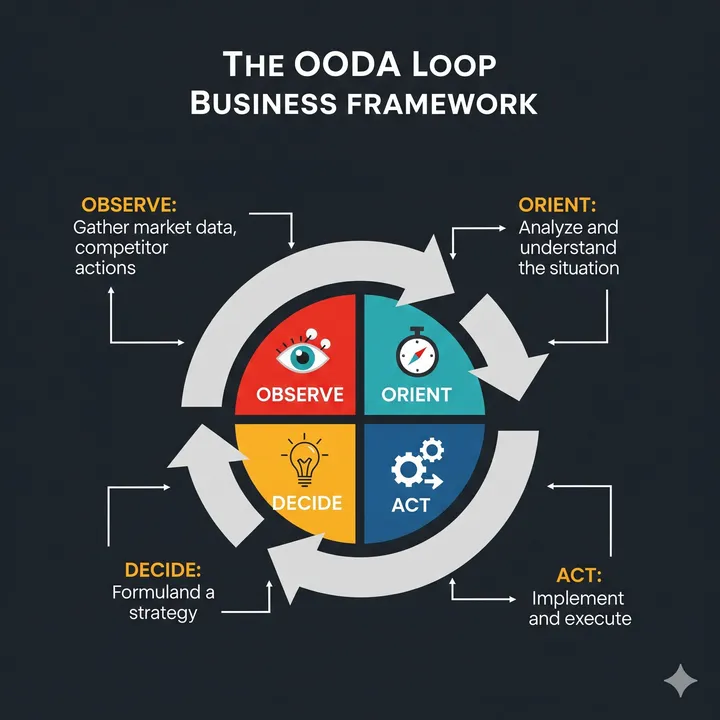
"OODA is a decision loop made of the initials of Observe, Orient, Decide, and Act," I explained. "It originated in air-combat theory, but its essence is cycling 'observe the situation, make sense of it, decide, and move' quickly. Observe the phenomenon of a meeting, orient on what the problem is, decide on a move, and deploy it. It's a tool for not ending at one cycle but keeping it turning."
"Let's measure the current cost first," Gemini said, opening ROI Polygraph and entering the data Urushibara had provided.
"The monthly meeting cost is in," Gemini read out. "Minutes-writing effort averages 180 hours a month; at ¥4,200 an hour, that's ¥756,000 a month. Rework and perception gaps from gaps in verbal records average ¥600,000 a month. The untraceable-decision cost of important meetings going unrecorded averages ¥450,000 a month. Delays to downstream work while waiting for minutes average ¥350,000 a month. The expected value of key-person risk in the recording task averages ¥400,000 a month. The total is ¥2,556,000 a month—roughly ¥30.67 million a year."
Urushibara stared at the figures. "I thought it was only the time to write minutes. Add the cost of untraceable decisions and downstream delays, and it comes to this much."
"Then let's design it with OODA," I continued.
[Observe—Observe the Current State of Meetings]
"First, we observe the reality of the meetings," Claude said. "Which meetings, at what frequency, recorded by whom, and where the record drops. Observe, and you find the record drops least in the high-frequency regulars and most in the monthly executive meetings. Observation pinpoints where the damage is greatest."
[Orient—Orient Observation Toward a Solution]
"Next, we orient on the observed results," Gemini continued. "The cause of the dropped record is reliance on manual notes. So an AI minutes tool that records meeting content from audio in real time becomes the solution. This is the stage of converting observed facts into the direction of a move."
[Decide—Decide on the Tool to Adopt]
"Once direction is set, we decide on specifics," I continued. "We choose a tool with high speech-recognition accuracy and low operating burden. What matters is whether the floor will keep using it. However high-spec, a tool that goes unused leaves no record. We place the decision criterion on adoption, not features."
[Act—Try It, and Return to Observation]
"Finally, Act," Claude continued. "Rather than rolling out company-wide at once, we pilot in the executive meetings first. Run it, observe the effect, and return to orienting. OODA isn't run once and done; the result of Act becomes the next Observe—a cycle."
[Estimating the Payback]
"Let's run the numbers with ROI Proposal Generator," Gemini proposed.
- Initial cost: AI minutes tool selection, speech-recognition tuning, integration into existing meeting bodies, and company-wide rollout training—¥5.2 million total
- Monthly cost: tool fees and ongoing operation combined—¥180,000 a month
- Monthly savings: minutes-writing hours cut = ¥600,000 a month (assuming 80% reduction); gap-and-rework cut = ¥420,000 a month; decision traceability restored = ¥300,000 a month; downstream delays resolved = ¥260,000 a month—¥1,580,000 a month total
- Net monthly savings: ¥1,580,000 − ¥180,000 = ¥1,400,000 a month
- Payback period: ¥5.2 million ÷ ¥1,400,000 = about 3.7 months
"Payback in just under four months," Gemini summarized. "What makes it work is narrowing the rollout to executive meetings first. Rather than deploying company-wide all at once, you try it where the record drops most. Because you expand based on observing the result of Act, you avoid the failure where the investment ends without the tool ever taking hold."
Urushibara said as he checked the figures, "I'd only thought of making minutes more efficient. Observe, and you can see concretely in which meeting the record drops. From there you can decide."
"OODA is a tool for cycling observation all the way to a move," I responded.
Chapter 3: A Rollout Plan That Loops from the Executives
"Let me lay out the approach," I said, standing at the whiteboard.
"Month one—inventory the meeting bodies and observe the recording reality; pinpoint the meetings where the record drops. Month two—select the AI minutes tool and tune speech recognition. Month three—pilot in executive meetings and observe the effect. Month four—orient on the observed results and improve; confirm adoption. Month five—roll out to department meetings. Month six onward—company-wide rollout, building a base to search and use minutes data, and keeping the OODA loop running."
"I'm anxious about whether the floor will use it," Urushibara confirmed.
"That's why we start with the executives," Claude responded. "If the top uses it, the floor follows. If the pilot lets us observe that 'the burden drops,' that becomes the argument for rollout. Far cheaper than regretting after handing an unused tool to the whole company—expanding while observing keeps the loss far smaller."
Urushibara said as he took notes, "Observe, decide, try, and observe again. I can see the order now."
Chapter 4: The Day Decisions Became Traceable
Nine months later, a report arrived from Urushibara.
After the pilot led to full rollout, minutes-writing effort was down 80% versus before. "When a meeting ends, a draft of the minutes is already there. The writer just confirms and tidies. A half-day job became a dozen-odd minutes," Urushibara wrote.
Gaps in verbal records dropped sharply too. Important meetings were recorded in real time, and 'he-said-she-said' disappeared. "Decisions become text on the spot. We can now trace 'what we decided' afterward," the report said.
The most unexpected change showed up in the quality of the meetings themselves. With the premise that the record survives automatically, the discussion changed. "Participants who were distracted by taking notes could focus on the discussion. Leave the record to the machine, and people return to thinking," Urushibara wrote.
The key-person dependency on recording was resolved too. They escaped the state where the meeting hangs in the air without a specific person. "The tightrope of 'no record survives without that person' is gone," the report said.
As a side effect, past decisions became searchable. The accumulated minutes could be used as a history of decisions. "We can trace 'when did we decide what on that matter' by search. Meetings became an asset, not a pile of records," Urushibara wrote.
At the end of Urushibara's report, he had written this: "I thought the minutes problem was the labor of writing them. But the real problem was that decisions weren't recorded and couldn't be traced. The moment we observed meetings with OODA, where to start was decided. Loop observation all the way to a move, and the decisions that had vanished out loud survive."
The day a company where what was decided out loud survived nowhere became one that could trace decisions, meetings had turned from the labor of producing records into a place for focusing on thought, the report read.
"The meeting problem is usually spoken of as 'the labor of writing minutes.' But beneath the labor lurks a deeper problem: the more important the decision, the more it vanishes out loud and can't be traced afterward. What OODA asks for is one cycle of observe, orient, decide, act. Observe the meetings to pinpoint where the record drops, orient on a solution, decide on a tool, and try it where the damage is greatest. Return the result of Act to observation again. When a company where what was decided out loud survived nowhere got the day decisions could be traced, what changed was not the minutes tool but the very judgment that observes meetings and loops all the way to a move."
Related Files
Tools Used
- ROI Polygraph — Visualizing minutes-writing hours, gap-and-rework, and untraceable-decision cost
- ROI Proposal Generator — Payback simulation for observation-driven AI minutes deployment


