
ROI Case File No.537: The 'Something' in 'Something with AI' No One Could Name

The "Something" in "Something with AI" No One Could Name
Chapter 1: We Want To, but Can't Say What
"We want to make work more efficient with generative AI. But what to do, and how, isn't settled yet."
Yu Kamoshida, in charge of data utilization at DataSphere, spoke about the current state. "We're in the middle of building a setup that pulls data from internal systems into an analysis environment, and we're building dashboards with Google's services. We want to combine generative AI here, but how to actually use it isn't visible."
"What have you tried with AI use so far?" Claude asked.
"We looked at auto-generating proposals," Kamoshida answered. "But the formats were too varied to handle, and we gave up. Right now, how to combine the accumulated data with generative AI isn't clear. Neither the direction nor the resources are settled."
"When are you thinking of deploying?" I confirmed.
"2027 or '28," Kamoshida answered. "First I want to hear a broad range of proposals and start from information gathering. We have the will, but the 'what' part is something no one can put into words."
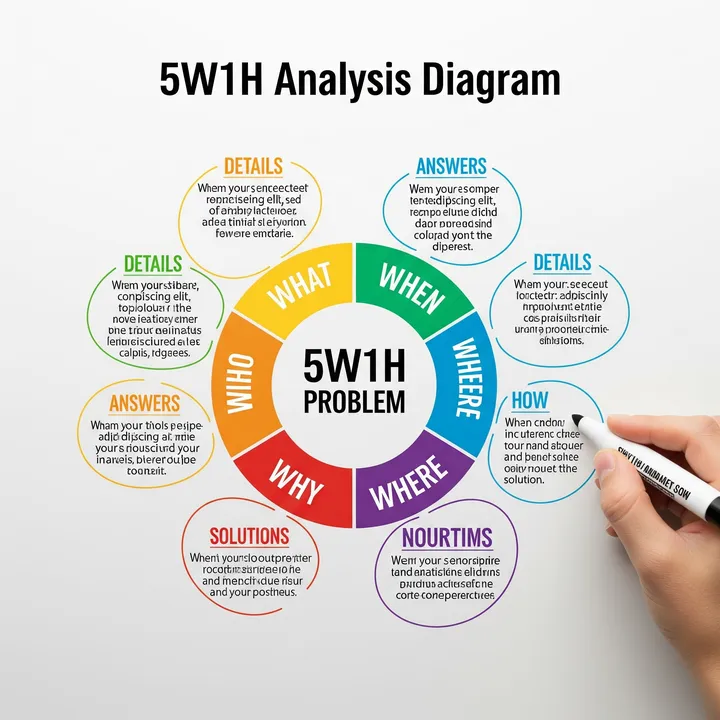
"If you can't put what you want into words, let's pose questions and order the issues," I responded. "Let's break it down with 5W1H."
Chapter 2: 5W1H Asks Who, What, Why, and How
"This case needs 5W1H."
Claude wrote "5W1H" on the whiteboard.
"5W1H is a framework that breaks a vague vision into concrete issues with six questions—Who, What, When, Where, Why, How," I explained. "It looks simple, but the more vague the wish—'something with AI'—the better it works. Who, what, when, where, why, how—until you can answer these six, nothing can start. Conversely, answer them and the vision becomes a plan. It's a tool for clearing the fog."
"Let's measure the current cost first," Gemini said, opening ROI Polygraph and entering the data Kamoshida had provided.
"The monthly work cost is in," Gemini read out. "Proposal and document creation averages 200 hours a month; at ¥4,400 an hour, that's ¥880,000 a month. Manual aggregation and shaping of internal data averages ¥600,000 a month. The opportunity loss of initiatives stalling for lack of a data-utilization direction averages ¥550,000 a month. Rework from inconsistent proposal formats averages ¥380,000 a month. The expected value of key-person risk in data and know-how averages ¥420,000 a month. The total is ¥2,830,000 a month—roughly ¥33.96 million a year."
Kamoshida stared at the figures. "While we gather information with no settled direction, we were losing this much every month. Being unable to move was itself a cost."
"Then let's design it with 5W1H," I continued.
[Who, Why—Who Does It, and Why]
"First, we set Who and Why," Claude said. "Who is the staff in the department handling internal data. Why is, learning from the proposal-automation failure, to make work efficient with data and generative AI. Set the agent and the purpose, and a core forms: 'whose initiative, for what.' Vague here, and everything blurs."
[What, Where—What to Make Efficient, and Where]
"Next, What and Where," Gemini continued. "What is business efficiency combining internal data and generative AI—especially building out the data-analysis environment and dashboard use. Where is internal. Settle 'what and where,' and the vague 'something' becomes a concrete target."
[When—By When, and in What Order]
"With When, we draw the time axis," I continued. "A 2027–'28 deployment target. Then, now is information gathering and issue-ordering, next term a small-scale verification, the term after full deployment—we draw the order by working backward. Set the deadline, and what to do now is decided. When is the question that pulls action into the present."
[How—How to Start]
"Finally, How," Claude continued. "Rather than rolling out company-wide at once, start from a small pilot. The 'format variety' that sank the proposal automation can be overcome by narrowing the target. Gather a broad range of proposals and try from the feasible measures. How is the question that turns a vision into a first step."
[Estimating the Payback]
"Let's run the numbers with ROI Proposal Generator," Gemini proposed.
- Initial cost: internal-data linkage, building a generative-AI utilization base, proposal-generation support, dashboard integration, pilot-environment build, and training—¥6.8 million total
- Monthly cost: AI operation and ongoing base updates combined—¥260,000 a month
- Monthly savings: proposal and document-creation hours cut = ¥660,000 a month (assuming 75% reduction); data aggregation and shaping cut = ¥460,000 a month; direction stagnation resolved = ¥380,000 a month; format rework cut = ¥280,000 a month—¥1,780,000 a month total
- Net monthly savings: ¥1,780,000 − ¥260,000 = ¥1,520,000 a month
- Payback period: ¥6.8 million ÷ ¥1,520,000 = about 4.5 months
"Payback in four and a half months," Gemini summarized. "What matters is that even with a 2027 deployment target, the issue-ordering can be done now. Answer the six with 5W1H, and you can start a pilot without waiting for full deployment. The period stuck 'gathering information,' unable to move, was the biggest cost."
Kamoshida said as he checked the figures, "We'd been stuck at 'something with AI' the whole time. Answer the six questions, and the 'something' becomes a concrete target. What to do now becomes visible."
"5W1H is a tool for turning a vision you can't put into words into issues you can answer," I responded.
Chapter 3: A Rollout Plan That Advances by Answering Questions
"Let me lay out the approach," I said, standing at the whiteboard.
"Month one—order the issues with 5W1H; fix Who and Why. Month two—make What and Where concrete; narrow the target work. Month three—design the When time axis; fix the pilot scope. Months four and five—build a small-scale pilot, linking internal data and generative AI. Month six—verify the pilot's effect and test the format issue. Month seven onward—expand targets based on verification, connecting to full deployment from 2027."
"Can we advance even though the direction isn't settled?" Kamoshida confirmed.
"We use 5W1H to settle it," Claude responded. "The direction isn't settled not because information is lacking but because no question has been posed. Answer the six and the direction forms naturally. Gathering a broad range of proposals, too—once Who, What, and Why are set, you can ask with a clear target. Because there's a question, the gathered information can be used in judgment."
Kamoshida said as he took notes, "Pose the questions before gathering information. I see the order was backward."
Chapter 4: The Day the "Something" Became Words
Nine months later, a report arrived from Kamoshida.
After a generative-AI-assisted pilot, proposal and document-creation hours were down 75% versus before in the target work. "A draft proposal comes out automatically from the data. The format issue, too, was overcome by narrowing the target," Kamoshida wrote.
The data-utilization direction settled too. The vague 'something with AI' became a list of concrete measures. "'What to do' became words. We could explain it internally, and discussions started moving forward," the report said.
The biggest change showed up in being able to start moving. Without waiting for 2027 deployment, what could be done now became visible. "We broke out of being stuck 'gathering information.' Just by answering the questions, the first step was decided," Kamoshida wrote.
The view of the past failure changed, too. Abandoning proposal automation came alive as a lesson. "We'd stopped at 'impossible because formats are varied.' We learned that narrowing the target with How overcomes it. The failure became material for the next design," the report said.
As a side effect, the quality of internal discussion rose. 5W1H became a shared language, and new measures got ordered with the same questions. "The habit of asking 'who, why, how' took hold internally. Vague visions decreased," Kamoshida wrote.
At the end of Kamoshida's report, he had written this: "Wanting to but unable to say what—the true nature of this state wasn't a lack of information but the absence of questions. The moment we answered the six with 5W1H, the 'something' became concrete. A vision becomes a plan only by answering questions."
The day a company where no one could name the 'something' in 'something with AI' became one that could put its measures into words, generative-AI use had turned from a vague wish into a plan assembled by answering questions, the report read.
"'We want to do something with AI'—this consultation is increasing. But many stall with what to do left unsaid. The cause isn't a lack of information. It's the absence of questions. What 5W1H asks is who, what, when, where, why, how. Break a vague vision into the six questions, and the unanswerable parts surface as issues while the answered parts become a plan. The day a company that could name no 'something' could put its measures into words, what changed was not the performance of the generative AI but the very perspective that breaks a vision into questions."
Related Files
Tools Used
- ROI Polygraph — Visualizing proposal-creation hours, data aggregation, and the opportunity loss of a stalled direction
- ROI Proposal Generator — Payback simulation for generative-AI use starting from issue-ordering


