
ROI Case File No.567: 'Looking at One Task, They Couldn't See the Whole Hiring Flow'

Looking at One Task, They Couldn't See the Whole Hiring Flow
Chapter 1: I Know the Heaviest Task—but I Can't See the Whole
"Writing offer letters takes thirty minutes every day. I want to streamline that with AI."
Ren Kachihara, HR director at Innovate Solutions, an IT-industry company, described the situation. "We aim to hire about thirty new graduates a year. Writing the offer letters for direct recruiting is a thirty-minute-a-day load. I want to do something about that first."
"Is offer-letter writing your only issue?" Claude asked.
"...Put that way, it isn't only that," Kachihara answered. "The data-analysis feature of our applicant-tracking system is weak, and applications drop year by year. We need retention measures, too. But I figured we'd start with the most conspicuous—offer-letter writing."
"Hiring has stages before and after offer-letter writing, too," I said, to confirm.
"It does," Kachihara answered. "Gather the applicant pool, select, extend offers, and retain after joining. It's a single flow. But I've never looked at the whole flow and considered where to act. I was looking only at the one conspicuous task."
"Trim only one task, and the clog in the whole flow remains," I replied. "Let's break this down with VALUECHAIN."
Chapter 2: VALUECHAIN Asks—Split the Chain into Stages and Stack Value
"This case calls for VALUECHAIN."
Claude wrote on the whiteboard: "Attract, Select, Decide, Retain."
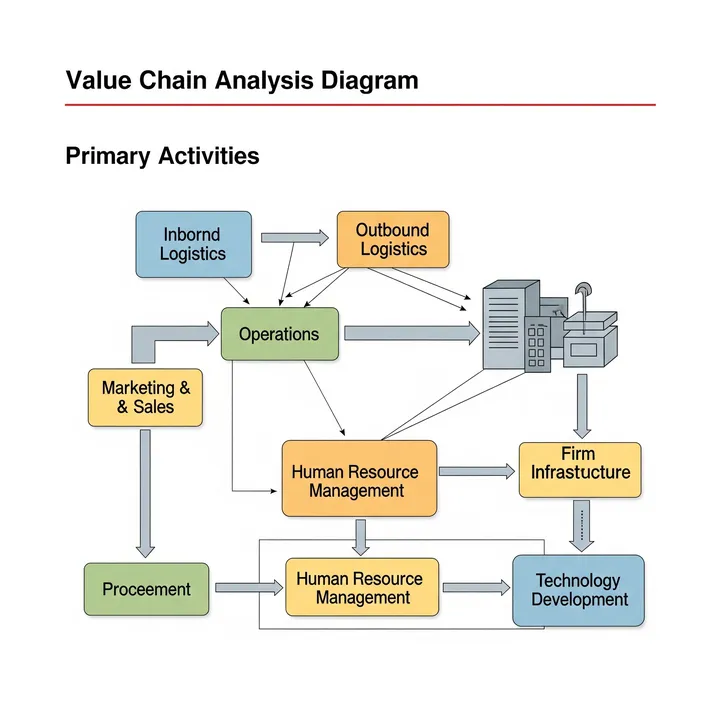
"VALUECHAIN—the value chain—splits work into stages as a chain of value, sees the value and efficiency of each stage, and acts for whole-system optimization," I explained. "The key is to see it as a chain, not a single task. Hiring is a linked chain from pool formation through selection, offers, and retention. Trim only one conspicuous stage, and if the others clog, the flow doesn't improve. Stack value stage by stage, and the whole of hiring runs smooth."
"First, let's measure the current cost," Gemini said, opening ROI Polygraph. The data Kachihara provided was entered.
"Here is the monthly cost," Gemini read out. "Manual labor for hiring clerical work such as offer-letter writing: 140 hours per month on average, at ¥3,800 per hour, ¥532,000 per month. Degraded measure precision from weak data analysis in the applicant-tracking system: ¥360,000 per month. Opportunity loss in pool formation from declining applications: ¥400,000 per month. Early-turnover cost from the absence of retention measures: ¥380,000 per month. Inefficiency across the whole of hiring from stage fragmentation: ¥300,000 per month. A total of ¥1,972,000 per month. Roughly ¥23.66 million per year."
Kachihara stared at the figures. "I was only looking at the thirty minutes of offer-letter writing. Add the clog in the whole flow, and it comes to this much."
"Then let's design it with VALUECHAIN," I continued.
[Attract—See the pool-formation stage]
"First, see the attract stage," Claude said. "Applications drop year by year. If the pool thins, no matter how much you streamline later stages, the denominator falls short. Reset the entrance of the chain first."
[Select—Streamline the offer and selection stages]
"Next, streamline the select stage," Gemini continued. "Bring AI into offer-letter writing and cut the thirty-minute-a-day load. Strengthen the applicant-tracking system's data analysis and raise selection precision. Position the conspicuous task within the chain and act on it."
[Decide—Support offer decisions with data]
"After select, support the decide stage," I continued. "Put the strengthened data analysis to work in offer decisions. Support who to decide on with data, not gut. Because the stages connect, the earlier streamlining pays off in the next."
[Retain—Preserve value with retention]
"Finally, build the retain stage," Claude continued. "Bring in a survey tool, grasp employee satisfaction, and prevent turnover. Not 'hire and done,' but stacking value through retention. Only by seeing all the way to the exit of the chain is hiring complete."
[Estimating the payback]
"Let's run the numbers on ROI Proposal Generator," Gemini proposed.
- Initial cost: offer automation, renewing the applicant-tracking system, strengthening data analysis, adopting a survey tool, and operational design—¥4.9 million total
- Monthly cost: system licensing and operation combined, ¥200,000
- Monthly savings: automation of offer writing = ¥370,000 (assuming a 70% reduction); improved selection precision via strengthened data analysis = ¥340,000; more applications via improved pool formation = ¥360,000; better retention via turnover prevention = ¥340,000; totaling ¥1,410,000 per month
- Net monthly savings: ¥1,410,000 − ¥200,000 = ¥1,210,000 per month
- Payback period: ¥4.9 million ÷ ¥1.21 million = about 4.0 months
"Four months to recoup," Gemini summarized. "What works is not trimming only the conspicuous task, but stacking value across the whole hiring chain. Streamline only offer writing, and if the pool thins and people don't stay, the flow doesn't improve. Act stage by stage, and the whole of hiring runs smooth. The investment doesn't miss."
Kachihara checked the figures. "I thought trimming the heaviest task would make it better. Seen as a chain, unless you act on the stages before and after, it doesn't work."
"VALUECHAIN is a tool for splitting the chain into stages and stacking value," I replied.
Chapter 3: An Implementation Plan That Stacks Value Across the Chain
"Let me lay out the approach," I said, standing at the whiteboard.
"Month one—split the hiring process into stages and grasp each stage's value and clog. Month two—organize the pool-formation issues and design offer automation. Months three and four—offer automation and renewing the applicant-tracking system with strengthened data analysis. Month five—adopt the survey tool and design retention measures. Month six—trial operation and effect verification (measuring each stage). Month seven onward—continuously improve each stage and optimize the whole hiring chain."
"Is it all right to widen beyond offer-letter writing?" Kachihara asked.
"That works better," Claude replied. "Trim one task and the whole flow doesn't improve. If the pool thins, the selection denominator falls short; if people don't stay, the effort spent hiring is wasted. Split the chain into stages with VALUECHAIN and stack value from entrance to exit. The earlier stage's streamlining pays off in the next. The whole of hiring connects, smoothly."
Kachihara took notes. "Before trimming one task, see the whole chain. Now I see the order."
Chapter 4: The Day the Whole Flow Connected
Ten months later, a report arrived from Kachihara.
After automation, the thirty-minute-a-day load of offer writing vanished. "Offers I wrote by hand became something started from a draft. We turned the freed time to dialogue with candidates," Kachihara wrote.
Data analysis was strengthened, too. The renewed system supported selection judgment. "The part we decided by gut got backed by data. We could act on the decline in applications, too," the report read.
The biggest change showed in how hiring appeared. From chasing only one task, to seeing the whole chain. "I was only looking at the thirty minutes of offer writing. Once split into stages, the clogs before and after—the pool and retention—became visible, and we could act on those too," Kachihara wrote.
Turnover dropped as well. The survey tool supported the retention stage. "'Hire and done' became 'see it through to retention.' Early turnover decreased," the report read.
As a side effect, the way work was viewed changed. Seeing a chain rather than a single task took root in HR. "We stopped 'crush the conspicuous task first.' We started asking where in the whole flow the clog is," Kachihara wrote.
At the end of Kachihara's report was this: "I thought the hiring-efficiency struggle was how to trim the heaviest task. But the real problem was that, looking at one task, I couldn't see the whole hiring flow. The moment we split the chain into stages with VALUECHAIN, the clogs before and after became visible. Before trimming one task, seeing the whole came first."
The day a company that couldn't see the whole flow while looking at one task became a company that could stack value across the chain, hiring efficiency had shifted from trimming one conspicuous task to a design that splits into stages and stacks value.
"Hiring-efficiency requests usually arrive as 'I want to trim the heaviest task.' But before trimming one task, there's a question to ask: where in the hiring flow does that task sit? What VALUECHAIN asks is the chain of attract, select, decide, and retain. Trim only one stage, and if the others clog, the flow doesn't improve. The day a company looking at only one task connected the whole flow, what changed was not the tool's performance but the very perspective that splits the chain into stages and stacks value."
Related Files
Tools Used
- ROI Polygraph — Visualizing hiring-clerical labor, degraded measure precision from weak data analysis, and inefficiency from stage fragmentation
- ROI Proposal Generator — Payback simulation for hiring efficiency, starting from splitting the hiring chain into stages


