
ROI Case File No.590: They Kept Saying They Wanted Automation, but Never What, by Whom, or How Far
They Kept Saying They Wanted Automation, but Never What, by Whom, or How Far
Chapter 1: They Want More Automation, but the Conversation Won't Move
"We're looking for a company that can automate our work inside a closed AI environment."
Akira Rokutanda, information systems manager at AetherTech, said this as he laid out the situation. "We already have RPA. But it doesn't reach the point where human hands become unnecessary. We've tried AI for minute-taking and contract review too, and a human still ends up making the judgment somewhere."
"Is there anything else on your mind?" Claude asked.
"Shadow AI," Rokutanda answered. "People are using free ChatGPT on their own. I'm afraid of an information leak. I want to set a company AI policy and consolidate everything into a closed environment. I want a setup a small team can run, with the know-how staying in-house."
"For that automation—what work, by whom, and how far?" I confirmed.
"...That part is vague," Rokutanda answered. "We've been moving on the word 'automation' alone. Minutes, contracts, email, drawings—we want all of it. But which ones, why, as whose job, by when, where, and how. We haven't decided. That's why nothing lines up when we talk to vendors."
"On a word alone, the conversation can't move," I replied. "Let's break this down with 5W1H."
Chapter 2: 5W1H Asks—Six Questions to Fix the Target and the Scope
"This case calls for 5W1H."
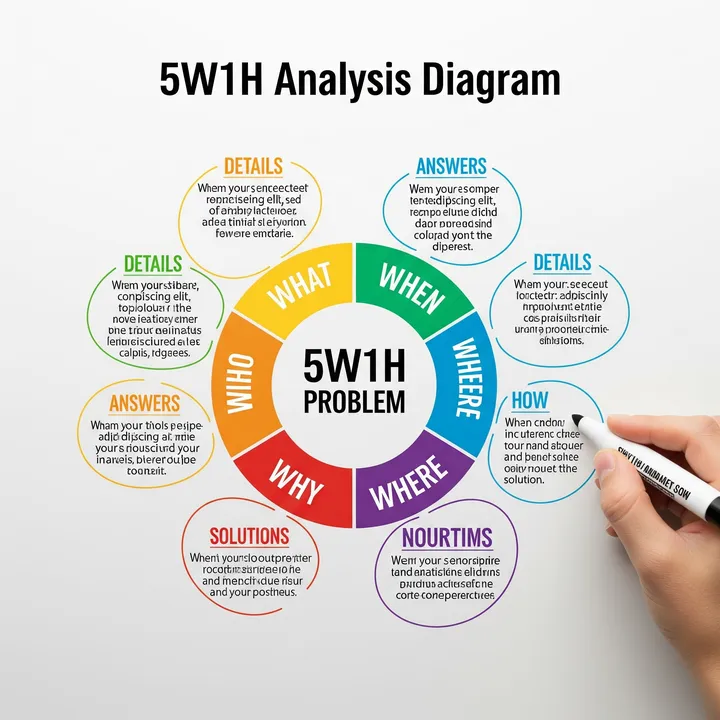
Claude wrote "What / Why / Who / Where / When / How" on the whiteboard.
"5W1H—the six questions—is a framework for converting a vague request into a target, a reason, an owner, a place, a deadline, and a method," I explained. "The essence is not proceeding on the word 'automation' as-is. What, why, as whose work, where, by when, and how. Only once these six are filled can proposals and quotes be compared. Meetings that don't line up usually have one of them blank."
"First, let's measure the current cost," Gemini said, opening ROI Polygraph. The data Rokutanda provided went in.
"The monthly costs are out," Gemini read off. "Manual minute-taking, contract review, and email triage averages 185 hours per month; at ¥3,800 per hour, that's ¥703,000 per month. Information-leak risk from individual use of free AI averages ¥460,000 per month. Judgment work that RPA can't pick up averages ¥360,000 per month. Searching and cross-checking caused by person-dependent drawing management averages ¥320,000 per month. Loss of reproducibility from know-how staying with individuals averages ¥300,000 per month. The total is ¥2,143,000 per month. Annualized, roughly ¥25,720,000."
Rokutanda stared at the figures. "I was only looking at efficiency not improving. Once you add the shadow AI risk and the loss from know-how not staying, it comes to this much."
"Then let's design with 5W1H," I continued.
[What and Why—Name what you're automating and why]
"First, the target and the reason," Claude said. "Minute-taking, contract clause checking, first-pass email triage, drawing search. Name those four. Separate the reasons too. Minutes are about labor reduction, contracts about risk reduction, email about response speed. Different reasons mean different accuracy requirements."
[Who and Where—Decide whose work it is and where]
"Next, the owner and the place," Gemini continued. "Headquarters sales, or the branch technical department? Is operation carried by information systems or by the business units? Who uses it, who maintains it, and who holds responsibility for the judgment. Leave this blank and it floats unowned after deployment."
[When—By when, and in what order to switch over]
"After the owner, the deadline," I continued. "Resolving shadow AI is immediate. Preparing the closed environment and publicizing the usage policy takes top priority. Minutes at three months, contracts at six. Not all at once—set deadlines starting from the highest risk."
[How—How it runs inside the closed environment]
"Last, the method," Claude continued. "Put a closed AI platform inside the company and connect it to the existing RPA. RPA carries the steps, AI carries the judgment. And build, at the same time, a mechanism for accumulating usage patterns and failure cases internally. Retaining know-how is part of the method."
[Calculating the payback]
"Let's run the numbers with ROI Proposal Generator," Gemini proposed.
- Initial cost: Fixing the target tasks, building the closed AI environment, integrating with existing RPA, implementing minutes/contract/email processing, and formulating the usage policy with internal training — ¥5,200,000 total
- Monthly cost: AI platform usage fees plus ongoing operation and maintenance — ¥240,000 per month
- Monthly savings: Automation of minutes, contract, and email processing = ¥540,000 per month (assuming a 70% reduction), reduced information-leak risk through resolving shadow AI = ¥380,000 per month, elimination of drawing search and cross-checking = ¥260,000 per month, reproducibility secured through accumulated know-how = ¥300,000 per month — ¥1,480,000 per month in total
- Net monthly savings: ¥1,480,000 − ¥240,000 = ¥1,240,000 per month
- Payback period: ¥5,200,000 ÷ ¥1,240,000 = approximately 4.2 months
"A payback of just over four months," Gemini summarized. "What makes it work is not stopping at the word 'automation,' but filling in the six. With blanks, vendors fill them in with whatever shape suits them, and the proposals can't be compared. With the six filled, the quotes line up on the same ground. The investment doesn't swing at air."
Rokutanda looked over the figures. "I thought finding a good AI environment would settle it. Without filling in the six, there's no way even to search."
"5W1H is a tool for converting a vague request into a target and a scope," I replied.
Chapter 3: An Implementation Plan That Fills In the Six
"Let me lay out how to proceed," I said, standing at the whiteboard.
"Month one—fix the target tasks and inventory the six questions. Month two—build the closed AI environment and resolve shadow AI by publicizing the usage policy. Months three and four—automate minute-taking and integrate with existing RPA. Month five—implement contract checking and first-pass email triage. Month six—organize drawing management and verify results. Month seven onward—embed know-how accumulation and expand to more departments."
"Wouldn't it be better to start with contracts, where the effect is largest?" Rokutanda asked.
"Deadlines are set by risk, not by effect," Claude replied. "Shadow AI is running this very moment, and one leak is irreversible. Prepare the closed environment first and it becomes the receptacle that stops the leakage. Deciding what by when comes before ordering things by size of effect."
Rokutanda took notes. "Before talking about automation, fill in the six. I can see the order now."
Chapter 4: The Day the Six Were Filled and the Conversation Moved
Ten months later, a report arrived from Rokutanda.
Shadow AI vanished the moment the closed environment was ready. "Telling people not to use it never stopped it. Once we built a place they could use, nearly everyone moved over within two weeks," Rokutanda wrote.
Minutes started coming out automatically as well. RPA carrying and AI summarizing erased the manual work. "What used to take an hour of transcription after a meeting now takes only a check," the report said.
The largest change showed up in how they made requests. From nothing but the word "automation," they moved to talking with the six filled in. "The reason nothing lined up with vendors was that we brought it to them with blanks. Once we handed over the six filled in, the proposals lined up on the same ground," Rokutanda wrote.
Know-how began staying in-house too. A mechanism for accumulating usage patterns and failure cases prevented person-dependency. "The state where only the people good at it benefited is over. We have a setup a small team can run," the report said.
As a secondary effect, the way they write requests changed. Filling in the six took root on other projects as well. "We stopped ending at 'here's what we want to do.' Now we write what, why, who, where, by when, and how," Rokutanda wrote.
At the end of Rokutanda's report, he had written: "I thought the automation problem was the limits of RPA. But the real problem was that we kept saying we wanted automation without what, by whom, or how far. The moment 5W1H filled in the six, proposals and quotes became comparable. Before looking for a vendor, filling in the six came first."
The day a company that had said it wanted automation without what, by whom, or how far became a company that fills in the six before asking, business automation had changed from a request made of words into a design that fixes the target, the reason, the owner, the place, the deadline, and the method, the report noted.
"Automation consultations almost always arrive in the form of 'we want more automation.' But before you look for a vendor, there is something to ask. Have what, who, and how far been decided? What 5W1H asks about is the target, the reason, the owner, the place, the deadline, and the method. Fill in the six and the proposals line up on the same ground, ready to be compared. The day a company that had moved on the word 'automation' alone managed to fill in the six, what changed was not the AI's performance but the very perspective of fixing a vague request into a defined scope."
Related Files
Tools Used
- ROI Polygraph — Visualizing minutes, contract, and email processing hours, shadow AI risk, and person-dependency costs
- ROI Proposal Generator — Investment-recovery simulation for business automation in a closed AI environment driven by fixing the target through six questions


