
ROI Case File No.494 'The Night the Same Lighting Lit 26 Locations'

The Night the Same Lighting Lit 26 Locations
Chapter One: Each Location Judges Differently
"We run the same scenario for banquet productions across 26 locations. Yet the output differs subtly by location."
Takaya Jinguji, business division manager at NexTech Innovations, lined up event reports by location. For the same wedding customer group, locations A and B had adopted different lighting setups. "Field staff experience differences cause judgment to diverge."
"I understand your company was the first in the industry to introduce sound and lighting to hotel banquets," I confirmed.
"40 years ago," Jinguji answered. "What was groundbreaking then became the industry standard, and we now operate sound, lighting, and video operations at 26 hotel locations nationwide. However, in the process of expanding locations, the operational quality of each site has come to depend on individual experience."
"What are the specific challenges?" Claude asked.
"Three," Jinguji continued. "First, we can't deploy enough staff at each location. Each location operates with two to three people, and judgment for sudden situations falls on one person. Second, human errors occur several times a month—equipment operation mistakes and timing slips in proceedings. Third, response speed to unexpected situations—sound trouble, lighting equipment failures, schedule changes—varies by location."
"You also mentioned video production and confidential information handling," Gemini confirmed.
"Wedding and corporate event videos contain customers' private information," Jinguji answered. "Security management has been left to each location, and rules aren't unified. Looking 10 to 15 years ahead, without addressing this, the business won't function."
"Judgment varying by location is because the basis for judgment isn't standardized," I said quietly.
Chapter Two: TPS Asks About the Boundary Between Standard and Anomaly
"This case requires TPS."
Claude wrote three letters on the whiteboard: T, P, S.
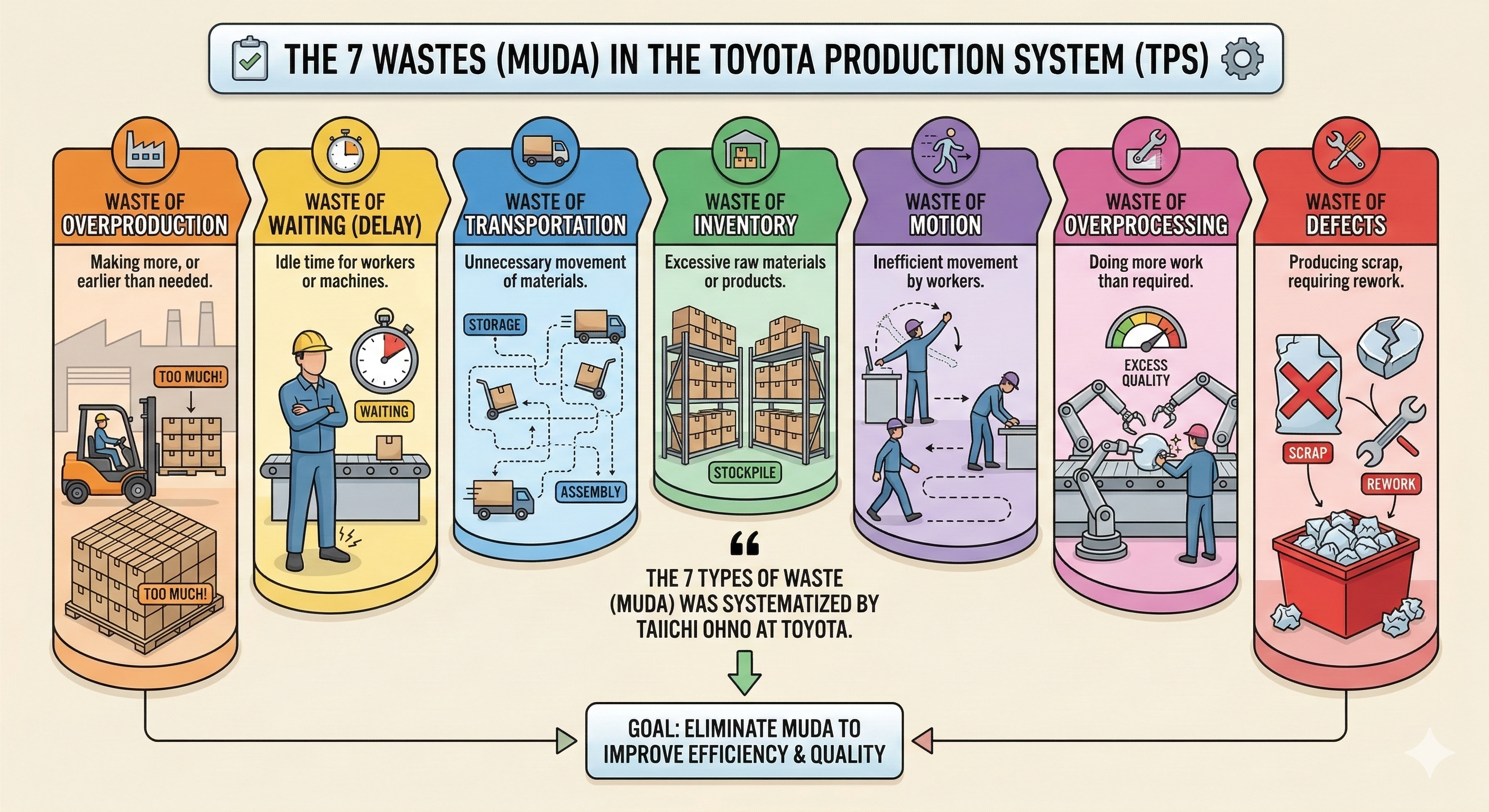
"TPS stands for Toyota Production System," I explained. "It's a manufacturing field improvement methodology, but it can be applied to service industry operations. At its core is establishing standard work and the mechanism to instantly detect deviations from that standard—'elimination of waste' and 'visualization of anomalies.' To produce the same quality across 26 locations, we first need to define what constitutes the standard, then build a structure that can detect the moment something falls outside it."
"Let's first measure current costs," Gemini said, opening ROI Polygraph. She entered the operational data from Jinguji.
"Monthly variance costs are out," Gemini read. "Human error response averages 30 cases per month, at three hours per case, totaling 90 hours, at field hourly rate of 4,200 yen, equals 378,000 yen. Schedule extensions and additional response from judgment delays average 60 hours, equaling 252,000 yen. Customer satisfaction decline and reduced repeat rate from cross-location quality variance estimated at 900,000 yen monthly. Video data security management workload at 70 hours, equaling 294,000 yen. Total: 1,824,000 yen monthly. Annualized: approximately 21.9 million yen."
Jinguji studied the figures. "Quality variance opportunity loss is the largest."
"Now let's design with TPS," I continued.
[T—Establishing Standard Work]
"First, we define standard work," Claude said. "Create standard scenarios by event type—weddings, corporate events, banquets. Sound levels, lighting scenes, schedule timing—decompose the judgment of excellent field staff and extract elements that can be standardized. Standards are procedures where anyone produces the same result."
"How do you standardize veteran judgment?" Jinguji asked.
"We analyze three years of event reports," Gemini answered. "Compare successful cases with cases where issues arose, and extract decision points. Convert how excellent staff judged in which situations into data, and translate that into standard work procedures. The process of converting experience into standards through data."
[P—Visualizing Process Anomalies]
"Once standards are decided, we build mechanisms to detect deviations from standard," I continued. "IoT sensors measure sound levels and lighting illumination, sending alerts to headquarters when thresholds are exceeded. Video production progress management systems share each location's work status in real time. The 'andon' mechanism—creating a state where headquarters and other locations know the moment an anomaly occurs."
"Connecting locations that are currently isolated," Jinguji confirmed.
"Yes," Claude agreed. "When anomalies are visible, support from headquarters can intervene. Judgment that field staff bore alone shifts to a structure supported by the organization."
[S—Systematization and Continuous Improvement]
"Finally, we incorporate AI-based judgment support," Gemini continued. "Train AI on past event data, and have AI present recommended judgments when field staff are uncertain. Make veteran tacit knowledge accessible to younger or less experienced staff via AI."
"You're not replacing humans with AI," Jinguji said.
"Support, not replacement," I responded. "Final judgment is made by field staff. AI only presents options and past cases. It's a mechanism to elevate judgment quality, not to take judgment away."
[Calculating Investment Recovery]
"Let's run the numbers with ROI Proposal Generator," Gemini suggested.
- Initial cost: Standard work procedure development, IoT sensor implementation across 26 locations, AI judgment support system construction, security infrastructure, all-location training. Total: 12.8 million yen
- Monthly cost: System operation, AI inference, security management combined: 320,000 yen
- Monthly reduction: Human error reduction = 250,000 yen (assuming 70% reduction), resolution of judgment delays = 180,000 yen, customer satisfaction recovery from quality variance improvement = 600,000 yen, security management workload reduction = 200,000 yen. Total: 1.23 million yen monthly
- Net monthly reduction: 1,230,000 − 320,000 = 910,000 yen
- Payback period: 12,800,000 ÷ 910,000 = approximately 14.1 months
"Payback in just over a year," Gemini summarized. "The large initial investment is due to simultaneous deployment across 26 locations. From year two onward, net reductions on the scale of 11 million yen per year continue. Furthermore, the launch period for adding new locations is expected to be cut to less than half the current period."
Jinguji confirmed the figures. "I was thinking about staffing optimization. With TPS, standardization comes first, and staffing comes after."
"Before placing people, we unify the basis for judgment," I responded.
Chapter Three: Making Judgment an Organizational Asset
"Let me organize the approach," I said, standing at the whiteboard.
"Months 1–2—Analyze three years of event reports, draft standard work procedures. Month 3—Pilot operation at three locations, verify and refine standard work procedures. Months 4–5—IoT sensor implementation, build headquarters monitoring structure. Month 6—Launch initial version of AI judgment support system. Months 7–8—Staged rollout to all 26 locations. Month 9 onward—Continuous improvement of standard work procedures, monthly review."
"Will there be field resistance?" Jinguji confirmed.
"From veterans, yes," Claude answered. "A certain number will perceive 'standardization as denying craftsmanship.' The countermeasure is involving veterans in the standardization work. Include them in the work of extracting their own judgment. Position it not as denial, but as formalization for organizational use. Building a structure where veterans become instructors reduces resistance."
Jinguji closed his materials. "A company that created the industry-first production 40 years ago now takes on industry-first standardization—it sounds like a coherent story."
Chapter Four: The Day Locations Could See Each Other
Twelve months later, a report arrived from Jinguji.
With standard work procedures established and IoT sensors deployed, human error incidents decreased from a monthly average of 30 to 8. The nature of errors also shifted—where previously most were "operational mistakes due to inexperience," now they are mainly external factors like "equipment aging" and "unexpected customer requests." "Internal-cause errors decreased structurally," the report noted.
The biggest change appeared in cross-location coordination. With all 26 locations visible on the headquarters dashboard, response methods for trouble at one location were shared with other locations in real time. "A near-miss at one location becomes a preventive measure at other locations the same day," Jinguji wrote.
The AI judgment support system improved younger staff's judgment speed by 40 percent on average. Response quality during hours without veterans rose, and quality variance decreased even in night and weekend operations. "Veteran judgment became an organizational asset constantly accessible," the report noted.
On the security front, video data management rules were unified across all locations. Access logs became centrally managed at headquarters, and previously ambiguous "who handled which video" became continuously trackable. "We built a management structure we can explain to customers," Jinguji wrote.
As a secondary effect, the launch period for new locations shortened. When deploying services to new hotels, providing standard work procedures cut field staff training time from three months to one and a half. "The cost of expanding locations was halved," the report noted.
Resistance from veterans was smaller than expected. The eight veterans who participated as instructors in standardization work expressed satisfaction at having their judgment articulated and conveyed to younger staff. "Forty years of accumulated instinct remaining as the organization's standard—this becomes a source of pride for me even after retirement," one veteran's words were quoted at the end of the report.
In the nights of 26 locations, the same lighting lit for the same event—it had become the norm.
"TPS asks the boundary between standard and anomaly. Without defining the standard, anomalies are invisible. Without visible anomalies, the organization can't learn. The state where 26 locations' judgment depended on individual experience was a structure that produced variance and didn't accumulate improvement. Standardization isn't denial of craftsmanship. It's the work of converting craftsmanship into an organizational asset. The night the same lighting lit at 26 locations, field judgment hadn't homogenized—the organization had grown stronger."
Related Files
Tools Used
- ROI Polygraph — Visualizing cross-location variance, human errors, and security workload
- ROI Proposal Generator — Investment recovery simulation for standardization, IoT, and AI judgment support

