
ROI Case File No.558: 'The Mountain of Paper Was Robbing the Settlement of Speed'

The Mountain of Paper Was Robbing the Settlement of Speed
Chapter 1: Buried in Paper, Judgment Delayed
"With the chance to move our administrative division to a new research building, we want to advance DX—over about three years."
Makoto Kamiya, head of management accounting at GlobaTech, described his situation as he spoke. His company was facing a relocation from July to August 2026. "Right now almost all of our work runs on paper. There are so many stored documents that they're crowding out storage space. Sometimes we can't tell where something is. We got the board's approval for DX promotion, but general staff are still ahead of us. What to tackle first hasn't been decided."
"With paper, what troubles you most?" Claude asked.
"Not being able to close the monthly settlement," Kamiya answered. "We're chased by paper processing and can't close monthly. So management judgment gets delayed. And plan changes happen frequently at customer request, and the work has become person-dependent."
"Do you look at where the waste hides in the paper work?" I asked, to confirm.
"I just vaguely think 'paper is inefficient,'" Kamiya answered. "But I've never looked, broken apart, at which task's where is the waste. We said three years, but the first move isn't decided."
"We have to wash out the paper waste before applying jidoka," I replied. "Let's break it down with TPS."
Chapter 2: TPS Asks—Eliminating Waste and Jidoka
"This case calls for TPS."
Claude wrote "TPS—Eliminate Waste, Jidoka" on the whiteboard.
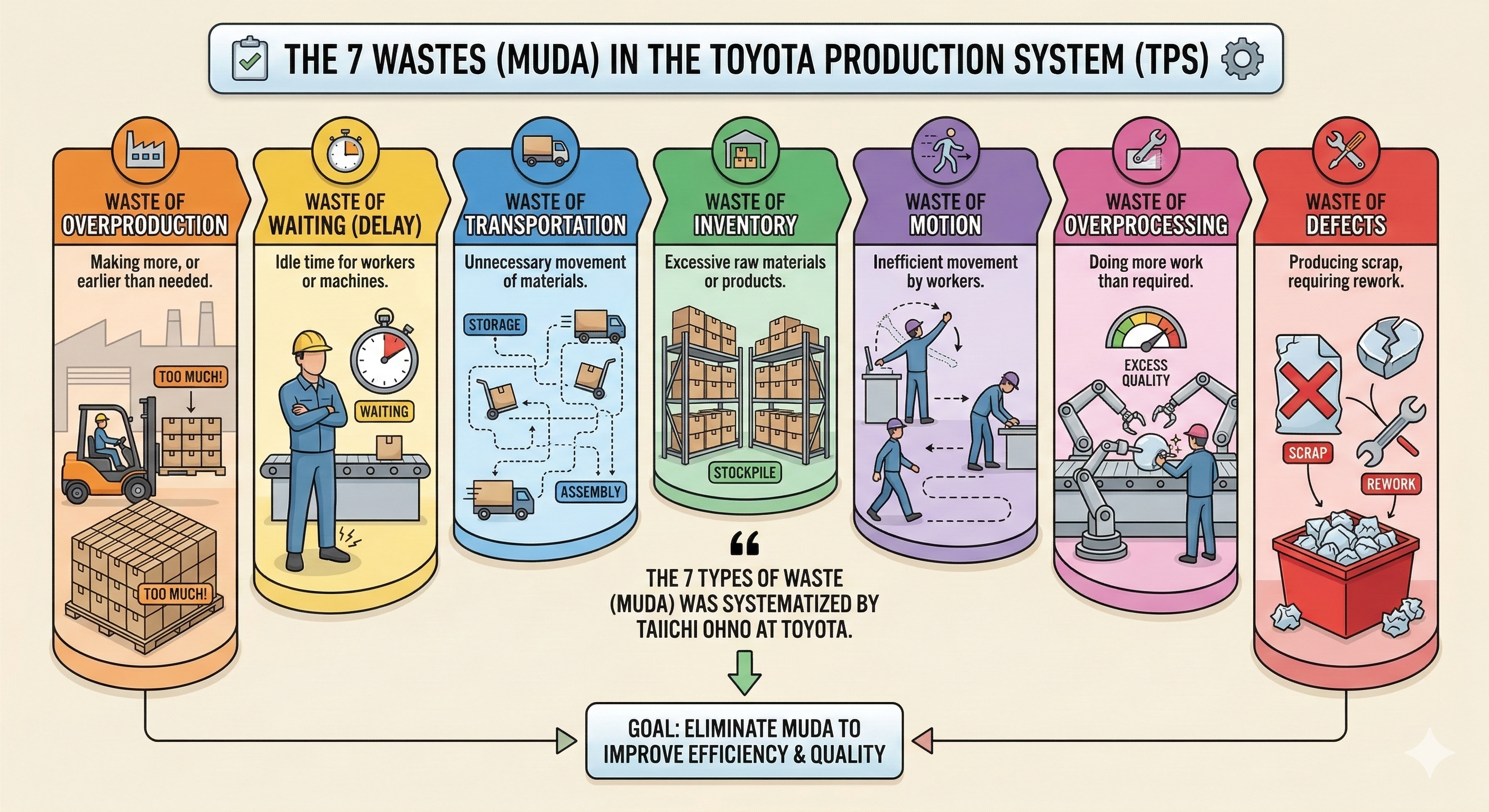
"TPS—Toyota Production System—is a framework that, on the basic principles of 'eliminating waste' and 'jidoka' (automation with a human touch), arranges the flow of work," I explained. "The key is first making waste visible. Conveyance, inventory, waiting, rework—paper work hides waste that goes unnoticed. Wash it out, standardize it, and connect it to jidoka that stops abnormalities by mechanism. It's the tool that turns what was vaguely 'inefficient' into erasable waste."
"Let's measure the current cost first," Gemini said, opening ROI Polygraph, and entered the data Kamiya had provided.
"The monthly cost is in," Gemini read out. "Hours for processing, storing, and searching paper-based work average 210 hours a month; at ¥4,000 an hour, that's ¥840,000 a month. Storage-space cost for stored documents and search loss from missing locations average ¥380,000 a month. Person-dependent handling of plan changes at customer request averages ¥440,000 a month. Lost opportunity from delayed management judgment due to the monthly settlement not being done averages ¥500,000 a month. Idle initiatives from the absence of priorities in starting DX average ¥320,000 a month. The total is ¥2,480,000 a month—roughly ¥29.76 million a year."
Kamiya stared at the figures. "I thought it was just the paper-processing hours. Once you include the delay of the settlement itself and the time spent searching for documents, I never imagined it would be this much."
"Then let's design it with TPS," I continued.
[Make waste visible—Wash out the waste in paper work]
"First, we wash out the waste hidden in the paper work," Claude said. "Conveyance, storage, search, rework—we make visible which task's where holds waste. The spots to digitize get pinned down here."
[Standard work—Make anyone produce the same quality]
"Next, we standardize the person-dependent work," Gemini continued. "We turn a state where handling varies by person at each plan change into a procedure anyone can do at the same quality. With a standard, you can respond to changes without wavering."
[Jidoka—Stop abnormalities by mechanism]
"After the standard, we advance jidoka," I continued. "We automate document management and the monthly settlement with digital tools, and stop input errors and missed closes by mechanism. Rather than people being careful to prevent them, the machine detects and stops abnormalities. This is jidoka."
[Flow—Don't let it stall before the monthly settlement]
"Finally, we make a structure that doesn't stop the flow," Claude continued. "We erase the paper stall and let data flow without stalling all the way to the monthly settlement. Arrange the flow and the speed of management judgment rises."
[Estimating the payback]
"Let's run the numbers with ROI Proposal Generator," Gemini proposed.
- Initial cost: Making paper-work waste visible, a document-digitization base, standard-work development, monthly-settlement automation, and a jidoka check build—¥6,500,000 total
- Monthly cost: System operations and ongoing update fees combined—¥260,000 a month
- Monthly savings: Paper work digitized = ¥620,000 a month; person-dependence eliminated by standardization = ¥420,000 a month; monthly settlement automated = ¥400,000 a month; storage and search loss reduced = ¥300,000 a month; ¥1,740,000 a month total
- Net monthly savings: ¥1,740,000 − ¥260,000 = ¥1,480,000 a month
- Payback period: ¥6,500,000 ÷ ¥1,480,000 = about 4.4 months
"Payback in just under four and a half months," Gemini summarized. "What works is washing out the waste before jidoka, rather than vaguely 'turning paper into digital.' Digitize without seeing the waste and you just electronify what stays inefficient. Because you follow the order of make-visible, standardize, jidoka, the flow arranges and the monthly settlement runs. The investment doesn't whiff."
Kamiya said, checking the figures, "I'd only thought of turning all the paper into digital. Wash out the waste and where to start gets decided."
"TPS is the tool that erases waste and arranges the flow," I replied.
Chapter 3: A Rollout Plan That Washes Out Waste Before Jidoka
"Let me lay out the approach," I said, standing at the whiteboard.
"Month 1—make the paper-work waste visible and pin down the spots to digitize. Month 2—standardize the person-dependent work and develop the standard work. Months 3–4—build the document-digitization base and monthly-settlement automation. Month 5—introduce the jidoka check and run a pilot. Month 6—full operation and effect verification. Month 7 onward—expanding the DX scope along the three-year plan and penetration to general staff."
"Does it really take three years? Can't the effect come out sooner?" Kamiya asked, to confirm.
"The early effect comes out in six months," Claude replied. "The three years is about settling in across the whole company. With TPS, make the waste visible and apply jidoka from the high-impact monthly settlement and document management, and the flow changes in six months. The first move doesn't get decided because you try to change everything at once. Act from the largest waste down and the effect shows early."
Kamiya said, taking notes, "Before digitizing, wash out the waste. I can see the order now."
Chapter 4: The Day Paper Turned into Flow
Nine months later, a report arrived from Kamiya.
The paper-based work grew much lighter after digitization. "The documents crowding out storage space became data. Searching around because you can't tell where something is—that's gone," Kamiya had written.
The person-dependent handling was standardized, too. Responses to plan changes stopped varying by person. "Work that relied on 'that person's way' can now be run by anyone with the same procedure," the report said.
The biggest change appeared in the settlement's speed. From a state unable to close monthly, the settlement came to run. "Chased by paper processing, we couldn't do the monthly settlement, and judgment was delayed. Once we applied jidoka, it closed monthly. Management judgment got faster," Kamiya had written.
The idle initiatives were resolved, too. DX that had stalled, unable to decide what to tackle first, began moving from the largest waste down. "DX that had stalled with no first move started moving along with priorities," the report said.
As a secondary effect, the way improvement was pursued changed. The idea of washing out waste before acting took root on the floor. "We stopped vaguely saying 'it's inefficient.' We came to look first at where the waste is," Kamiya had written.
At the end of his report, he wrote: "I thought DX promotion meant replacing paper with digital. But the real starting point was washing out the waste hidden in the paper work. The moment we made the waste visible with TPS, what to apply jidoka to first got decided. Before digitizing, erasing the waste came first."
The day a company where the mountain of paper was robbing the settlement of speed became a company that could arrange the flow, DX promotion had changed from a command to adopt tools into a design that arranges the flow through eliminating waste and jidoka, the report noted.
"DX-promotion requests usually come in the form of 'we want to turn paper into digital.' But there's something to ask before turning it. Where in that paper work does the waste hide? What TPS asks is eliminating waste and jidoka. Make the waste visible, standardize it, and stop abnormalities by mechanism, and the flow arranges. The day a company where the mountain of paper was robbing the settlement of speed could arrange the flow, what changed wasn't the digital tool but the very perspective that washes out the waste before applying jidoka."
Related Files
Tools Used
- ROI Polygraph — Visualizing paper-work hours, storage and search loss, and lost opportunity from delayed monthly settlement
- ROI Proposal Generator — Payback simulation for DX promotion starting from eliminating waste and jidoka


