
ROI Case File No.510 'Proprietary DX That Only the Company Itself Understood'
Proprietary DX That Only the Company Itself Understood
Chapter One: Building In-House Was the Only Option
"Commercial systems don't fit our work."
Seishi Maruo, CEO of OptiTech Solutions, showed us their in-house tool suite. Construction management, labor management, daily reporting, budget management, safety management—all five systems built in-house. "Field-specific requirements outpace commercial software. We've had no choice but to build internally. Three in-house engineers run operations today."
"Why in-house?" Claude asked.
"There was nothing that fit," Maruo answered. "Construction-site project management isn't like generic schedule management. Safety management involves regulation. We tried commercial software, and customization fees ended up similar to new development costs, so we chose to build. That was the right call, I think."
"The challenge?" Gemini asked.
"Integration across tools, and rollout difficulty," Maruo answered. "The five systems run independently. There's no horizontal dashboard. Rolling out to a new site takes time for setup and training. Three engineers can't keep up. We want to bring in external DX consultants, but consultants who only know commercial products can't grasp our proprietary requirements."
"Staffing shortages and scheduling are issues too?" I confirmed.
"Critical," Maruo answered. "Effectively one person on DX promotion. The engineers are tied up in development and operations. We can't gather external market trends or new technology. Executive briefing materials are also behind. Investment decisions stall."
"Strength and weakness are two sides of the same coin," I replied. "Let's break it down with SWOT."
Chapter Two: SWOT Asks—Strengths, Weaknesses, Opportunities, Threats
"This case calls for SWOT."
Claude wrote four letters on the whiteboard. S, W, O, T.
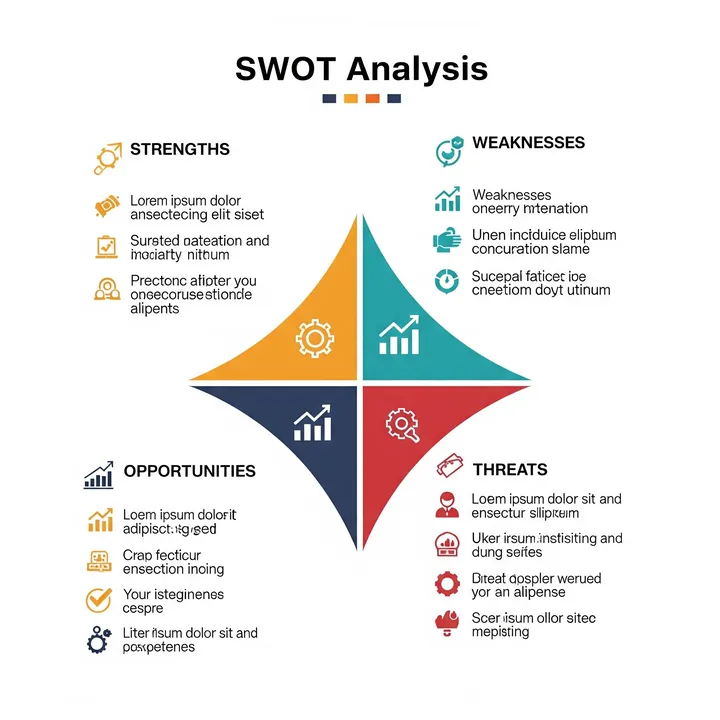
"SWOT analyzes the strategic environment through four quadrants: Strengths, Weaknesses, Opportunities, Threats," I explained. "Often used superficially because it's so standard, but it's powerful in DX direction-setting. DX investment decisions require combining internal factors (strengths, weaknesses) with external factors (opportunities, threats). The strength of in-house development is simultaneously a weakness. Without structuring this, decisions become ad hoc."
"First, let's measure the current cost," Gemini said, opening ROI Polygraph. He input the data Maruo provided.
"The monthly DX-related cost has come out," Gemini read. "Three in-house engineers' operations and maintenance labor averages 480 hours per month at 5,000 yen per hour, or 2.4 million yen monthly. Opportunity cost from stalled new feature development—delays responding to field requests—averages 900,000 yen monthly. Cost from delayed executive decisions due to no horizontal dashboard averages 600,000 yen monthly. Setup and training labor for rolling out to new sites averages 120 hours per month, or 600,000 yen monthly. Expected value of technology-selection risk from inadequate external information gathering averages 400,000 yen monthly. Stagnant DX investment decisions—next-investment delays due to inadequate executive briefing materials—cost 700,000 yen monthly. Total: 5.6 million yen monthly. Annualized: approximately 67.2 million yen."
Maruo looked at the figures. "I had no idea the maintenance cost of in-house development was stacking up to this."
"Now let's design with SWOT," I continued.
[S—Strengths: Articulating the Value of In-House Development]
"First, strengths," Claude said. "The five in-house tools are assets embodying field-specific knowledge. Operational fit that commercial software can't replicate. Knowledge of construction-site safety and project management is accumulated as code. This is a clear differentiator versus competitors. Strength is the flip side of weakness, so abandoning isn't an option."
[W—Weaknesses: Headcount Shortage and Operational Load]
"Next, weaknesses," Gemini continued. "Maintaining five systems with three in-house engineers is overload. New feature development stalls; horizontal integration can't be assembled. Without auto-updates like commercial software, operations and maintenance are constant. And dependence on in-house engineers carries knowledge-transfer risk."
[O—Opportunities: Maturing DX Consulting Market]
"On opportunities," I continued. "The DX consulting market has matured in recent years. Consulting firms capable of supporting in-house development, system integration specialists, business-savvy SIs—they've grown. Three years ago, only 'commercial software adoption support' was available; today, 'continuous support for in-house development' is a choice. External resource activation possibilities have expanded."
[T—Threats: Information Lag and Talent Drain]
"On threats," Claude continued. "Risk of obsolescing technology selection from not tracking market trends. Knowledge-transfer risk if in-house engineers depart. Response-delay risk on the proprietary side when regulations change. Each of these, if left, transforms the strength of in-house development into a weakness."
[Composing Strategy—Move on S×O]
"Combine the four quadrants to derive strategy," Gemini continued. "Strengths × Opportunities—the strength of in-house development times the opportunity of external resource activation. While continuing in-house development, deploy DX consultants in operations, maintenance, and horizontal integration. In-house engineers focus on new feature development. That's the SWOT S×O strategy."
"We handle Weaknesses × Threats in parallel," I continued. "Risks emerging from weakness-threat combinations are addressed by external information services and a junior-engineer recruiting/development program. This is defensive investment."
[Estimating the Payback]
"Let's run it through ROI Proposal Generator," Gemini proposed.
- Initial cost: 8.6 million yen (DX consultant engagement contract, horizontal dashboard development, new-site rollout templates, junior development program, information service initial fees)
- Monthly cost: 450,000 yen (DX consulting support and information services combined)
- Monthly savings: in-house engineer operations labor reduction = 1.44 million yen (60% reduction, shift to new development); resolution of stalled new development = 700,000 yen; faster executive decisions from horizontal dashboard = 450,000 yen; new-site rollout labor reduction = 350,000 yen; technology-selection risk reduction = 200,000 yen; resolution of investment-decision delays = 500,000 yen. Total: 3.64 million yen monthly
- Net monthly savings: 3.64 million − 450,000 = 3.19 million yen
- Payback period: 8.6 million yen ÷ 3.19 million yen ≈ 2.7 months
"Under three months," Gemini summarized. "What matters is that we don't discard in-house development—we shore up the operations/maintenance side with external resources. Keep the strength, cover the weakness. The SWOT S×O strategy is backed by numbers."
Maruo looked at the numbers. "I'd been thinking it was a binary—bring in external consultants or grind it out in-house. With SWOT, options multiply."
"Look at strengths and weaknesses together, and strategy emerges from combinations," I replied.
Chapter Three: A Collaboration Plan Driven by S×O Strategy
"Here's the implementation plan," I said, standing at the whiteboard.
"Month 1: select DX consulting firm. Send RFP to multiple firms with experience supporting in-house development. Month 2: select, contract, agree on scope. Months 3–4: document the five proprietary tools, onboard external consultants on the business context. Month 5: design the horizontal dashboard, begin phased transfer of operations and maintenance work. Month 6: build new-site rollout templates. Month 7 onward: in-house engineers focus on new feature development, junior recruiting and training program begins, information services run in parallel."
"What's the key to consultant selection?" Maruo confirmed.
"Whether they can understand in-house development," Claude replied. "Consultants who only know commercial products won't function here. Select firms with construction-industry knowledge or in-house-system support experience. In multiple-firm RFPs, how each understands your systems becomes the evaluation axis."
Maruo took notes. "Continuing in-house development via external collaboration is a new framing. The premise of 'protect it alone' collapsed."
Chapter Four: The Day Proprietary Spec Started Moving Through the Organization
Ten months later, a report arrived from Maruo.
Collaboration with the external DX consultants stabilized into steady operations, and the three in-house engineers were freed to focus on new feature development. "Roughly half of operations and maintenance shifted to the external side. In-house engineering development time grew by over 300 hours per month," Maruo wrote.
The horizontal dashboard launched in month 5. Key KPIs were aggregated from the five tools, letting executives grasp company-wide status on one screen. "Time spent on current-state confirmation in executive meetings was reduced. Discussion time grew," the report said.
New-site rollout accelerated. With templated configurations and training programs, what used to take three months for a new site dropped to roughly one month. "Site-expansion decisions stopped stalling on system-side constraints," Maruo wrote.
The most surprising change appeared in in-house engineer attrition risk. Freed from operations load, engineers spent time on new feature development they had wanted to do, and morale rose. "An engineer rumored to be leaving decided to stay. They said it was because the substance of the work changed," the report said.
The information service also delivered. Monthly reports on industry tech trends provided judgment material for technology selection. "Areas previously decided blind now have a decision axis," Maruo wrote.
The junior development program also began. The three in-house engineers shifted into veteran-side roles, leading OJT for two new hires. "We expected eighteen months from hire to full productivity; with veterans freed to spend time, six months feels achievable," the report said.
As a side effect, executive DX investment decisions accelerated. Effects visualized by the horizontal dashboard made additional investment easier to approve. "The reason investment decisions stalled shifted from inadequate explanation materials to abundance of options. That's progress," Maruo wrote.
The final line of the report read: "In-house development didn't need to be abandoned, and didn't need to be protected alone. Look at strengths and weaknesses together with SWOT, and combine with external opportunities. S×O looks textbook, but in practice it works. Combination design is strategy itself."
The day proprietary spec that only the company understood became something the organization can handle, the strength stopped being a weakness, the report said.
"In-house development is two-sided. Differentiation as a strength, maintenance cost as a weakness. SWOT asks you to look at all four quadrants together. Strengths alone leads to a defense talk; weaknesses alone leads to an abandon talk. Strengths combined with opportunities—S×O—produces the most constructive move. Running in-house development through external collaboration is a design that turns proprietary spec only the company understands into proprietary spec the organization can handle. The day the premise of protecting it alone collapsed, proprietary spec became an organizational asset."
Related Files
Tools Used
- ROI Polygraph — Visualizing in-house maintenance cost, stalled new development, and investment-decision delays
- ROI Proposal Generator — Payback simulation for continuing in-house development through external partnership


