
ROI Case File No.560: 'The Veteran's Memory Lay Dormant Alongside the Drawings'
The Veteran's Memory Lay Dormant Alongside the Drawings
Chapter 1: The Veteran Can Recall, the Younger Staff Can't Find
"We want to bring in a system that searches drawings with AI. We want to make estimation work faster."
Yohei Zushi, sales director at TechNova, described his situation as he spoke. "When we receive a drawing from a customer, we want to find similar drawings and refer to past estimates and suppliers. But right now we can only do simple drawing-number-based search. For customers who don't know the drawing number, or whose drawings a different rep handled, we can't find them."
"Can the veterans handle it?" Claude asked.
"The veterans can handle it from memory," Zushi answered. "'For that drawing, we put out this kind of estimate in the past'—they can recall it. But the younger staff don't grasp product information outside their assigned customers. So estimation takes time. What's in the veterans' heads is invisible to the younger staff."
"Does that veteran memory remain in the organization?" I asked, to confirm.
"It doesn't," Zushi answered. "It stays as individual memory, dormant alongside the drawings. It isn't handed down. If a veteran leaves, that knowledge vanishes with them. We want to share the knowledge of similar drawings and products beyond the assigned-customer boundary."
"We have to turn the veteran's memory into an organizational asset," I replied. "Let's break it down with SWOT."
Chapter 2: SWOT Asks—Strengths, Weaknesses, Opportunities, Threats
"This case calls for SWOT."
Claude wrote "Strengths, Weaknesses, Opportunities, Threats" on the whiteboard.
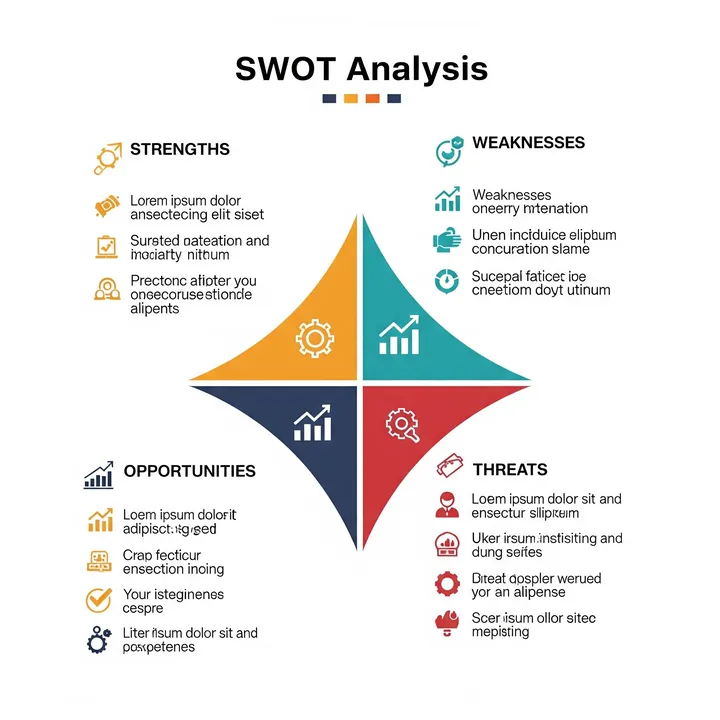
"SWOT—Strengths, Weaknesses, Opportunities, Threats—is a framework that organizes internal strengths and weaknesses and external opportunities and threats to derive a move," I explained. "The key is casting strengths onto opportunities and preparing for weaknesses and threats. The veteran's memory is a strength, person-dependence a weakness. AI search is an opportunity, the rollout cost and resistance threats. Organize the four and a move that uses the strength while covering the weakness comes into view."
"Let's measure the current cost first," Gemini said, opening ROI Polygraph, and entered the data Zushi had provided.
"The monthly cost is in," Gemini read out. "Hours for estimate investigation and similar-drawing searches when the drawing number is unknown average 180 hours a month; at ¥4,200 an hour, that's ¥756,000 a month. The expected value of person-dependence and inability-to-hand-down risk from reliance on veteran memory averages ¥420,000 a month. Estimate delays and send-backs from younger staff's insufficient product knowledge average ¥380,000 a month. Duplicated investigation from being unable to share knowledge beyond the assigned sales rep averages ¥320,000 a month. Lost opportunity from lost deals and forgone profit due to variance in estimate accuracy averages ¥340,000 a month. The total is ¥2,216,000 a month—roughly ¥26.59 million a year."
Zushi stared at the figures. "I thought it was just the estimate investigation time. Once you include person-dependence risk and lost deals from accuracy variance, I never imagined it would be this much."
"Then let's design it with SWOT," I continued.
[Strengths—See the veterans' knowledge as an asset]
"First, we confirm the strengths," Claude said. "The veterans' rich knowledge and experience, and the high skill of the whole sales division. These are unmistakable strengths. The problem is that this strength stays in individual memory. Extract it as an asset and it becomes a weapon."
[Weaknesses—Face person-dependence and number-reliance head-on]
"Next, we face the weaknesses head-on," Gemini continued. "Search is drawing-number-based only, so you can't find anything when the number is unknown. Younger staff's product knowledge is short, and the work is person-dependent. This weakness delays the younger staff's estimates."
[Opportunities—Measure the room AI search can widen]
"After weaknesses, we measure the opportunities," I continued. "Use AI drawing search and you can find similar drawings even without the number. Raise estimate accuracy and it connects to higher customer satisfaction and new acquisition. Cast the strength onto the opportunity—have the AI learn the veterans' memory so anyone can draw it out."
[Threats—Prepare for cost and resistance]
"Finally, we prepare for the threats," Claude continued. "The initial rollout cost and employees' resistance to AI are threats. Run employee training in parallel and adopt it in a form that uses the veterans' knowledge, and the resistance can be lowered. We foresee the threats and factor in the preparation."
[Estimating the payback]
"Let's run the numbers with ROI Proposal Generator," Gemini proposed.
- Initial cost: AI drawing-search system build, a similar-drawing matching engine, integration with past estimate/supplier information, and employee training—¥5,800,000 total
- Monthly cost: System operations and ongoing model updates combined—¥240,000 a month
- Monthly savings: Similar-drawing search automated = ¥620,000 a month; handoff eased by eliminating person-dependence = ¥400,000 a month; younger-staff estimate delays reduced = ¥350,000 a month; duplicated investigation eliminated = ¥320,000 a month; ¥1,690,000 a month total
- Net monthly savings: ¥1,690,000 − ¥240,000 = ¥1,450,000 a month
- Payback period: ¥5,800,000 ÷ ¥1,450,000 = about 4.0 months
"Payback in four months," Gemini summarized. "What works is not just crushing the weakness but moving the strength of the veteran's memory into AI and using it. Merely covering person-dependence is half. Because you cast the strength onto the opportunity and prepare for the threats, both the speed and accuracy of estimation rise. The investment doesn't whiff."
Zushi said, checking the figures, "I'd only thought of fixing the younger staff's delay. Move the veteran's memory as a strength and the whole organization speeds up."
"SWOT is the tool that derives a move to use the strength and cover the weakness," I replied.
Chapter 3: A Rollout Plan That Casts Strengths onto Opportunities
"Let me lay out the approach," I said, standing at the whiteboard.
"Month 1—organize SWOT and fix Strengths, Weaknesses, Opportunities, and Threats. Month 2—inventory the veterans' knowledge and define the search requirements. Months 3–4—build the AI drawing-search system and the similar-drawing matching engine. Month 5—integrate past estimate and supplier information and conduct employee training. Month 6—pilot operation and effect verification (measuring estimate accuracy and speed). Month 7 onward—settling in knowledge sharing beyond the assigned-rep boundary and expanding the search scope. Full operation begins after the estimation-related business-system revamp is complete."
"Will the younger staff also become able to handle it at a veteran level?" Zushi asked, to confirm.
"They'll get close," Claude replied. "The younger staff are slow because they can't access the veterans' memory. With SWOT, define the strength as the veterans' knowledge, have the AI learn it, and make it so anyone can draw it out. Even without the drawing number, they can refer to past estimates from similar drawings. Move the strength into the organization and the younger staff can use the veterans' accumulation, too."
Zushi said, taking notes, "Before crushing the weakness, use the strength. I can see the order now."
Chapter 4: The Day the Dormant Memory Could Be Drawn Out
Ten months later, a report arrived from Zushi.
Similar-drawing search changed greatly after the AI system was introduced. "Even without the drawing number, we can search for similar drawings. Past estimates and suppliers can be referred to right away," Zushi had written.
The younger staff's estimates got faster, too. They could now access product information outside their assignments. "What was in the veterans' heads could now be drawn out by the younger staff. Estimate send-backs went down," the report said.
The biggest change appeared in how the veteran's memory was handled. Knowledge that had lain dormant in individual memory turned into an organizational asset. "Knowledge I'd thought would vanish if a veteran left moved into the AI and remained. The memory that had lain dormant alongside the drawings could now be drawn out," Zushi had written.
Estimate accuracy rose, too. The variance that had been person-dependent leveled out through reference to past data. "Accuracy differing by rep went down. Lost deals went down," the report said.
As a secondary effect, the idea of knowledge sharing changed. The thinking of moving a strength into the organization took root on the floor. "We stopped relying on veterans. We came to think about how to move individual memory into an organizational asset," Zushi had written.
At the end of his report, he wrote: "I thought the estimation trouble was that the younger staff were slow. But the real problem was that the strength of the veteran's memory lay dormant in an individual. The moment we cast the strength onto the opportunity with SWOT, the path to moving that memory into AI came into view. Before crushing the weakness, using the strength came first."
The day a company where the veteran's memory lay dormant alongside the drawings became a company that could draw it out, the estimation efficiency had changed from resolving the weakness into a design that casts the strength onto the opportunity and uses it, the report noted.
"Operational-efficiency requests usually come in the form of 'we want to fix the slow part.' But there's something to ask before crushing the weakness. Is the dormant strength being used? What SWOT asks is Strengths, Weaknesses, Opportunities, and Threats. Cast the strength onto the opportunity and prepare for the weaknesses and threats, and you don't just cover—you extend. The day a company where the veteran's memory lay dormant alongside the drawings could draw it out, what changed wasn't the AI's performance but the very perspective that uses the strength before crushing the weakness."
Related Files
Tools Used
- ROI Polygraph — Visualizing drawing-search hours, person-dependence risk, and lost deals from estimate-accuracy variance
- ROI Proposal Generator — Payback simulation for an AI drawing-search system starting from Strengths, Weaknesses, Opportunities, and Threats


