
ROI Case File No.523: Twelve Hundred Times a Year, They Chased Letters by Eye

Twelve Hundred Times a Year, They Chased Letters by Eye
Chapter 1: Twelve Hundred Proofreads, All Done by Hand
"A thousand to twelve hundred items a year. We follow every single proofread with the human eye."
Reina Ebisu, production management department manager at ZenoTech, said this while lining up packaging samples. A household-goods maker. Different packaging design, content, and warnings for every product. "We extract the original text into Excel and match it letter by letter against the text in the design. A typo, an inconsistent spelling, a missing legally-required label—an oversight leads straight to a complaint or a recall. So we proofread by eye, wearing our nerves to the bone."
"How long does one proofread take?" Claude asked.
"An hour and a half on average," Ebisu answered. "Packaging formats aren't standardized across products. The size, the typesetting, the order of items—all different. So we match from zero every time. The checklist can't be reused. We run twelve hundred items a year with a limited number of people."
"To what extent do mistakes occur?" I confirmed.
"There are a few near-misses a month," Ebisu answered. "We catch them in the end, but the eye is our lifeline. If the person is tired, the risk of an oversight rises. We want to bring in proofreading AI and achieve both efficiency and accuracy. But I have big worries about whether AI can handle inconsistent formats, and whether it will take root on the floor after we deploy it."
"You need to design the deployment not just as product selection but all the way through to adoption," I responded. "Let's break it down with 4P."
Chapter 2: 4P Asks About Product, Price, Place, and Promotion
"This case needs 4P."
Claude wrote "Product, Price, Place, Promotion" on the whiteboard.
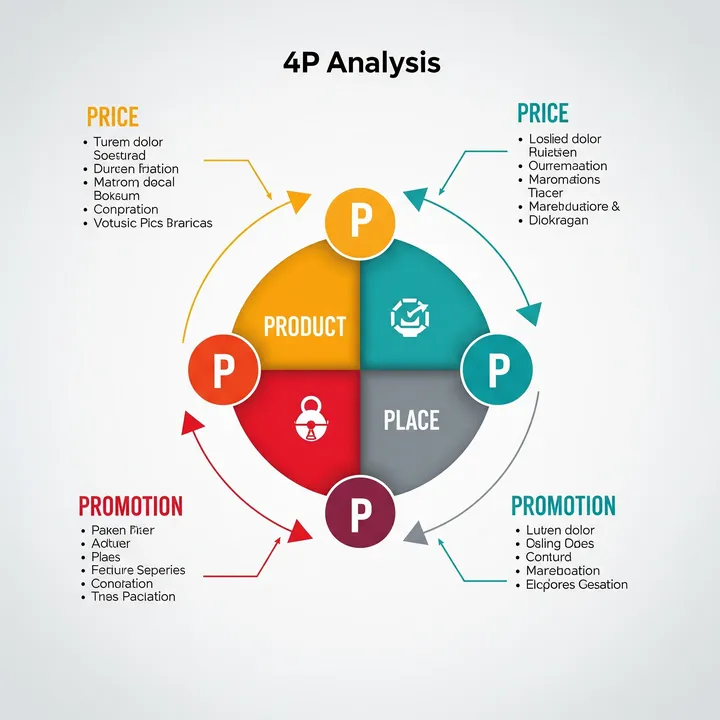
"4P is a basic marketing framework that assembles measures from four elements—product, price, distribution, and promotion," I explained. "It's originally a seller's perspective, but it transfers to internal AI deployment too. Because the process of 'selling a tool internally and making it take root' has the same structure as delivering a product to market. How do we deliver this product—proofreading AI—at what cost, make it usable where, and spread it on the floor how? We design without gaps across four perspectives."
"First, let's measure the current cost," Gemini said, opening ROI Polygraph. He entered the data Ebisu had provided.
"The monthly proofreading cost came out," Gemini read aloud. "Proofreading labor averages 150 hours a month; on a base of 1,200 items a year, converted at an hourly rate of 3,600 yen, that's 540,000 yen a month. The additional labor of preparing for matching due to format inconsistency averages 60 hours a month, or 216,000 yen. The labor for oversight-risk response and double-checking averages 40 hours a month, or 144,000 yen. The cost of sending back and re-proofreading when a near-miss occurs averages 350,000 yen a month. The expected value of the personnel-dependency risk in proofreading quality averages 300,000 yen a month. The total is 1,550,000 yen a month. Annualized, that's about 18.6 million yen."
Ebisu stared at the figures. "I had no idea that the preparation labor from inconsistent formats rode on top this much—not just the proofreading labor itself."
"Then let's design with 4P," I continued.
[Product—Choosing an AI That Handles Format Inconsistency]
"First, Product," Claude said. "The most important thing in selecting proofreading AI is flexibility to handle format variation. An AI premised on fixed templates can't be used at ZenoTech. We choose AI that matches the original Excel text against the design data and can still proofread even when the layout differs by product. At the selection stage, we set format-independence as a mandatory condition."
[Price—Judging by the Long-Term Cost Structure]
"Next, Price," Gemini continued. "We separate deployment cost and operating cost and analyze them. Even if the initial cost is high, if it keeps reducing proofreading labor for 1,200 items a year, it pays back over the long term. We compare subscription-type and one-time-purchase types and judge by a cost structure that includes ongoing operating cost. We evaluate price by recovery structure, not by cheapness."
[Place—An Environment Where You Can Proofread From Anywhere]
"The Place perspective," I continued. "We adopt a cloud-based AI and create an environment where you can proofread regardless of location. It supports remote work and distributed proofreading across multiple sites. Because proofreading work is no longer tied to a particular desk, a structure forms in which we can flex personnel during busy periods."
[Promotion—Designing for Adoption on the Floor]
"Last is Promotion," Claude continued. "The most common failure in tool deployment is that the floor doesn't use it. We run internal training and design a transition in which proofreaders feel the effect early. At first we run human eyes and AI side by side; we move to full adoption only after the floor comes to trust the AI's accuracy. Promotion is the adoption activity itself, internally."
[Estimating the Investment Recovery]
"Let's estimate with ROI Proposal Generator," Gemini proposed.
- Initial cost: Proofreading AI deployment, format-independence configuration, integration with existing Excel original text, internal training, and parallel-run operation design—4,600,000 yen total
- Monthly cost: AI usage fee plus ongoing operating cost—160,000 yen a month combined
- Monthly reduction effect: Proofreading labor reduction = 380,000 yen a month (assuming 70% reduction), matching-preparation labor reduction = 150,000 yen a month, double-check labor reduction = 100,000 yen a month, near-miss send-back reduction = 250,000 yen a month—880,000 yen a month total
- Monthly net reduction: 880,000 yen − 160,000 yen = 720,000 yen a month
- Payback period: 4,600,000 yen ÷ 720,000 yen = about 6.4 months
"Recovery in a little over half a year," Gemini summarized. "What matters is the reduction in near-miss send-back cost. As oversights decrease, the downstream costs of re-proofreading and send-backs vanish. More than mere time savings, the quality-driven cost is what works here."
Ebisu confirmed the figures and said, "I thought choosing the tool was the end of it. The evaluation axis for price, and adoption on the floor—those are objects of design too."
"4P is a tool for delivering a tool all the way into the organization," I responded.
Chapter 3: A Deployment Plan That Proceeds by Parallel Operation
"Let me organize how we'll proceed," I said, standing before the whiteboard.
"Weeks one and two—selecting the proofreading AI and verifying format-independence. Weeks three and four—configuring integration with the existing Excel original text and defining the matching rules. Weeks five and six—a pilot on a small number of products, verifying the parallel run of human eyes and AI. Weeks seven and eight—accuracy tuning and adjusting false-detection patterns. Weeks nine and ten—internal training and onboarding the proofreaders. Week eleven onward—transitioning to full operation, gradually scaling down the eye-based parallel run, and expanding the target products."
"So you don't hand it over to the AI right away," Ebisu confirmed.
"At first it's parallel," Claude responded. "Proofreading is work where oversights aren't permitted. If you switch over before the floor trusts the AI's accuracy, they'll check twice out of anxiety anyway. That won't reduce labor. We run human eyes and AI in parallel, and reduce the eye-based check only after the AI has earned trust. The essence of Promotion lies in forming this trust."
Taking notes, Ebisu said, "For the first time I'm conscious that whether the floor uses it is within the scope of design."
Chapter 4: The Day the Eye Can Concentrate on Judgment
Eight months later, a report arrived from Ebisu.
Proofreading labor was cut 70% versus before, three months after going live, having passed through AI deployment and parallel operation. "A proofread that took an hour and a half per item now takes a person under thirty minutes after the AI's first-pass check. The load of 1,200 items a year became dramatically lighter," Ebisu wrote.
Oversight risk also dropped sharply. Because the AI mechanically matches every item, oversights from human fatigue decreased. "The human eye can now concentrate on judging the spots of concern the AI flagged. Freed from exhaustive matching, we can devote ourselves to judgment work," the report said.
The most unexpected change appeared in a move toward format standardization. With AI deployment as the trigger, a discussion began about organizing the inconsistent packaging formats. "When we standardized how the original text is made to suit the AI, not only proofreading but the design process got easier too. AI deployment triggered upstream standardization," Ebisu wrote.
Near-misses decreased as well. With the AI's first-pass check working comprehensively, send-backs stemming from human oversight nearly vanished. "The tension of the era when the eye was the only lifeline eased. The drop in the proofreaders' psychological load is significant," the report said.
As a secondary effect, capacity to handle busy periods rose. Because proofreading can be done from anywhere in the cloud environment, personnel from other sites could be flexed in during busy periods. "The structure where particular staff alone burned out when new products concentrated was resolved," Ebisu wrote.
The personnel dependency of proofreading quality also dissolved. With the AI carrying the standard for matching, the influence of staff experience gaps on quality shrank. "Veteran or newcomer, a proofread that has passed the AI's first-pass check reaches a consistent quality," the report said.
At the end of Ebisu's report, she had written: "I'd thought that bringing in proofreading AI was just a matter of choosing the product. But what was truly hard was getting the floor to master it and make it take root. Because we split it into four perspectives with 4P, we didn't lean only on product selection—we could design price, place, and adoption too."
It was recorded that the day a production department that had chased letters by eye twelve hundred times a year could use its eyes only for judgment, proofreading changed from work to endure into work to discern.
"The most common failure in tool-deployment consultations is choosing the product and calling it done. Even if you choose a good tool, nothing changes if the floor doesn't use it. What 4P asks isn't only the product. With what cost structure, usable from where, made to take root on the floor how—it's a design that delivers all the way through, across four perspectives. Harder than choosing proofreading AI as a product is the Promotion of turning it into a habit on the floor. The day a production department that had chased letters by eye twelve hundred times a year could use its eyes for judgment, what changed was not the proofreading tool but the very way the eyes were used."
Related Files
Tools Used
- ROI Polygraph — Visualizing proofreading labor, matching-preparation labor, and near-miss send-back cost
- ROI Proposal Generator — Investment-recovery simulation for format-independent proofreading AI


