
ROI Case File No.547: The Unseen Contents Were Shipped Wrong Almost Every Month
The Unseen Contents Were Shipped Wrong Almost Every Month
Chapter 1: With Paper and One Free Hand, the Mistakes Don't Stop
"We want to make picking and shipping in the factory more efficient with smart glasses. We want to view product information hands-free while working."
Ryo Kuga, in charge of production management at AeroCool, said this as he described the situation. The company manufactures and sells air-conditioning equipment. "Misshipments and missing component installations happen constantly. We manage delivery information on paper, but once it's wrapped, you can't see the contents. We ship without being able to confirm, and we get it wrong."
"What other causes are there for the mistakes?" Claude asked.
"Instruction changes from sales don't reach the floor," Kuga answered. "Even when the shipping quantity changes at the last minute, the floor doesn't know and ships the original count. Quantity errors happen."
"What countermeasure have you taken?" I confirmed.
"We brought in a Keyence barcode reader for about ¥3,000,000," Kuga answered. "But it ties up one hand, and there were accuracy issues, so the effect was limited. We spent three million and the mistakes don't stop. Now I'm thinking smart glasses, but I'm afraid of missing again."
"You need to record where the mistakes occur and take action after confirming," I responded. "Let's break this down with RCD."
Chapter 2: What RCD Asks—The Order of Record, Check, Do
"This case needs RCD."
Claude wrote "R, C, D" on the whiteboard.
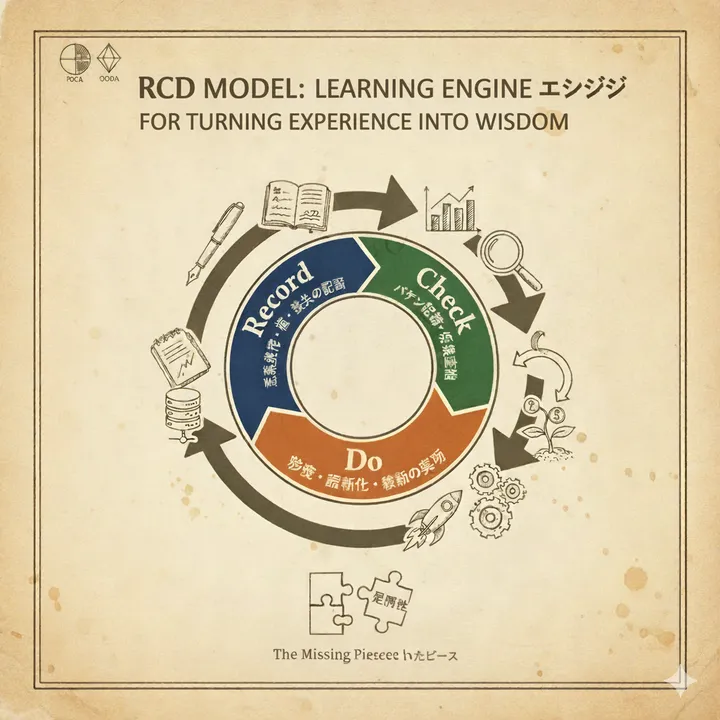
"RCD is a framework that takes action after recording the current state, across three stages: Record, Check, and Do," I explained. "The crux is not leaping straight to Do. The ¥3,000,000 barcode reader didn't work because it skipped record and check and entered from the tool. First record where misshipments occur, confirm the cause, and then act. It's a tool that keeps the investment from missing."
"First, let's measure the current cost," Gemini said, opening the ROI Polygraph. He entered the data Kuga had provided.
"The monthly cost is in," Gemini read out. "Returns, re-shipments, and losses from misshipments and missing installations: ¥650,000 per month on average. Confirmation and cross-checking labor for paper-based delivery-information management: 170 hours per month on average, at ¥3,400 per hour, ¥578,000 per month. Rework from shipping-quantity errors due to missed transmission of sales instruction changes: ¥420,000 per month on average. Inefficient labor from the existing barcode reader tying up one hand: ¥300,000 per month on average. Expected value of inspection personnel-dependency risk: ¥350,000 per month on average. A total of ¥2,298,000 per month. Annualized, about ¥27,580,000."
Kuga stared at the figures. "I thought it was just the misshipment losses. Add the paper cross-checking and the inefficiency of the reader that didn't work, and it's this much?"
"Now, let's design with RCD," I continued.
[Record—Record the Occurrence of Mistakes]
"First, we record where mistakes occur," Claude said. "At which stage of the work do misshipments, missing installations, and quantity errors arise? We also trace the flow of sales instruction changes reaching the floor. Before choosing a tool, we record the facts first."
[Check—Confirm the Cause]
"Next, we confirm the cause from the record," Gemini continued. "Contents unseen due to paper management and wrapping, a reader that ties up one hand and goes unused—look at the record and you understand why ¥3,000,000 didn't work. We confirm the cause before moving on."
[Do—Execute Hands-Free]
"We match the execution to the confirmed cause," I continued. "If contents can't be seen and both hands are needed, smart glasses that display product information hands-free become the solution. Because it's a tool choice that passed through record and check, it doesn't miss."
[System Linkage—Deliver Instruction Changes to the Floor]
"Finally, we build a linkage where instruction changes arrive in real time," Claude continued. "We connect the production-management system to the smart glasses so a sales change shows on the floor immediately. We plug the 'doesn't get transmitted' that the record revealed, with linkage."
[Calculating the Investment Recovery]
"Let's run the estimate with the ROI Proposal Generator," Gemini proposed.
- Initial cost: Work recording, cause analysis, smart-glasses adoption, production-management system replacement, linkage build, and training—¥5,800,000 total
- Monthly cost: Smart-glasses operation, licensing, and update ongoing fees combined, ¥280,000 per month
- Monthly reduction effect: Misshipment and missing-installation loss reduction = ¥540,000 per month, paper-management cross-checking labor reduction = ¥460,000 per month (assuming 80% reduction), quantity-error resolution via instruction-change transmission = ¥340,000 per month, work efficiency from going hands-free = ¥220,000 per month, totaling ¥1,560,000 per month
- Net monthly reduction: ¥1,560,000 − ¥280,000 = ¥1,280,000 per month
- Payback period: ¥5,800,000 ÷ ¥1,280,000 = approximately 4.5 months
"Recovery in four and a half months," Gemini summarized. "What works is choosing the tool after passing through record and check. The barcode reader didn't work because it entered from Do. This time we record the occurrence of misshipments, confirm the cause, and then choose smart glasses. Because it's an investment backed by the record, it won't miss the way the ¥3,000,000 did."
Kuga confirmed the figures. "We entered from the tool and missed by three million. Record and confirm, then choose, and you understand why it works."
"RCD is a tool that places record and check before the tool," I responded.
Chapter 3: A Deployment Plan That Records Before Choosing the Tool
"Let me organize the approach," I said, standing at the whiteboard.
"Month one—recording the workflow and the occurrence of misshipments and missing installations, investigating the instruction-change transmission process. Month two—confirming the record, identifying the cause and analyzing the barcode-reader failure factors. Months three and four—smart-glasses adoption and replacement of the production-management system. Month five—building the system linkage, real-time transmission of instruction changes. Month six—trial operation on the floor and effect verification. Month seven onward—rollout to all processes, standardizing inspection and shipping."
"I'm anxious about missing again," Kuga confirmed.
"That's why we start from record," Claude responded. "The ¥3,000,000 missed because you grabbed the tool without recording the current state. This time we record the stage where misshipments occur, confirm why they happen, and then choose the tool. Because it's an investment after the record backs up 'this tool will work,' the kind of miss you had last time won't happen."
Kuga said, taking notes, "Record, check, do. I see there were things to do before the tool."
Chapter 4: The Day the Contents Became Visible
Nine months later, a report arrived from Kuga.
Misshipments and missing installations plummeted after the smart glasses were adopted. "Even when wrapped, the product information shows on the glasses. Shipping without seeing the contents went away," Kuga wrote.
Paper-based cross-checking labor also dropped sharply. With delivery information displayed digitally, the chore of flipping through paper vanished. "The work of comparing paper against the actual item went away. Both hands free, the work itself got faster," the report read.
The biggest change appeared in how instruction changes were transmitted. Sales changes now reached the floor in real time. "Even when shipping quantity changed at the last minute, it reflected on the glasses immediately. Quantity errors went away," Kuga wrote.
The ¥3,000,000 failure also turned into a lesson. The mindset of entering from the record took hold. "Before grabbing a tool, record first. The barcode-reader failure taught us the order of RCD," the report read.
As a secondary effect, inspection personnel-dependency was resolved too. With procedures displayed on the glasses, anyone could inspect at the same quality. "Inspection that relied on a veteran's eye was leveled by the glasses' display," Kuga wrote.
At the end of Kuga's report it said: "The ¥3,000,000 barcode reader was a failure of entering from the tool, skipping both record and check. The moment we recorded and confirmed with RCD, then chose the tool, why it works became visible. Before the tool, record and check are needed."
The day a company where unseen contents were shipped wrong almost every month became a company that could see the contents and ship, factory efficiency had changed from grabbing for the tool into a design run by record, check, and do, the report noted.
"Factory-efficiency consultations are shadowed by 'we brought in an expensive tool and it didn't work.' AeroCool's ¥3,000,000 barcode reader had missed too. Why? Because it skipped record and check and entered from the tool. What RCD asks is the order of record, check, do. Record where mistakes occur, confirm the cause, and choose the tool that fits it. The day a company where unseen contents were shipped wrong could see the contents and ship, what changed was not the smart glasses but the very perspective that places record and check before the tool."
Related Files
Tools Used
- ROI Polygraph — Visualizing misshipment loss, paper-management cross-checking labor, and instruction-transmission-miss cost
- ROI Proposal Generator — Investment-recovery simulation for record-and-check-rooted smart-glasses adoption


