
ROI Case File No.548: In Peak Season, the Paper Order Forms Piled Up at the Center

In Peak Season, the Paper Order Forms Piled Up at the Center
Chapter 1: Online Connects, but In-Store Stays Manual
"We want to digitalize in-store orders. We want to change the current state where paper order forms are entered by hand at the center."
Kenta Tanase, sales department manager at TechSync, said this as he described the situation. "In-store orders make up half of our total. Orders from the online store link as data, but only in-store stays on paper. We send the order forms to the center, and people re-key them by hand."
"What happens in peak season?" Claude asked.
"At year-end, order volume swells to more than five times a normal month," Tanase answered. "Paper order forms pile up, and the manual entry can't keep up. Human resources fall completely short. We patch it with overtime and temp staff, but it's at the limit."
"Are there issues besides orders?" I confirmed.
"Manufacturing orders rely on the person's intuition and past data," Tanase answered. "Because the in-store order data isn't put to use, surpluses and shortages occur in ordering. Digitalizing orders ought to improve the downstream ordering accuracy too, but they're not connected."
"You need to design the stretch from a customer placing an in-store order to it connecting to revenue as a single path," I responded. "Let's break this down with AARRR."
Chapter 2: What AARRR Asks—The Path From Acquisition to Revenue
"This case needs AARRR."
Claude wrote "A, A, R, R, R" on the whiteboard.
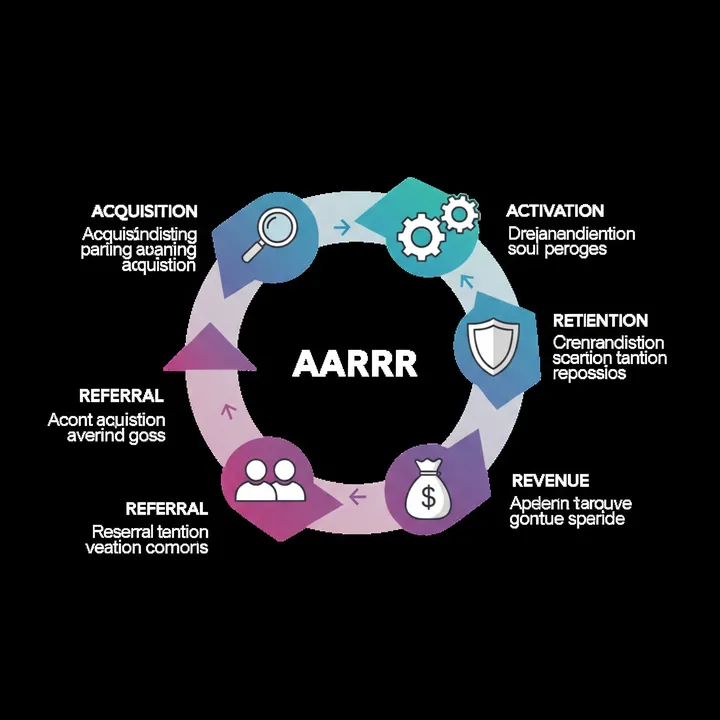
"AARRR is a framework that designs the flow of usage across five stages: Acquisition, Activation, Retention, Referral, and Revenue," I explained. "It's a method used in growth, but it works for digitalizing in-store orders too. A customer touches an app in-store, orders, uses it again, refers others, and it connects to revenue—design this path, and you erase the paper handwork while order data reaches all the way to ordering accuracy. It's a tool that designs by flow, not by point."
"First, let's measure the current cost," Gemini said, opening the ROI Polygraph. He entered the data Tanase had provided.
"The monthly cost is in," Gemini read out. "Center manual-entry labor for in-store paper order forms: 210 hours per month on average, at ¥3,500 per hour, ¥735,000 per month. Overtime and temp-staff cost from human-resource tightness in peak season: ¥550,000 per month on average. Order mistakes and rework caused by manual entry: ¥400,000 per month on average. Surplus-and-shortage loss from manufacturing orders depending on intuition and experience: ¥450,000 per month on average. Analysis opportunity loss from non-linked in-store order data: ¥300,000 per month on average. A total of ¥2,435,000 per month. Annualized, about ¥29,220,000."
Tanase stared at the figures. "I thought it was just the manual-entry labor cost. Add the peak-season temp staff and the surplus-and-shortage loss in ordering, and it's this much?"
"Now, let's design with AARRR," I continued.
[Acquisition—Get Customers to Touch the App In-Store]
"First, we build an entrance where customers can easily order in-store," Claude said. "Through something like a LINE mini-app, customers enter the order themselves. Without paper in between, data enters directly. This is the stage of changing the order entrance to digital."
[Activation and Retention—Get Them to Use It, and Use It Again]
"Next, we prompt first use and connect it to repeat use," Gemini continued. "We attach a perk to the first order and let them reserve a pickup time. We prompt re-visits with campaign delivery. We create a flow where once they use it, they don't go back to paper."
[Referral—Spread Through Introductions]
"We place a mechanism where using customers bring in new ones," I continued. "With a mechanism where introductions earn points, we prompt new acquisition by word of mouth. It's a structure where customers themselves widen the circle of digital ordering."
[Revenue—Connect Data to Revenue and Ordering Accuracy]
"Finally, we connect order data to revenue," Claude continued. "The data links directly to the core system, and the manual entry vanishes. The accumulated order data also raises the accuracy of manufacturing orders that relied on intuition. It's a structure where the order path reaches all the way to ordering."
[Calculating the Investment Recovery]
"Let's run the estimate with the ROI Proposal Generator," Gemini proposed.
- Initial cost: In-store order-app build, reservation/perk functions, core-system linkage, ordering-data-use infrastructure, and training—¥6,200,000 total
- Monthly cost: App operation, licensing, and update ongoing fees combined, ¥260,000 per month
- Monthly reduction effect: In-store order-entry labor reduction = ¥590,000 per month (assuming 80% reduction), mitigation of peak-season resource tightness = ¥440,000 per month, order-mistake rework reduction = ¥320,000 per month, surplus-and-shortage loss reduction via improved ordering accuracy = ¥350,000 per month, totaling ¥1,700,000 per month
- Net monthly reduction: ¥1,700,000 − ¥260,000 = ¥1,440,000 per month
- Payback period: ¥6,200,000 ÷ ¥1,440,000 = approximately 4.3 months
"Recovery in just over four months," Gemini summarized. "What works is connecting order digitalization all the way to ordering accuracy. We don't merely erase manual entry—we also reduce ordering surpluses and shortages with the accumulated data. Because we design by path from acquisition to revenue, the peak-season mountain and the intuition-dependent ordering get solved at the same time."
Tanase confirmed the figures. "I only thought of erasing in-store order manual entry. Seen as a path, it connects all the way to ordering accuracy. What I saw as a point became a flow."
"AARRR is a tool that designs from orders to revenue as a path," I responded.
Chapter 3: A Deployment Plan That Connects by Path
"Let me organize the approach," I said, standing at the whiteboard.
"Month one—visualizing the in-store order flow, designing the digitalization path. Months two and three—building the in-store order app, implementing reservation and perk functions. Month four—core-system linkage, replacing the manual entry. Month five—trial operation before peak season and effect verification. Month six—adding the referral function, accumulating order data. Month seven onward—full-scale use of ordering data, improving manufacturing-order accuracy."
"Will it make it in time for peak season?" Tanase confirmed.
"We finish the trial operation before peak season," Claude responded. "Meet year-end's fivefold with manual entry, and it'll mountain up again. Before that, we stand up the app and linkage and acclimate with a trial run. Because the path is visible, we can work backward and assemble which stage to finish before peak season."
Tanase said, taking notes, "I never had the idea of seeing it as a single stretch from acquisition to revenue. Connect it as a flow, and it works all the way to ordering."
Chapter 4: The Day the Paper Mountain Vanished
Nine months later, a report arrived from Tanase.
In-store order manual entry was reduced 80% from before after the app was introduced. "Because customers enter into the app themselves, paper order forms don't come to the center. The work of re-keying by hand vanished," Tanase wrote.
The peak-season tightness was greatly mitigated too. Because orders enter directly as data, even with volume at five times, the workforce kept up. "What we'd survived by bringing in masses of temp staff at year-end became like a lie. No mountains piled up," the report read.
The biggest change appeared in manufacturing-order accuracy. The accumulated order data backed up the ordering that had relied on intuition. "Ordering that depended on the person's intuition and past data gained grounds from the in-store order data. Surpluses and shortages decreased," Tanase wrote.
Order mistakes also dropped. The mis-keying of manual entry vanished. "Mistakes that occurred every time people re-keyed disappeared with the direct data connection," the report read.
As a secondary effect, contact points with customers increased. Through campaigns and referrals via the app, re-visits and new acquisition advanced. "Digitalize the orders, and even the connection with customers increased. Digitalization became a sales tool too," Tanase wrote.
At the end of Tanase's report it said: "I thought digitalizing in-store orders meant erasing manual entry. But turned into a path with AARRR, the order data reached all the way to ordering accuracy. Designed as a flow rather than a point, digitalization works to unexpectedly far places."
The day a company where paper order forms piled at the center in peak season became a company that could connect orders as a path, digitalization had changed from reducing manual entry into a flow that designs from acquisition to revenue, the report noted.
"Digitalizing in-store orders is usually spoken of as the point of 'eliminating manual entry.' But behind the manual entry, the peak-season tightness and the intuition-dependent ordering are connected too. What AARRR asks is the path of acquisition, activation, retention, referral, revenue. Design the stretch from a customer touching an app in-store to it connecting to revenue as a flow, and order data reaches all the way to ordering accuracy. The day a company where paper order forms mountained up in peak season could connect orders as a path, what changed was not the app but the very perspective that designs digitalization as a flow rather than a point."
Related Files
Tools Used
- ROI Polygraph — Visualizing in-store order-entry labor, peak-season tightness cost, and ordering surplus-and-shortage loss
- ROI Proposal Generator — Investment-recovery simulation for order digitalization designed as a path from acquisition to revenue


